DAT Organic Chem
 Call Kai
 Learn
Learn Practice Test
 Spaced Repetition
 Match
Match Flashcards
 Knowt Play
1/131

There's no tags or description
Looks like no tags are added yet.
Name | Mastery | Learn | Test | Matching | Spaced | Call with Kai | Chat |
|---|
No analytics yet
Send a link to your students to track their progress
132 Terms
amphiprotic
molecule that can act as either acid or base
higher pH
more basic, more -OH
lower pH
more acidic, more H+
pKa and Ka values
increase Ka = decrease pKa
low pKa = high acidity = low pH
Rank Acids and Bases with CARDIO
Charge: more positive charge, more acidic. more negative charge, more basic
Atom: acidity increases from left to right across row (EN), and doing down the columns (atom size)
Resonance: increases stability of charge
Dipole Induction: electrons sucked away by withdrawal group makes it easier for H+ to leave (increase acidity), donating groups push electrons (decrease acidity)
Orbitals: more s-orbitals an atom has, more EN, more acidic. sp orbitals from triple bonds make the H more acidic than sp3 orbitals from single bonds
pH and Amino Acids
have carboxylic acid and amine group
pKa < pH = depronated molecule (missing H+)
pKa > pH = pronated molecule (filled with H+)
lower pH = more pronated
Configurational Isomers
Z vs E
cis vs trans
conformational isomers
Newman projections
anti-staggered, eclipsed, gauche staggered, total eclipsed
Naming Alcohols
1) parent chain is longest chain with -OH group
2) add -ol to end of parent chain
Naming Ethers
1) parent chain is whichever is the longer side on the O
2) name substituent on other side and add - oxy
Naming Amines
primary amine: add the suffix -amine to the parent chain
symmetrical amine: add di- or tri- to alkyl group
asymmetrical secondary or tertiary amine: the longer side is the parent group, add -amine, name substituents with prefix N-
naming aldehydes
1) parent chain is longest group that has the carbon with the double bond to O
2) replace -e with -al
naming ketones
1) name the parent chain replace -e with -one
2) number which carbon the double bond to O is
Naming Carboxylic Acids
1) parent chain is longest containing carboxylic acid
2) replace -e with -oic acid
Naming Acid Halides
1) replace -e with -oyl “name of halide”
4-methylpentanoyl iodide
naming esters
1) alkyl group atatched to single bonded O is listed first with suffix -yl
2) parent chain follows counting away from double bonded O, replace -e with -oate
ethylbutanoate
Naming Amides
1) group attached to nitrogen gets prefix N-
2) parent chain attached to double-bonded O replace -e with -amide
N-propyl butanamide
Naming Acid anhydrides
1) list both sides in alphabetical order, replace -e with -oic
2) add anhydride at end
butanoic propanoic anhydride
Naming Nitriles
add suffix -nitrile
pentanenitrile
Naming aromatics
1) give lowest number to highest priority group
2) use common name for the benzene and then add other substituents
1-chloro-2-methyl benzene or 2chlorotoluane
Naming spiro alkanes
spiro [a,b] parent name
parent name: total number of carbon atoms
a,b: number of carbons to the left and right of the center carbon: list lowest to highest
Bicyclic Alkanes
bicyclo [a,b,c] parent name
parent name: total number of electrons
a,b,c: number of carbons to the left, right, and above the center carbon: list highest to lowest
constitutional isomers
same chemical formula but different connectivity and location of atoms
enantiomers
mirror image
diastereomers
Non-mirror images
1) cis/trans isomers of ringed compounds
2) cis/trans or E/Z isomers of alkenes
3) molecules with multiple stereocenters that do not have exact opposite R/S forms
chiral centers
R: clockwise
S: counterclockwise
counting stereoisomers
2n
chirality (optical activity)
uses polarimeter to rotate plane-polarized light
L molecules: clockwise
D molecules: counterclockwise
physical properties of enantiomers
are the same and cannot tell apart
meso compounds
two or more stereocenters with a line of symmetry
dirrections cancel each other out to become achiral
fischer projections
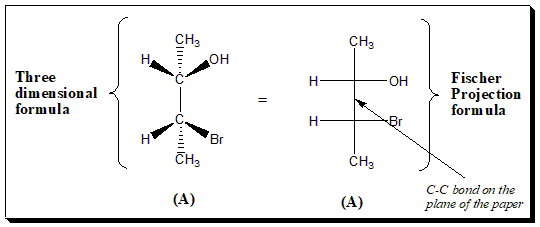
IR Spectroscopy
x-axis: wavenumber, cm-1
y-axis: transmittance, %
UV-Vis Spectroscopy
tells if the molecule has conjugated bonds: back and forth double then single bonds
Mass Spectrometry
determine compounds mass
sprays e- at the molecule, they stick to parts and give slightly negative charge, move towards pos side of tube, can break apart in pieces but weight adds up to the whole molecule
molecular ion of mass spectrometry
parent peak, complete molecule
base peak in mass spectrometry
most stable ion produces tallest peak, most abundent
Bromine in mass spectrometry
50% of all Br weigh 79 and 50% weigh 81
Chlorine in mass spectrometry
75% of all Cl weigh 35 and 25% weigh 37
Degrees of unsaturation
each double bond, ring, or triple bond (2)
CnH2n+2 Then subtract oringinal formula from this.
Ignore Oxygen, add one for every Halogen, subtract one for every Nitrogen
Divide by 2
C-NMR Spectroscopy
shows where different kinds of carbons show up on the graph
use symmetry to determine number of unique carbons
positively charged carbons
more left on C-NMR
“de-sheilded”
negatively charged carbons
more right on C-NMR
“sheilded”
C-NMR Chart
Carbons ppm
alkane 0-70
alkene 90-120
aromatic 110-160
carbonyl carbons:
esters, amides, carboxylic 160-180
aldehydes, ketones >200
H-NMR Spectroscopy
peaks produced by different kinds of hydrogens
more pos, more left
more neg, more right
H-NMR Chart
Hydrogens ppm
alkane 1-4
alkene 4-6
aromatic 6-8
aldehyde 9-10
carboxylic a 11-14
alcohol 1-5
amine 1-5
integrals of H-NMR
number above peak that shows how many of that kind of hydrogen
splitting
hydrogen A looks to its neighbor and sees how many hydrogen Bs there are. Count all neighbooring hydrogens and add 1
SN1
occurs in two steps
the more stable the carbocation intermediate, the more likely to occur
weak nucleophiles allow rxn to occur
rearrangements can occur
produces racemic mixture of enantiomers
rate = k[electrophile]
SN2
one step reaction
no carbocation formed
rate = k[electrophile][nucleophile]
become more reactive with less carbons bonded to middle carbon
strong nucleophiles required
inversion of sterocenter
For substitution reactions:
The larger the atom (Cl, Br, I)
the better the leaving group
E1
produces an alkene
likes a weak base
two step reaction
rate = k[electrophile]
zaitsev’s rule
give the more substituted carbon the double carbon bond and favor the E-alkene
E2
one step reaction
likes a strong base
rate = k[electrophile][nucleophile]
E alkene is major, Z alkene is minor
more substituted the carbon in the LG, the more likely to react
more branching in relation to melting point
increased melting point
more branching in relation to boiling point
decreases boiling point
melting point detector use
use to determine compound and compounds purity (match to literature)
Extraction with Separatory Funnel
separates polar compounds (aqueous layer) from nonpolar substances (organic layer)
purifys product from water soluble contaminants
for most reactions the organic layer is on top
Acid and base extractions
carboxylic acids and phenols: do not dissolve in aqueous layer. first deprotonate with a strong base (NaOH) to make it soluble in the aqueous layer. Then separate and add acid (HCl) to make it protonate which then will precipiate out of the aquous layer
amines: first protonate with acid to make it water soluble then separate layers and add base to deprotonate and make it precipitate
distillation
separate mixtures of 2 or more boilable liquids (volatile)
liquid with lower bp goes to to condensor then changes to liquid and goes to different funnel
fractional distilation
separate volatile liquids with boiling points that are 25 degrees Celsius apart
uses series of flasks
sublimation
impure mixture of salts in the flask, put test tube with ice to block the hole, boil compound in flask and solid turns to gas, hits cold test tube and turns solid again
recrystalization
Dissolved solids become less soluble when solvent is cools
scratch glass to provide nucleation site
not for volatile liquids
Gas-Liquid Chromatography
heat mixture of compounds to boiling and then push them using a gas down a coiled tube, separates individual components by boiling point
detector measures which component travels furthest in and how much comes out
Thin-Layer Chromatography, TLC
Separate compounds by solubility in solvent, by polarity
the most soluble compound travels furthest up the plate
dot shows the highest (more nonpolar) vs the lowest (more polar) compound
plate is coated with a polar substance, solvent at bottom is nonpolar
good for following a reaction’s progress
retention factor, Rf
polar compounds, smaller rf
nonpolar compounds, larger rf
solvent specific, increase rf by adding more polar solvent
column chromatography
fill glass cylander with silica gel (white powder). add impure mixture to top.
add organic solvent (eluent) to the top
it will gradually separate by polarity with the most polar compound traveling the shortest distance and the most nonpolar compound eluding the furthest
Hydrohalogenations
adding HX to an alkene
acid-catalyzed hydration
adding H+ and -OH to alkene
product is an alcohol
Oxymercuration-Demercuration
does the same thing as acid-catalyzed hydration but does not do rearrangements
anti-addition, markovinkov, -OH adds to the most substituted carbon
acid-catalyzed alcohol addition
adds H+ and HOR group to alkene
Markovnikov, rearrangements possible
Halogens to Alkenes
adds X2 to an alkene
Markovnikov, anti-addition, no rearrangements
Halogens with Water to Alkene
add X2 with water. adds an alcohol functional group
Hydroboration Oxidation
adds an alcohol functional group to the least substituted carbon in the double bond
anti-markovinkov, syn-addition (cis), no rearrangements
Hydrobromination with Peroxide
HBr plus peroxide added to alkene
anti-markovinkov, forms radicals no rearrangement
Epoxidation
adds mCPBA to create ring with oxygen
anti-dihydroxide
Adding nucleophile to an epoxide
in basic conditions: nuc attacks the least substituted carbon
in acidic conditions: the oxygen attacks H+ first, then the nuc goes to the most stable bond and breaks the ring
Syn (cis) dihydroxide
add OsO4 and peroxide to the double bond
creates a vicinal diol with cis -OH functional groups
Ozonolysis
using O3 to cut the alkene in half
each side is double bonded to O
Ozonolysis with Zn/H2O or (CH3)2S workup
each half of the alkene is double bonded to O
ozonolysis with H2O2 workup
each half of the alkene is bonded to O but then one of the hydrogen atoms bonded to the double bonded carbon gets replaced with -OH
ozonolysis with KMnO4/H3O (hot.conc) workup
internal alkenes: does the same thing as O3/H2O2
terminal alkenes: turns the outside CH2 into O = C = O
Oncolysis with HIO4
1) OsO4 used to put two -OH on each carbon of the alkene in cis figuration
2) use HIO4 to create ketones (=O) out of those -OH groups.
KMnO4 without acid
Baeyer’s reagent (neutral KmnO4) does same thing as OsO4 with peroxide
alkyne ozonolysis
creates carboxylic acids from the two halfs
basic KMnO4/H3O does the same thing with internal alkynes
terminal alkynes: makes the outside CH into CO2
Catalytic Hydrogenation of Alkenes
Adding H2
uses metal catalyst (Pd, Pt, Rh, or Ni) to form cis alkane
Catalytic Hydrogenation of Alkynes
uses metal catalyst (Pd, Pt, Rh, Ni) to form alkane
Lindlar’s catalyst makes a Z alkene
Na or Li with NH3 at -78 degrees Celsius forms an E alkene
Addition reactions with alkynes
typically anti-addition giving E-Alkene
Hydrohalogenation
internal alkyne: bind to either side to create two forms of the halide product
terminal alkyne: halides bind to the most substituted carbon
Di-Halogenation
adds X2 to alkyne, with excess forms alkane with four halogens bonded to it
Hydrobromination with Peroxide
alkyne adds HBr and H2O2 to add the Br in an anti-Markovnikov addition
Acid-Catalyzed Hydration of Alkyne
Alkyne adds H20, H2SO4 and HgSO4 to form an enol and then proceed through tautomerism to form a ketone
Hydroboration Hydration for Alkynes
alkyne added to BH3/THF or (Sia)2BH/THF with H2O, H2O2, -OH to form anti-markovinkov enol which tautomerism to become aldehyde
Alkylating Alkynes
NaNH2 removes the H from the terminal alkyne. creates an acetylide (alkyne with negative carbon group)
able to go through substitution reactions to add carbons on the chain
Alkylating Alkynes with ketones
alkyne adds to the carbonyl carbon of the ketone and then the double bond of the carbonyl transfers to the O to have a negative charge, then the negative oxygen takes a H+ from water to become an alcohol
Alkylating Alkynes with an epoxide
negative acetylide combined with epoxide and the negative oxygen takes a H+ from water to become an alcohol
Forming Alkynes from Alkanes
can be done with vicinal halides or geminal halides
use NaNH2 (sodamide) to take the H+ away and kicks the Halogen to create a double bond the excess takes the other H+ to form the alkyne and kicks the halogen
kinetic product
forms fastest
comes from the most stable carbocation intermediate
favored at low temperatures (kinetic control: -40 degrees Celsius or lower)
Thermodynamic product
forms slower
favored at high temperatures (thermo control: 0 degrees Celsius or higher)
forms the most substituted alkene product (most internalized)
most stable product due to Zaitsev’s rule
Zaitsev’s rule
alkene with the largest number of non-hydrogen bonds on its C=C bond is the most thermodynamically stable
the most substituted, the most internalized
X2 to alkanes
need light, heat, or peroxide, ROOR
Br always ends up on most subsitiuated carbon
Cl is less selective