citric acid cycle (Krebs cycle)
 Call Kai
 Learn
Learn Practice Test
 Spaced Repetition
 Match
Match Flashcards
 Knowt Play
1/42

There's no tags or description
Looks like no tags are added yet.
Name | Mastery | Learn | Test | Matching | Spaced | Call with Kai | Chat |
|---|
No analytics yet
Send a link to your students to track their progress
43 Terms
what is the citric acid cycle?
series of vital biochemical reactions in cellular respiration that cells use to release stored energy
“A cyclic pathway for the oxidation of acetyl residues to carbon dioxide, in which formation of citrate is the first step”
what is the purpose of the citric acid cycle?
convert stored energy into chemical energy that can be used
where does the citric acid cycle occur and what conditions does it require?
takes place in mitochondrial matrix
requires oxygen
what are the three main categories of macromolecules in human diets?
proteins (amino acids)
carbohydrates (sugars)
fats (fatty acids)
what does the breakdown of macromolecules produce?
Energy
Reducing power (reduced coenzymes)
Useful carbon (can be used to make other compounds)
general outline of the citric acid cycle
oxidises acetyl CoA (derived from proteins, carbs and fats) into carbon dioxide and water
energy is released as ATP, NADH and FADH2

how are carbohydrates/sugars broken down to acetyl CoA?
through glycolysis
sugars → pyruvate → acetyl CoA
how are fatty acids broken down to acetyl CoA?
through fatty acid oxidation
how are amino acids broken down to acetyl CoA?
amino acid catabolism
what compounds are released during the citric acid cycle?
reduced coenzymes
carbon dioxide
GTP
reduced coenzyme Q (interaction with ETC)
what is the link reaction?
links cystolic glycolysis (anaerobic) to the citric acid cycle (mitochondrial metabolism (aerobic))
occurs in the mitochondrial matrix
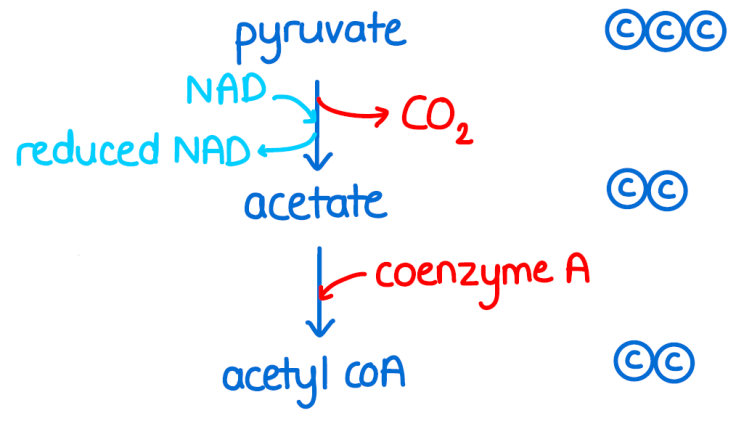
describe the link reaction process
pyruvate (from cytosol) enters the mitochondrial matrix
pyruvate is decarboxylated and oxidised by pyruvate dehydrogenase (enzyme) to form acetyl CoA
what type of reaction is the link reaction?
oxidative decarboxylation
link reaction diagram
why is the link reaction important?
important for regulation
once pyruvate is converted to acetyl CoA it cannot be converted back - IRREVERSIBLE
pyruvate can be used to make glucose but acetyl CoA cannot - important to maintain pyruvate during fasting/starvation
what is the rate of the link reaction in fed and fasting states?
fed state: link reaction occurs at high rates
fasting/starvation: link reaction does not occur (pyruvate dehydrogenase enzyme is inhibited)
step 1 of citric acid cycle?
oxaloacetate (4C) + acetyl CoA (2C) → citrate (6C)
thioester bond in acetyl CoA is hydrolysed - exothermic so provides enough energy to form C-C bond with oxaloacetate
reaction is very exothermic so enzyme is regulated
ΔG = -32kJ/mol
what enzyme is used to hydrolyse thioester bond/synthesise citrate?
citrate synthase
step 2
citrate (6C) → isocitrate (6C)
citrate is rearranged into an isomer of itself
standard ΔG° = +13.3kJ/mol
actual ΔG in cell = 0
how is reaction catalysed if there is a +ΔG°?
the reaction before and after this (step 1/3) are very exothermic
enzyme is receiving lots of substrate from the step 1 reaction and products are being quickly removed by step 3 reaction
what enzyme is used in step 2?
aconitase (type of isomerase)
step 3
isocitrate (6C) → alpha-ketoglutarate (5C)
NADH (NAD → NADH) and CO2 also produced
oxidative decarboxylation
ΔG° = -20.9kJ/mol (very exothermic)
favourable process as taking a reduced product that would rather be oxidised
what enzyme is used in step 3?
isocitrate dehydrogenase (remove H, oxidise substrate)
enzyme is regulated
step 4
alpha-ketoglutarate → succinyl CoA
NADH and CO2 also produced
oxidative decarboxylation
ΔG° = -33.5kJ/mol (very exothermic)
what enzyme is used in step 4?
alpha-ketoglutarate dehydrogenase
regulated enzyme
step 5
succinyl CoA → succinate
GTP or ATP is also produced (GDP/ADP → GTP/ATP)
thioester bond in succinyl CoA is hydrolysed which provides energy for substrate level phosphorylation
ΔG° = -2.9kJ/mol (similar energy is provided by hydrolysis as is used for phosphorylation)
reversible reaction
what enzyme is used in step 5?
succinyl CoA synthetase
two versions of the enzyme: version 1 ADP → ATP, version 2 GDP → GTP
version used depends on what the cell needs
step 6
succinate → fumarate
(coenzyme Q → coenzyme QH2 also happens)
oxidation reaction, double bond formation
ΔG° = 0
what enzyme is used?
succinate dehydrogenase
only enzyme in the cycle bound to the IMM
enzyme is part of the electron transport chain, same as complex II
electrons from succinate are transferred directly to ETC
step 7
fumarate → L-malate
hydration reaction, addition of H2O
highly stereospecific reaction, OH group on malate on left hand side
ΔG° = -3.8
what enzyme is used in step 7?
fumarase (type of lysase enzyme)
step 8
L-malate → oxaloacetate
(NAD → NADH)
ΔG° = +29.7
oxidation reaction
oxaloacetate is regenerated and the cycle repeats
what enzyme is used in step 8?
malate DH
how is reaction catalysed with positive ΔG°?
reaction is pulled forwards by the exothermic reaction that follows (STEP 1)
ETC, succinate dehydrogenase and reduction potential
Reduction potential of succinate DH/complex II is very similar to reduction potential of coenzyme Q
When succinate transfers electrons to coenzyme Q, NO PROTONS are pumped because succinate does not have negative enough reduction potential
only complex III and IV pump protons
substrates reduced by flavoproteins have lower P:O ratio becaus less ATP is made per oxygen reduced
only 6H+ pumped when succinate DH is used to reduce oxygen

what is the overall yield of the oxidative catabolism of 1 mole of acetyl CoA
3 NADH
2 CO2
1 FADH2
1 GTP/ATP
1 CoA
why is the citric acid cycle an aerobic pathway?
ETC is used which indirectly uses oxygen
needed to turn NADH back into NAD and coenzyme QH2 into coenzyme Q
what cells does the citric acid cycle occur in?
all cells
how does the rate of the citric acid cycle change in different metabolic states?
the cycle is NOT AFFECTED by metabolic state
metabolic state does affect where acetyl CoA is obtained
where is acetyl CoA obtained from in the fed state?
glycolysis increases so acetyl CoA comes from sugars
where is acetyl CoA obtained from in the fasting state?
acetyl CoA comes from fatty acids because glycolysis is inhibited
where is acetyl CoA obtained from in the exercise state?
acetyl CoA supply is increased from fatty acids and glucose
how is citric acid cycle activity increased?
Increase activity of enzymes - (citrate synthase, isocitrate dehydrogenase, alpha-ketoglutarate dehydrogenase - regulated enzymes)
Increase supply of acetyl CoA
Increase concentration of intermediates - e.g. oxaloacetate