chemistry: bonding and lewis structure
 Call Kai
 Learn
Learn Practice Test
 Spaced Repetition
 Match
Match Flashcards
 Knowt Play
1/36

There's no tags or description
Looks like no tags are added yet.
Name | Mastery | Learn | Test | Matching | Spaced | Call with Kai | Chat |
|---|
No analytics yet
Send a link to your students to track their progress
37 Terms
covalent bond
sharing electron pairs
nonpolar covalent
identical
polar
unequal attraction for the shared electrons
high electronegativity
strong attraction for electrons (halogens- fluorine)
polar covalent
bonds that have 5%-50% ionic character
ionic character
The greater the electronegativity difference between two bonded atoms, the greater the percentage of ___ in the bond
valence electrons
electrons in the formation of a chemical bond
ionic bond
bond that results from the electrostatic attraction between positive and negative ions
how does a covalent bond hold two atoms together
A pair of electrons is attracted to both nuclei of the two atoms bonded together
electronegativity
determines whether or not the bond will be polar
electronegativity greater than 1.7
ionic
exceptions from the octet rule
hydrogen, boron,, beryllium, phosphorus, sulfur, xenon
resonance structures
show delocalized electrons
NH3
ammonia

H20
water

CH4
methane

C2H2
Acetylene

The atoms in a polyatomic ion are held together with
covalent bonds
polyatomic ions combine with ions of opposite charge to form
ionic compounds
in metals the valence electrons are
shared by all surrounding atoms
as light strikes the surface of a metal, the electrons
absorb and re-emit the light
strength of the metallic bond
increases left to right across
metals
outer electrons in s orbitals
nonmetals
outer electrons in p orbitals
what makes metals good conductors
mobility of electrons
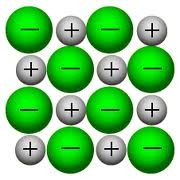
ionic compound
A compound that consists of positive and negative ions
what determines whether a molecule is polar
shape of molecule, electronegativity difference
attraction between molecules
dipole-dipole, london dispersion, hydrogen bonding
dipole-dipole
attractions between oppositely charged regions of polar molecules
London dispersion forces
weakest
hydrogen bonding
where a hydrogen atom is bonded to a highly electronegative atom is attracted to an unshared pair of electrons of an electronegative atom in a nearby molecule
water (H20)
bent, 104.5 angle, polar, 2 lone pairs (4 dots on O) and 2 covalent bonds (lines connecting H to O)
exponent on element
tells how many symbols you use on the lewis diagram
Steps of Lewis structure
1. determine which is central (least EN)
1A. To find the least electronegative, use how far away it is from fluorine and oxygen
2. Count v e- (add up all of valence electrons)
3. placing lone electron pairs on the outer atoms until each outer atom fulfills the octet. Place any rem lone electron pairs on the central atom.
4. if necessary add double/triple bonds to complete octet/duet
5. Formal charge (cation/anion) FC = # of valence electrons - # of lone pair electrons - ½(number of bonding electrons)
dots
pairs, count for 2 valence electrons
ionic bonds with models
opposite charge, don't share ve- , don't have - bc that is represented in covalent only
steps
find how many ve-, and put however many bonds needed to complete octet rule (use - for covalent)