Psych of Sport Exam 1
 Call Kai
 Learn
Learn Practice Test
 Spaced Repetition
 Match
Match Flashcards
 Knowt Play
1/87

Earn XP
Description and Tags
UNT Kine 4000
Name | Mastery | Learn | Test | Matching | Spaced | Call with Kai | Chat |
|---|
No analytics yet
Send a link to your students to track their progress
88 Terms
Definition of Psychology
The systematic study of BEHAVIOR and MENTAL PROCESSES
Psyche - meaning life
Logos - meaning explanation
What is Sport?
considered to be the activities involving POWER and SKILL, COMPETITION, STRATEGY, and/or CHANCE, and engaged in for the ENJOYMENT and SATISFACTION of the participant and/or others.
Physical activity with competition
Phyiscal Fitness
Any bodily movement that results in the burning of calories
Exercise
A subcategory of physical activity; it is a physical activity that is planned, structured, and repetitive
Anaerobic
Short-term or burst of activities
Aerobic
long-term activities
cycling, running, etc.
Physical Fitness
Is an outcome that can be attained through exercising at frequency, intensity, and length of the prescribed by the ACSM
Frequency
Intensity
Time
Type
(FITT)
2018 Physical Activity Guidelines
5 days per week → 150 minutes of moderate exercise
brisk walking, water aerobics, tennis doubles
3 days per week → 75 minutes of intense exercise
jogging, swimming, cycling over 10 mph, singles tennis
Energy in and Energy out
30 minutes of walking, body weight 150 pounds, will expend 150 calories
three 10 minutes walks with expend 150 calories
six 5 minute walks will expend 150 calories
REMEMBER → time is the biggest barriers to people being active!!!!
Performance = _________
Physical Preparation + Technical Skill + Mental Readiness
KEY: Mental training is the foundation!!!
→ Physical Characteristics
Strength
Speed
Stamina
→ Technical Characteristics
Skill development
Strategy
Synchronization
→ Psychological Characteristics
Confidence
Concentration
Consistency
Control
What are the two Objectives of Sport and Exercise Psychology?
The scientific study of how psychological factors affect performance
ex: adding money to darts to see how they perform
class example - putt off but if student wins, class gets extra credit
How participation in sport and exercise affect psychological and physcial factors
ex: can weight training decrease depression in adults?
What are the three roles for a Sport Psychology Practitioner?
Teaching →
University Professor: Kines., Sport sciences, Psychology
Research →
research scientist, professor, lab technician, etc.
Institue of higher learning
University
Medical Hospital
Research Facility
Government
Private/Indutry
Consulting →
Workkshops for coaches, parents, and athletes or….
Athlete, parent, coach, or team consultantions
Sport Psychology Specialties?
Clinical Sport Psychologist
licensed, trained to work with individuals with severe emotional disorders
trained to help with eating disorders and substance abuse
Educational sport psychology specialist
mental health coach - understand psychology of human movement
training in PE, Kines, or exercise sport sceince
educate and increase athlete and coach awareness of issues of anxiety management and confidence development
Period 1: The Early Years (1895-1920)
1897: Norman Triplett conducts first social psychology and sport psychology experiment
1918: Coleman Griffith conducts informal studies of football and basketball studies
Period 2: The Griffith Era (1921-1938)
1925: University of Illinois research in athletes labortaory established. Griffith appointed direction
KNOWN AS THE Father of North American Sport Psychology!
Period 3: Preparation for Furture (1938-1965)
1943: Dorothy Yates was one of the first women to conduct sport psychology
1965: First World Congress of Sport Psychology held in Rome
Period 4: The Establishment of Academic Sport Psychology (1966-1977)
1966: Clinical psychologist BRUCE OGLIVIE and Thomas Tutko write Problem Athletes and How to Handle Them.
Bruce Ogilive → Father of Applied Sport Psychology
Period 5: Multidisciplinary Science and Practice in Sport and Exercise Psychology (1978-2000)
1985: USOC hires first full-time sport psycologist
1986: The Association for the Advancement of Applied Sport Psychology is established
1988: US Olympic team is accompined by offically recognized sport psychologist for the first time
Period 6: Contemporary Sport and Exercise Psychology (2000-present)
Condidates who have a Master’s degree can apply for provisional status as a certified consultant
Sport and Exercise Psychology Organizations
NASPSPA → North American Society for the Psychology of Sport and Physical Activity
AASP → Association for Applied Sport Psychology
Division 47 → American Psychology Assoication
ISSP → Internation Society of Sport Psychology
ACSM, AAHPERD, BASES, SHAPE America, etc.
Sport and Exercise Journals
Journal of Applied Sport Psychology 1989 → Offical journal of AASP
What are the professional issues in sport psychology?
Credentialing
Certification, registry, and licensure
Training
theory, research, and practice
Employment
academic settings, independent practices, clinics
Job opportunities on the rise!
Consulting → all ages and skill levels, NCAA departments, fitness industry, etc
Academic → sport science but some psychology
Exercise Psychology → partly driven by greater external research funding
Ethics
Respect the dignity and worth of the individual and honor the preservation of fundamental human rights
Present and Future Pros and Cons?
Pros:
more courses, books, resources
more consulting opportunities
exercise psychology is growing
Cons:
need for certification
few full-time consulting opportunites available
Science in Sport and Exercise?
Def → a process or method of learning about the world through the….
systematic
controlled
emperical
critical filtering
…of knowledge acquired through experience
Sceintific Theory → End Goad?
Is a set of interrelated facts that presents a systematic view of some phenomenom in order to DESCRIBE, EXPLAIN, and PREDICT its future occurance.
Thoery into practice = Socail Facilitation Theory
What is a hypothesis?
A deduced statement which can be tested emperically (with actual supportive data)
An educated hunch that attempts to explain or predict a single phenomenon
What is and how many variables are needed?
Independent variable
variable whose effect upon the dependent variable you are trying to understand
Dependent variable
the consequence of resultant behavior
Types of Research
Study
the investigator observes or asses
does NOT change the environment in any way
Experiment
the investigator manipulates variables (environment)
Examines how changes in 1+ variables affect changes in others
Other types of Research in S&E Psychology
Analytical → historical, philosophical, literature review, meta-analysis
Descriptive → survey, case study, job analysis, etc.
Experimental → a cause-and-effect situation can be established
Qualitative → interpretive, ethnographic, participant observer, case study
Integrating Science and Professional Practice Knowledge
Apply scientific principles in your professional work setting
Evaluate the utility of scientific principles
Keep current with changes in the scientific knowledge base
Hold realistic expectations based on the strengths and limitations of scientific principles
Methods of Knowing “DK Theory”
Damn Konfident
Scientific method
Systematic observation
single case study
shared (public) experience
Introspection
intuition
Dont Know
Three Approaches to Sport and Exercise Psychology
Psychophysiological Orientation
Examines underlying psychophysiological processes of the brain (or heart, muscle, etc) in terms of primary causes of behavior
ex: Using biofeedback techniques to train marksmen
Social-psychological Orientation
Behavior is determined by a complex interaction of the environment (especially social) and the personal make-up of the athlete
ex: how a leader’s style and strategies foster group cohesion and influence participation rates
Cognitive-behavoiral Oreintation
behavior is determined by both the enviroment and thoughts (cognitions)
ex: studying differences on confidence (or anxiety, depression, etc.) among tennis players with or without burnout
STRENGTHS of Scientifc an Professional Practice Knowledge
Sceinfitic
Highly reliable
Systematic/Controlled
Objective/Unbiased
Professional Practice
holistic
Innovative
Immediate
LIMITATIONS of Scientifc an Professional Practice Knowledge
Scientific (increased internal validity)
Reductionism
Lack of Practicality
Conservative/Slow to Evolve
Professional Practice (Increased external validity)
less Reliable
Lack of Explanations
Suspectiable to Bias
Personaility?
Def: The sum of the characterisitcs that make a person unique!
why study?
helps us understand students, athletes, etc.
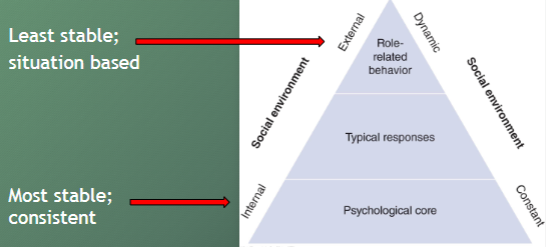
Personalitiy Structure (Hollander)
Psychological Core → the most basic and deepest attitudes, values, interests, and motives of a person
ex: religious values, etc.
Typical Responses → the way one typically responds to the environment
ex: happy-go-lucky, shy, etc.
Role-Related Behavior → how one acts in a particular social situation
ex: student, parent, manager of store, etc.
How many approaches are in the Conceptual Personality Structure?
Psychodynamic approach
Trait approach
Situational approach
Interactional approach
Phenomenological approach

1) Psychodynamic Approach
Understanding the person as a whole, rather than identifying isolated traits
emphasizes how unconscious determinants (ID) conflicts with conscious aspects (superego/ego) that cause behavior:
ID - carnal drives (irrational)
Superego - one’s moral conscience
Ego - one consciousness weighs impulse of instinctive drive and supergo (rational)
Research →
Current impact: little influences
Weakness: Focusues alomst entirely in internal determinanats of behavior - giving little attention to the social environment
Contribution: awareness that unconscious determinants of behavior exist
2) Trait approach
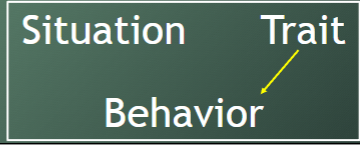
Personality traits predispose one to act in a certain way regardless of the situation
Traits like competitiveness, ambition, aggressiveness, organization, trustworthiness, etc. are stable
The FIVE FACTOR MODEL!!!!
Research →
Current impact: little
Weakness: knowing traits will not always help predict behavior in a particular situation
Contribution: emphasizes the importance of traits and the measurement of such dispositions
3) Situational approach
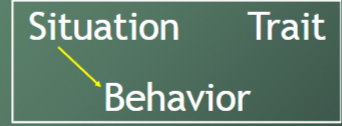
Behavior is determined by the situation or environment (e.g., modeling or reinforcement)
→ if the influence of the environment is strong enough, the effect on personality traits will be minimal
Research →
Current impact: little
Weakness: situation will NOT always influence individual behavior
Contribution: emphasizes the importance of the situation
4) Interactional approach
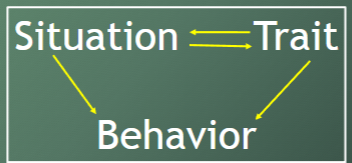
Behavior is determined by person and situation factors, as well as theit interaction.
ex: performance during free-throw shooting under pressure
Research →
Current impact: Considerable influence, adopted most contemport sport psychologist
Weakness: NONE
Contribution: emphasizes the consideration of both traits and situational variables and their interactions.
5) Phenomenological approach
Similar to the interaction approach, except a person’s experiences and personal perceptions of the world are critical
→ MOST POPULAR APPROACH TODAY

Who is Hans Eysenck? [Trait approach]
Dimensions of Personality (1947): personality traits exist on a continuum

Who is Raymond Cattel? [Trait apporach]
→ 16 independent facets of personality
→ all exist on a continuum

The Five Factor Model [Trait Approach]
MOST WIDELY used model for personality
known as BIG 5 MODEL
on continuum
2 foundational traits:
Extroversion
talkative vs quiet
assertive, energetic, enthusiasm, sociability
Neuroticism/Emotionality
emotional stability vs emotional
anxiety, nervousness, anger, depression
1) Openness to experience
→ originality, intelligence, curiosity, readiness for change
2) Agreeableness
→ Amiability, modesty, social adaptation, kindness
3) Conscientiousness
→ dependability, impulse control/self-displine, achievement striving

Sport and Five Factor Model
Athletes tend to have higher levels of extraversion than non-athletes
Athletes in teams sports tend to score higher on extraversion and lower on conscientiousness than athletes involved in indiidual sports
Measuring Personality
Rating Scales
judges and observes a situation
Unstructured projective procedures
Inference concerning underlying motives
Structured Questionaire
paper-and-pencil test
ALSO…..
Trait vs State measure
General vs Situation (sport) specific measures
ex: sport-specific test of anxiety assesses precomp. anxiety better than a general anxiety test does
What is a Projective Tests?
Word Association and Storytelling
clients say what they see based off the ambigous image (inkblots on the paper, etc.)
Responses are expressions of one’s private inner ideas, fears, wishes, etc.
Peronality Research in Sport and Exercise Psychology
NO SPECIFIC personality profile has been found that consistency discriminates athletes from non-athletes
few personality differences are evident between male and female athletes, especially at the elite level
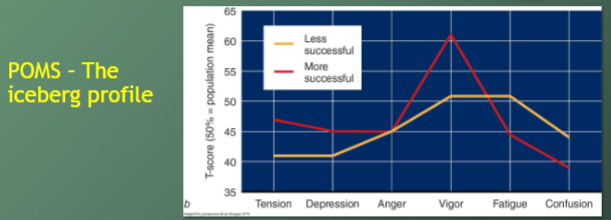
The Profile of Mood States! (POMS)
→ I feel…..energentic, tense, fatigued, full of pep, annoyed
→ Scoring….1 not at all, 2 a little, 3 moderately, 4 quite a bit, 5 extremely
Methodological Considerations
Principles of Testing and measurement error
Reliability and Validity
Sample Characterisitcs
Social Desirability
Sources of Error in Testing
Faking good
Faking bad
Conservative Response style
Response distortion
Carelessly responding
Defining Motivation
Motivation is the DIRECTION and INTENSITY of effort
Direction of effort → approach (seek out or be attracted to) a situation to avoid it
Intensity of effort → how much effort is put forth in a situation
Three Approaches to Motivation
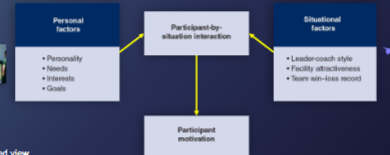
participant/Trait-Cenetered View
Situation-Centered view
Interational View
1) Participant/Trait-Cenetered View
Motivated behavior is primarily a function of individual characterisitics
Primary determinants
needs
interests
goals
personaility
EX: “you are a real winner” = Athlete excels at sports
2) Situation-Centered View
Motivation behvior is primarily determined by situational factors
primary determinants
coaching or teaching style
facility attractiveness
win/loss record of a team
EX: overcoming a bad situation → coach yelling!
3) Interactional View
Motivated behavior results from the interaction of personal and situation factors
What are the guidelines for Building Motivation?
Both situations and traits motivate people (e.g., the interactional view)
People have multiple motives for involvement
Change the environment to enhance motivation
Leaders influence motivation directly and indirectly
Use behavior modification to change participants’ undesirable motives
Building Motivation 1
Both situations and traits motivate people (e.g., the interactional view) → may change over time; continually monitor
Sorrentino and Sheppard (1978) [research example]
44 male, 33 female swimmers
Group involvement
social approval → viewing competing with others as a positive state
social rejection → feeling threatened by an affiliation-oriented activity, such as a relay, in which he/she might let others down
Personal Factor = approval vs rejection
Situational factor = alone vs team
From coach perspective → the four fastest individual swimmers might not make the best relay team, and starting the 3 most highly skilled athletes doesn’t guarantee you have the best in the game
→ Applying the Interactional View
![<p><strong>Both situations and traits motivate people </strong>(e.g., the interactional view) → may change over time; continually monitor</p><p></p><ul><li><p><strong><u>Sorrentino and Sheppard (1978</u></strong>)<strong> [research example]</strong></p><ul><li><p>44 male, 33 female swimmers</p></li><li><p>Group involvement</p><ul><li><p><strong>social approva</strong>l → viewing competing with others as a positive state</p></li><li><p><strong>social rejection </strong>→ feeling threatened by an affiliation-oriented activity, such as a relay, in which he/she might let others down</p></li></ul></li><li><p><strong>Personal Factor </strong>= approval vs rejection</p></li><li><p><strong>Situational factor</strong> = alone vs team</p></li><li><p><u>From coach perspective</u> → the four fastest individual swimmers might not make the best relay team, and starting the 3 most highly skilled athletes doesn’t guarantee you have the best in the game</p></li></ul></li></ul><p></p><p>→ Applying the Interactional View</p><p></p>](https://assets.knowt.com/user-attachments/0d2a7a27-d2a8-44c4-83f0-f0a6dd656e60.png)
Building Motivation 2
People have multiple motives for involvement →
understant why people participate
participate more than one reason
shared and unquie motives
motives change over time
Youth and Adult Example!!!!
BM 2 Youth Example
what motivates children to play sports? → FUN!!!
Parent’s influence → arguably the most important people in children’s lives are their parents or parental figures
(Does not prepare them for professional sports career!)
problems associated with youth sports? → orgnized YS is not automatically benfical
emphasis on winning
pressure by SO to achieve success
installing unrealisitic goals or professional careers
overuse injuries
Motives for discontinuing participation? →
primary concerns
not having fun
concerns about caoching
other life activites
Secondary
too musch pressure
too musch emphasis on winning
not getting played enough
BM 2 Adult Example
Major Motives for Exercise Participation
intially:
health factors, weight loss, fitness, etc.
continually:
enjoyment
orgainzation
leadership
social factors
More than one reason to participate → multiple benefits
competiting motives for involvement → exercise vs family
both shared and unique motives → friendship vs dominance
sex differences in motivation → competitive vs social
cultural emphasis affects motives → interval vs external
Building Motivation 3
Change the environment to enhance motivation
competition or recreational
multiple motives and opportunities
adjust to individuals in groups
Building Motivation 4
Leaders influence motivation directly and indirectly
Directly → the way a coach structures practice
Indirectly → a fitness instructor’s energetic, outgoing personality acts as positive reinforcement
Building Motivation 5
use behavior modification to change participants’ undesirable motives
ex: reinforce good clean play - punish aggressive play intended to inflict injury
1 → This individual is considered to be the Father of North American Sport Psychology.
a) Philip Wrigley
b) Bruce Olgilvie
c) Norman Triplett
d) Coleman Griffith
e) Dan Gould
D
2 → This sport psychology specialty area often works with athletes on issues like eating disorders and substance abuse. They are also required to be licensed psychologists in the state they practice.
a) Clinical Sport Psychologist
b) Educational Sport Psychologist
c) Mental Performance Coach
d) Experimental Sport Psychologist
e) Certified Mental Performance Consultant
A
3 → Dr. Olson is conducting an experiment examining the effects of goat yoga on anxiety symptoms. The dependent variable(s) in this study is/are:
a) neither anxiety symptoms nor goat yoga
b) both anxiety symptoms and goat yoga
c) goat yoga
d) anxiety symptoms
D
4 → An experiment examining the effects of competition on anxiety would be an example of objective #1 (the scientific study of how psychological factors affect performance) within sport and exercise psychology.
True or False?
FALSE!!!!
5 → __________ is considered to be activities involving power and skill, competition, strategy and/or chance, and engaged in for the enjoyment and satisfaction of the participant and/or others.
a) Recreation
b) Play
c) Sport
d) Physical activity
e) Exercise
C
6 → Identify the three roles of a sport psychology practitioner. [Select all that apply]
a) service
b) training
c) consulting
d) teaching
e) research
C, D, & E
7 → Match the three research approaches in sport and exercise psychology to its definition.
a) Behavior is determined by a complex interaction of the environment (especially the social environment) and the personal make-up of the athlete or exerciser.
b) Examines underlying psychophysiological processes of the brain (or heart, muscle, etc.) in terms of primary causes of behavior.
c) Behavior is determined by both the environment and thoughts (cognitions).
with….
1) Cognitive-behavioral orientation
2) Social-psychological orientation
3) Psychophysiological orientation
A-2……B-3…..C-1
8 → _________ is a process, or method of learning about the world through systematic, controlled, empirical, and critical filtering of knowledge acquired through experience.
a) Theory
b) Psychology
c) Science
d) Sport
e) Guessing
C
9 → This type of research consists of historical accounts, philosophic ideas, literature reviews, and meta-analyses.
a) descriptive
b) experimental
c) qualitative
d) case-study
e) analytical
E
10 → Match the following training components of performance with its outcome.
a) Technical training
b) Mental training
c) Physical training
with….
1) control
2) speed
3) strategy
A-3…..B-1…..C-2
1 → Match the Personality Structure approach to its definition.
a) Understanding the person as a whole, rather than identifying isolated traits
b) Behavior is determined by the situation or environment (e.g., modeling or reinforcement)
c) Personality traits predispose one to act in a certain way regardless of the situation
d) Similar to the interactional approach, except a person’s experiences and personal perceptions of the world are critical
with…..
1) Trait approach
2) Situational approach
3) Phenomenological approach
4) Psychodynamic approach
A-4…..B-2…..C-1…..D-3
2 → This type of personality assessment should be used when measuring current (in the moment) stress levels of an athlete during competition.
a) state-situation
b) trait-situation
c) trait-general
d) state-general
A
3 → Identify the three main sources of measurement error in sport and exercise psychology research.
a) social desirability
b) sample characteristics
c) sample size
d) reliability and validity
e) confirmation bias
A, B, & D
4 → Personality research in sport and exercise psychology has identified a specific personality profile that consistently discriminates athletes from non-athletes.
True or False?
False
5 → This part of a person’s personality structure is the least stable and is heavily influenced by the situation.
a) Psychological core
b) None of the above
c) Foundational component
d) Role-related behavior
e) Typical responses
D
6 → This is one of the most widely used models of personality that describes personality traits on a continuum and categorizes people into personality types.
a) The Five Factor Model
b) Personality Categorization System
c) The Personality Matrix
d) Model of Personality Measurement
e) The Personality Continuum Model
A
7 → This researcher developed the Dimensions of Personality (1947), where two main personality traits were viewed on a continuum.
a) Hans Eysenck
b) William P. Morgan
c) Raymond Cattell
d) Bradley Hatfield
e) Sigmund Freud
A
8 → __________ is/are the way we learn to adjust to the environment.
a) Belief systems
b) Typical responses
c) Resilience
d) Role-related behavior
e) Psychological core
B
9 → According to this approach, behavior is determined by the person (traits) and situational factors, as well as their interaction.
a) Psychodynamic approach
b) Interactional approach
c) Trait approach
d) Phenomenological approach
e) Situational approach
B
10 → Personality is the sum of the characteristics that make a person unique.
True or False?
True
1 → According to Ewing and Seefeldt (1996), which is a motive cited for youth sport participation? (SELECT ALL THAT APPLY)
a) Improving skills
b) Experiencing excitement
c) Having fun
d) Being with friends
e) Developing fitness
ALL OF THEM
2 → Motivation is defined as the ______ and ______ of effort.
a) type; direction
b) direction; intensity
c) type; intensity
d) intensity; ability
e) ability; type
B
3 → Findings from the Sorrentino and Sheppard (1978) study suggest that starting the best individual athletes may not guarantee the best team. (i.e., taking the four fastest individual runners may not equal the fastest relay team).
True or False?
True
4 → According to the guidelines for building motivation, behavior modification should be used to change an athletes' undesirable motives.
True or False?
True
5 → Primary determinants of the situation-centered view include the coaching style, facility attractiveness, and record of the team.
True or False?
True
6 → Identify the factor(s) that is/are associated with continued involvement in an exercise program.
a) Program enjoyment
b) Weight loss
c) Self-challenge
d) Health factors
e) Fitness
A