5.1 Photosynthesis
 Call Kai
 Learn
Learn Practice Test
 Spaced Repetition
 Match
Match Flashcards
 Knowt Play
1/4

There's no tags or description
Looks like no tags are added yet.
Name | Mastery | Learn | Test | Matching | Spaced | Call with Kai | Chat |
|---|
No analytics yet
Send a link to your students to track their progress
5 Terms
What are the stages
of photosynthesis?
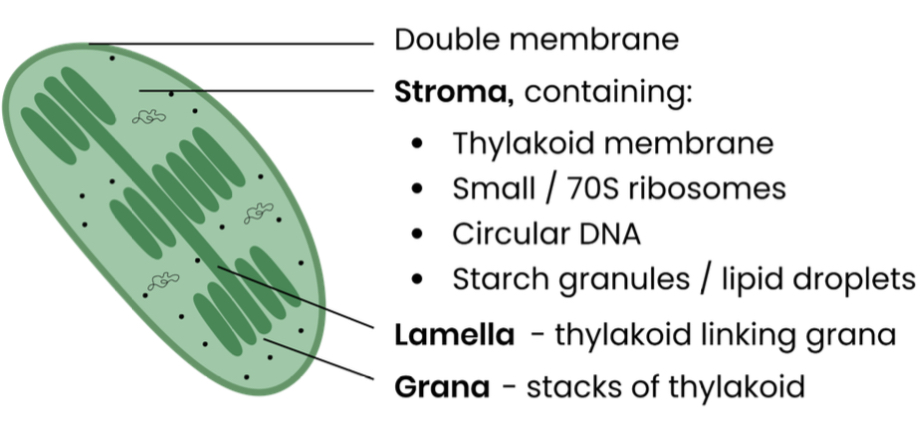
1. Light dependent reaction that happens in the thylakoid membrane of chloroplast
2. Light independent reaction that happens in the
stroma of chloroplast
Describe photoionisation in the light-dependent reaction (LDR)
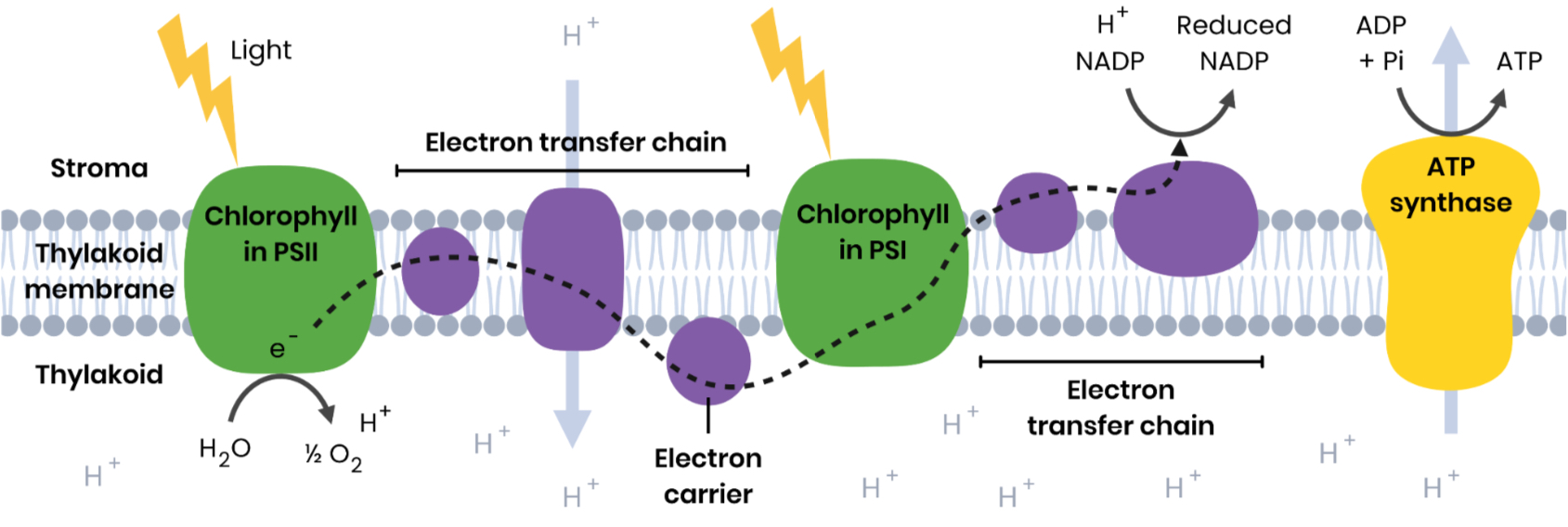
Chlorophyll absorbs light energy which excites its electrons (higher energy level)
So electrons are released from chlorophyll (chlorophyll becomes positively charged)
Describe what happens after photoionisation in the LDR
Some energy from electrons released in photoionisation is conserved in the production of ATP / reduced NADP
(chemiosmotic theory)
1. Electrons move along electron transfer chain (electron carriers), releasing energy
2. This energy is used to actively pump protons from stroma into thylakoid
3. Protons move by facilitated diffusion down electrochemical gradient into stroma via ATP synthase
4. Energy used to join ADP and Pi to form ATP (photophosphorylation)
5. NADP accepts a proton and an electron to become reduced NADP
Describe photolysis of water in the LDR
Water splits to produce protons, electrons and oxygen (H2O → ½ O2 + 2e- + 2H+)
Electrons replace those lost from chlorophyll
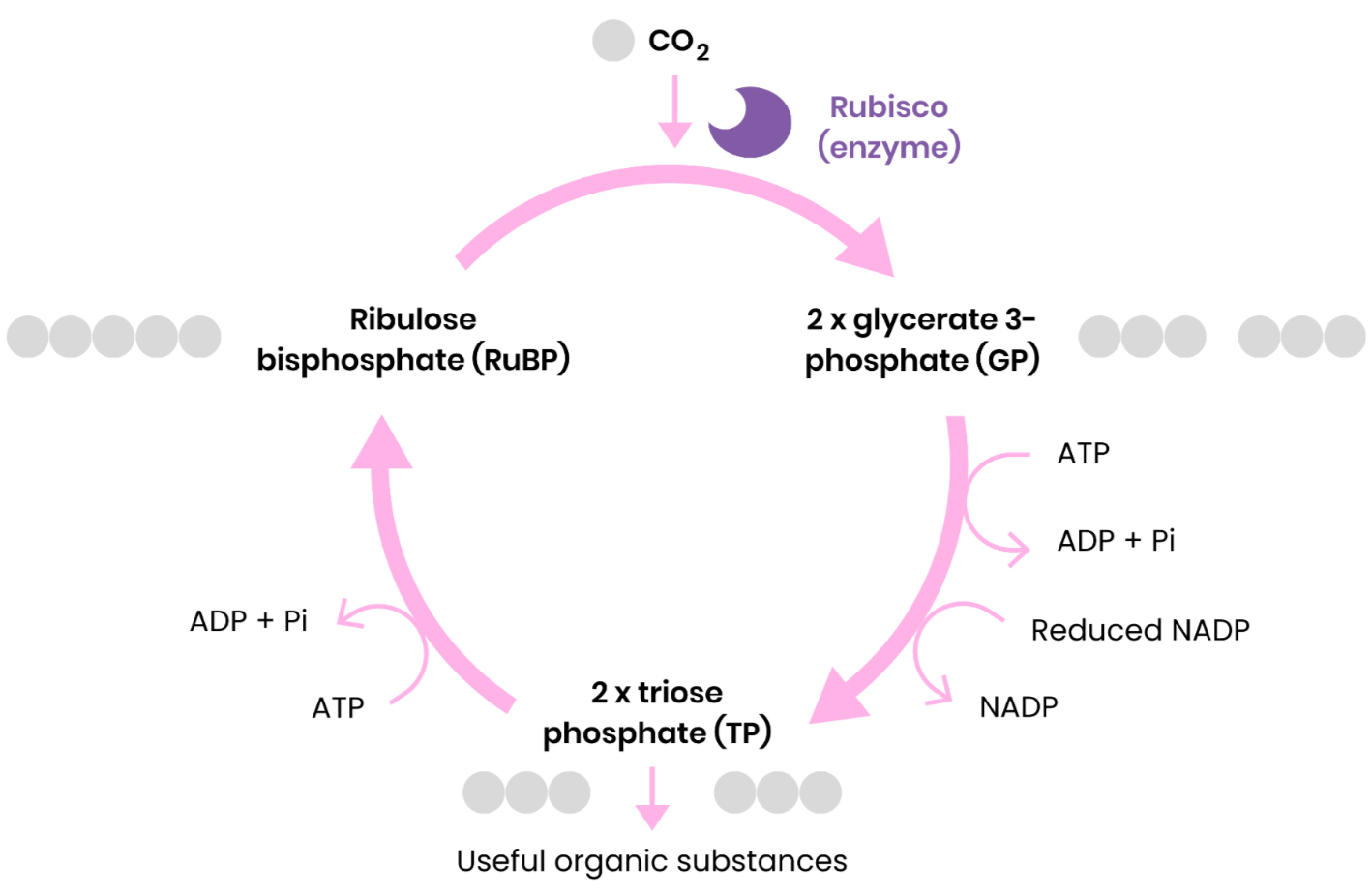
Describe the light-independent reaction of photosynthesis (Calvin cycle)
1. CO2 reacts with ribulose bisphosphate (RuBP)
Catalysed by the enzyme rubisco
2. Forming 2 glycerate 3-phosphate (GP) molecules
3. GP reduced to triose phosphate (TP)
Using products from light-dependent reaction - reduced NADP & energy from ATP hydrolysis
4. Some TP converted to useful organic substances (eg. glucose)
5. Some TP used to regenerate RuBP in the Calvin cycle (using energy from ATP hydrolysis)