Glycogen Metabolism and Storage Diseases
 Call Kai
 Learn
Learn Practice Test
 Spaced Repetition
 Match
Match Flashcards
 Knowt Play
1/30

There's no tags or description
Looks like no tags are added yet.
Name | Mastery | Learn | Test | Matching | Spaced | Call with Kai | Chat |
|---|
No analytics yet
Send a link to your students to track their progress
31 Terms
Glycogen
- An extensively branched glucose storage polysaccharide found in the liver and muscle of animals; the animal equivalent of starch.

Role of Glycogen in Muscle/Liver
- Muscle: For its OWN use (cannot release glucose into circulation)
- Liver: For the body (able to release glucose)
Glycogen Structure
- Large glucose polysaccharide
- Branches have alpha(1,6) bonds; Linkages have alpha(1,4) bonds.

Why is glycogen branched?
- Makes it more soluble
- Makes it possible for the body to store more of it
Glycogen synthesis is an offshoot of what?
- Glycolysis (Glucose-6-Phosphate)
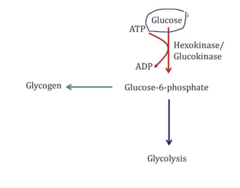
What happens if glucose-6-phosphate is shunted to glycogen synthesis?
- Cells then use a 4 step process to convert G6P → Glycogen
Steps of Glycogen Synthesis
1. Glucose-6-Phosphate → Glucose-1-Phosphate
2. G1P → UDP-Glucose
3. UDP-Glucose → Unbranched Glycogen (1;4)
4. Unbranched Glycogen → Branched Glycogen (1;6)

Glucose-6-Phosphate → Glucose-1-Phosphate: What enzyme?
- Phosphoglucomutase
G1P → UDP-Glucose: What Enzyme?
- UDP-Glucose Phosphorylase
UDP-Glucose → Unbranched Glycogen (1;4): What Enzyme?
- Glycogen Synthase
Unbranched Glycogen → Branched Glycogen (1;6): What Enzyme?
- Branching Enzyme
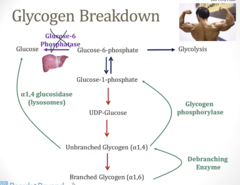
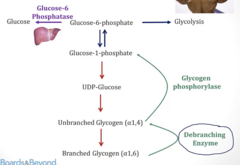
Steps of Glycogen Breakdown
1. Branched → Unbranched via Debranching Enzyme
2. Unbranched → G1P via Glycogen phosphorylase
3. G1P ↔ G6P in reversible rxn

Glycogen Breakdown: Where does Glucose-6-Phospghate go after its free from glycogen storage?
- Muscles lack Glucose-6-Phosphatase → goes to glycolysis
- Liver has Glucose-6-Phosphatase; G6P can be converted to glucose to be released into blood stream to maintain blood sugar levels
α1,4 Glycosidase
- Breaks unbranched glycogen (1;4) → directly into glucose
- Found in lysosomes
Glycogen Phosphorylase: What does it do? When does it stop? Stabilized by what?
- Action: Removes glucose molecules from glycogen polymer → creates G1P
- Stops: When glycogen branches decreased to 2-4 linked glucose molecules
- Stabilized: By Vitamin B6
Limit Dextrins
- Small glucose polymers containing the alpha 1-6 linkages, cannot be broken down by glycogen phosphorylase

Debranching Enzyme
- Takes the alpha 1,6 branching points that have been exposed due to glycogen phosphorylase and moves the whole branch to the terminal end of chain, making a new α1,4 glycosidic bond

Do Glucagon/Epinephrine favor the breakdown or storage of glycogen?
- ↑ During flight, fight, fasting → favors glycogen breakdown into glucose for energy use
Does Insulin favor the breakdown or storage of glycogen?
- Favors glucose → glycogen
Glycogen Storage Diseases: Shared Characteristics
- Most are autosomal recessive diseases of defective breakdown of glycogen
- Hypoglycemia
- Muscle weakness
Von Gierke's Disease: Deficiency and MOA
- Glucose-6-Phosphatase
- G6P cannot be converted into glucose
Von Gierke's Disease: Presentation
- Infancy: 2-6 months of age
- Severe hypoglycemia between meals (bc liver cannot release glucose)
- Lethargy, Seizures, Lactic acidosis
- Enlarged liver (d/t excess glycogen)
Von Gierke's Disease: Treatment
- Cornstarch between meals (prevents hypoglycemia)
- Avoid sucrose, lactose, fructose, galactose (cannot be metabolized into glucose via gluconeogenesis → worsened accumulation of G6P)
Pompe's Disease: Deficiency and MOA
- α-Glucosidase Deficiency
- MOA: Accumulation of glycogen in lysosomes

Pompe's Disease: Presentation
- Enlarged muscles (cardiomegaly, tongue)
- Hypotonia
- Liver enlargement from heart failure
Death from heart failure
Cori's Disease: Deficiency and MOA
- Debranching enzyme deficiency
- MOA: Cannot break down 1-6 linkages
Gluconeogenesis is intact
Cori's Disease: Presentation
- Infant/child with hypoglycemia/hepatomegaly
- Hypotonia/weakness
- Possible cardiomyopathy with hypertrophy
McArdle's Disease: Deficiency and MOA
- Glycogen Phosphorylase Deficiency
- Unable to breakdown Unbranched glycogen → G1P → glycogen not properly broken down in muscle cells
McArdle's Disease: Presentation
- Presents in adolescence/early adulthood
- Exercise intolerance, fatigue, cramps
- Poor insurance, muscle swelling, weakness
- Dark urine after exercise
What can be seen in the urine of McArdle's patients?
- Muscles injury/breakdown during exercise → myoglobin in urine → dark urine
Myoglobinuria
Glycogen Synthase Deficiency
Type: Metabolic Disease
Cause: Glycogen Synthase enzyme deficiency
Sx: Elevated blood glucose, lactate, & lipids after Carb meal. Low glucose & high ketone bodies during fasting. Defect in muscle tissue causes weakness & difficulty with exercise.
Tx: Frequent complex carb meals, and meals high in protein.