Chapter 12: Solutions
 Call Kai
 Learn
Learn Practice Test
 Spaced Repetition
 Match
Match Flashcards
 Knowt Play
1/48

Earn XP
Description and Tags
Chem 2
Name | Mastery | Learn | Test | Matching | Spaced | Call with Kai | Chat |
|---|
No analytics yet
Send a link to your students to track their progress
49 Terms
solutions
homogenous mixtures of two or more pure substances. solute is dispersed uniformly throughout the solvent
solute
substance that dissolves
solvent
major component of the solution
concentration
amount of solute that is present in a solution
solution contains small amount of solute
dilute
solution contains a large amount of solute
concentrated
solution contains the maximum amount of dissolved solute
saturated
mass %
mass of solute / mass of solution x 100%
volume percent
volume of solute / volume of solution x 100%
mass/volume %
mass of solute / volume of solution x 100%
ppm equation - expressing very small concentrations
mass of solute / mass of solution x 106
ppb equation - expressing very small concentrations
mass of solute / mass of solution x 109
Molarity (M) equation - describing chemical reactions
moles solute / liter solution
molality (m) equation - describing physical properties
moles solute / kg solvent
mole fraction (x) - describing physical properties
moles of solute / total moles solution
equation to solve for moles
moles = MV
dilution equation
M1V1 = M2V2
factors that affect solubility
solute-solvent interactions, pressure (for gaseous solutes), temperature
solute-solvent interactions
“like dissolves like”, the stronger the solute-solvent interaction, the greater the solubility of a solute in that solvent
no ions present, no polar molecules present
dispersion forces only
no ions present, yes polar molecules present, no H atoms bonded to N,O,F atoms
dipole-dipole forces
no ions present, yes polar molecules present, yes H atoms bonded to N,O,F atoms
hydrogen bonding
yes ions present, yes polar molecules present
ion-dipole forces
yes ions present, no polar molecuels present
ionic bonding
electrolytes
ionic compounds, acids. compounds that produce ions in solution
nonelectrolytes
most covalent compounds
enthalpy
entropy
determines whether a change happens spontaneously, a tendency toward disorder or mixing
exothermic
endothermic
low gas pressure
lower solubility
high gas pressure
higher solubility
henry’s law
S = kP
ideal solution
number of particles per formula unit if complete dissociation occurs
real solution
number of particles that actually form
colligative properties
depend on the number of particles in a solution, not on the type of particle
osmotic pressure equation
pie = iMRT - i: van’t hoff factor, M: molarity, R: 0.0821Lamt/molK
osmotic pressure
water flows toward a higher pie value
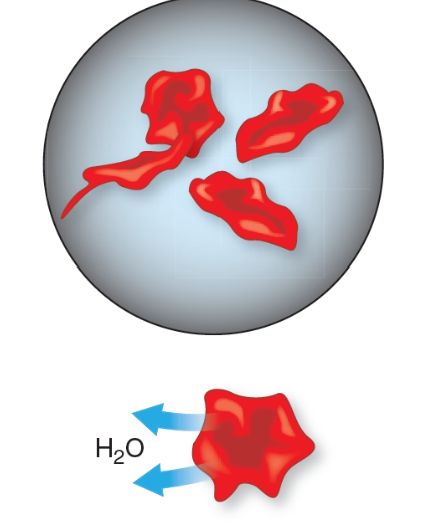
what is this
hypertonic
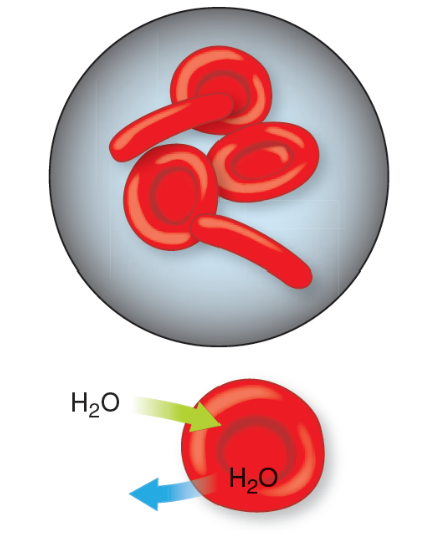
what is this
isotonic
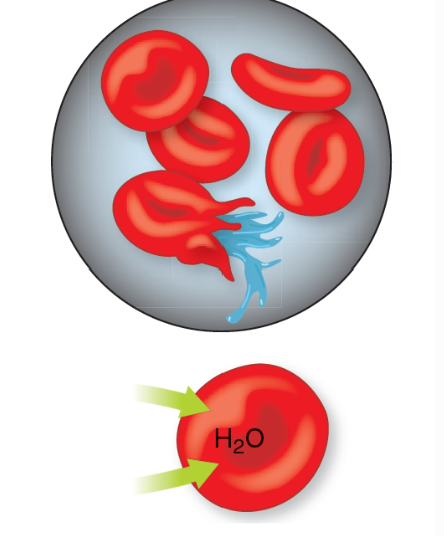
what is this
hypotonic
freezing point depression
presence of solute lowers the freezing point of a liquid. freezing point of a solution drops as more solute is added
freezing point depression equation
delta Tf = imKf - i: van’t hoff factor, m: molality, Kf: constant
vapor pressure
pressure of the gas above the liquid at dynamic equilibrium
solutions with nonvolatile solutes
vapor pressure of the solution is less than that of pure water
raoult’s law (nonvolatile solute)
Psoln = (Xsolvent)(Psolvent)
solutions with volatile solutes
Ptotal = {XiPi
distillation
colloids
suspension of particles larger than individual ions or molecules, but too small to be settled out by gravity