Basic Principles of Infectious Disease and Antimicrobials
 Call Kai
 Learn
Learn Practice Test
 Spaced Repetition
 Match
Match Flashcards
 Knowt Play
1/106

There's no tags or description
Looks like no tags are added yet.
Name | Mastery | Learn | Test | Matching | Spaced | Call with Kai | Chat |
|---|
No analytics yet
Send a link to your students to track their progress
107 Terms
What is considered when choosing an antibiotic?
- the bug
- the drug
- the patient
- the disease state
What Antimicrobial Properties are considered when choosing an antibiotic?
- Spectrum of activity (broad vs narrow)
- Dose (indication matters)
- Pharmacokinetics/Dynamics
- Adverse Effect Profile
- Cost
- Bactericidal vs Bacteriostatic
Bactericidal vs bacteriostatic is not nearly as important as we thought but __________________ is recommended for deep seated infections such as endocarditis.
bactericidal
What host (patient) factors are considered when choosing an antibiotic?
- Allergy history (Most critical!)
- Age
- Special populations (pregnancy, pediatrics, immunocompromised)
- organ function (renal dysfunction -- most antibiotics are cleared really -- and hepatic dysfunction)
What antimicrobial (bug) factors are considered when choosing an antibiotic?
- the normal flora (where the bacteria normally resides in the body)
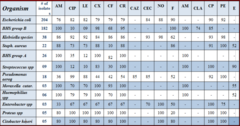
- the antibiogram
What is an antibiogram?
An overall summary report of antimicrobial susceptibility test results. It shows the percentage of specific bacterial or fungal strains that are inhibited or killed by various tested antibiotic drugs.
Antibiograms are especially important in ___________ therapy and they are always __________________ specific!
empiric; local/institution
What disease state factors are considered when choosing an antibiotic?
- physical exam findings
- signs/symptoms (septic shock patients)
- laboratory findings
- culture and susceptibility testing
Not all patients with positive cultures are considered infected! What are examples of when this is the case:
- Asymptomatic Bacteriuria: bacteria growing in the urine but no symptoms so we won't treat these patients unless they are pregnant
- Contaminated Blood Culture (Coagulase Negative Staph): contamination by a bacteria normally fund on the skin
Generally, choosing antibiotics depends on:
- the disease states, bugs, and drugs
- practice specific information: local epidemiology (organism and resistance trends), formularies, and cost
- patient specific information: exposure history, risk factors for specific bugs, allergies, organ dysfunction, interacting medications, weight, and height
Important resources for ID information:
- the Sanford Guide
- Antibiotics Simplified by J Gallagher
- IDSA Guidelines
- Social Media
What are the three ways that antibiotics are used?
Prophylaxis, empiric, and definitive.
Prophylaxis therapy
The use of a drug before a patient gets the infection.
Examples of medical prophylaxis:
- patients with exposure to virulent pathogens (HIV (PrEP) and N. meningitis)
- immunocompromised patients (HIV with CD4
Procedural prophylaxis
Short course of antibiotics recommended/preferred prior to surgery (ancef/cefazolin is the most commonly used)
Empiric therapy
treatment of an infection before specific culture information has been reported or obtained; usually lasts up to 72 hours
Empiric therapy is chosen based on:
- likely pathogen
- local susceptibility trends
- patient specific factors (allergies, organ dysfunction)
It is important to get cultures ________________ the start of antibiotics in empiric therapy so that growth in the culture is not suppressed.
prior to
It is important to start appropriate antibiotics ASAP in empiric therapy especially for the following conditions:
- sepsis (start within an hour)
- meningitis (start within 45 minutes)
______________ dosages are most appropriate for empiric therapy.
Higher
Definitive therapy
antibiotic therapy tailored to treat organism identified with cultures
Definitive therapy for T. palladium (it is susceptible to this drug) is
penicillin
Caveats to susceptibility testing:
- interpretation of mIC as S, I, or R is bug-drug specific (relative to concentrations of drug in body)
- one cannot just pick the one with the lowest MIC (MIC's are not comparable)
- CLSI and FDA determine breakpoints
MIC
minimum inhibitory concentration; the lowest concentration of an antibiotic that stops visible growth of a bacterium in a lab test
S
susceptible
I
Intermediate
R
resistant
S-DD
Susceptible but dose dependent
Sometimes we want to suppress the results to some broad spectrum agents because we want more narrow coverage drugs to be used when available. This is called _________________.
Cascaded reporting
E-test
A manual test that will get you an MIC. It is used as an additional test when the drug does not have established breakpoints or the drug is a new ABX that is not on the automated panels.
What is the goal of definitive therapy?
To use the most effective, least toxic, narrowest spectrum, and most cost effective agent aka the drug of choice.
The drug of choice may actually be...
a combination of drugs (e.g. ampicillin and gentamicin for enterococcal endocarditis)
It is important to know the ________________________ to the drug of choice especially when the patient is allergic to the DOC.
alternatives
After finding the drug of choice, one must understand that the dose, route, intervals, and duration are all _________________________________.
disease state and patient specific
What is the duration of treatment for antibiotics?
It is not well defined but generally shorter courses are better for most infections so its usually less than 7-10 days (such as in CABP, ABSSSI, Uncomplicated Cystitis).
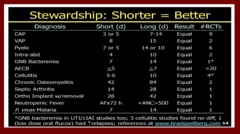
For which disease states are longer durations with antibiotics necessary?
- Endocarditis and Osteomyelitis often require 6 weeks
- Prostatitis often requires 4 weeks
- Staphylococcus aureus Bacteremis often require >/= 14 days via IV
When a patient is put on an antibiotic, it is important to...
track the number of days of therapy in progress notes and set an endpoint
Prolonged unnecessary antibiotic therapy increases...
the risk of resistance, adverse effects, and cost
List some gram positive organisms:
- Staph Aureus
- Enterococcus species (E. faecaliss and E. faecium)
- Strep Pneumoniae
How is staph aureus empirically treated?
as Methicillin-Resistant Staph Aureus (MRSA)
What is the Methicillin susceptible staph aureus drug of choice?
Cefazolin (preferred) and Nafcillin (can cause significant kidney injury)
What is the community acquired methicillin resistant staph aureus drug of choice (if uncomplicated)?
- Trimethoprim/Sulfamethoxazole
- Clindamycin
- Doxycycline and Minocycline
What are the primary enterococcus species?
E. faecalis and E. faecium
What is the drug of choice for Enterococcus species?
Ampicillin (or amoxicillin) or vancomycin
What can be used to treat a UTI caused by Enterococcus species?
Nitrofurantoin, Ampicillin, or Vancomycin
Vancomycin resistant Enterococci (VRE) is primarily ________________ and primary options for treatment include ____________________________________.
E. faecium isolates; daptomycin and linezolid
Which antibiotic class has ZERO coverage vs enterococci?
Cephalosporins
Strep Pneumoniae îs the primary pathogen for...
- community acquired bacterial pneumonia
- acute sinusitis
- bacterial meningitis
What is the regimen of choice for strep pneumoniae infections in the CNS is....
High dose (HD) Ceftriaxone (2g IV Q12H) + Vancomycin
What is special about the dose of Ceftriaxone for the treatment of strep pneumoniae infections in the CNS?
Ceftriaxone is usually dosed once a day but is dosed twice a day in strep pneumoniae CNS infections because it is difficult for drugs to penetrate the CNS.
What is the drug of choice for strep pneumoniae infections OUTSIDE thee CNS (outpatient):
High dose amoxicillin (PO)
What is the drug of choice for strep pneumoniae infections OUTSIDE thee CNS (inpatient):
- Ceftriaxone
- Respiratory Flouroquinolones if at risk for resistance or step-down for secondary bacteremia (high bioavailability)
List some gram negative organisms:
- E. coli
- Pseudomonas Aeruginosa
Where is E.coli commonly found?
In urine
Which drugs are the drugs of choice for E.coli infections?
- Trimethoprim/Sulfamethoxazole
- Flouroquinolones such as Ciprofloxacin and Levofloxacin
Which flouroquinolone is not recommended for E.coli infections and why?
Moxifloxicin because very little is excreted in the urine
What are the best drugs for treating Pseudomonas aeruginosa infections?
- Piperacillin/Tazobactam
- Cefepime
- Meropenem (reserve)
What are the "less effective" drugs (50-70% susceptible) used to treat Pseudomonas aeruginosa infections?
- Aztreonam
- Levofloxicin and Ciprofloxacin
How are ahminoglycosides used in Pseudomonas aeruginosa infections?
as second drugs in combination with the best drugs or the "less effective" drugs unless the infection is a UTI
Which anaerobes are gram positive?
Peptostreptococcus and Clostridium
Which anaerobes are gram negative?
Bacteroides
Which medications in general are used to treat anaerobe infections?
- amoxicillin/clavulanate
- ampicillin/sulbactam
- piperacillin/tazobactam
- carbapenems
Any Penicillin with __________________________ has excellent anaerobic coverage.
beta-lactamase inhibitor
Which type of anaerobes commonly affect the mouth and lungs and which antibiotic is best to treat that infection?
Gram positive anaerobes are most likely to infect the mouth/lungs and this infection is best treated with clindamycin.
Which type of anaerobes commonly affect the abdomen and GU and which antibiotic is best to treat that infection?
Gram negative anaerobes are most likely to infect the abdomen/GU and this infection is best treated with Metronidazole.
List atypical organisms:
- legionella
- mycoplasma
- chlamydia
Which antibiotics best treat atypical organisms?
- macrolides
- tetracyclines
- respiratory fluoroquinolone
Why do macrolides, tetracyclines, and respiratory fluoroquinolones work well on atypical organisms?
Because these antibiotics do not work by attacking cell walls and atypical organisms do not have cell walls (aka beta lactams won't work on them).
Which antibiotics work by attacking the peptidoglycans in the cell wall of an organisms?
- penicillins +/- beta lactamase inhibitors
- cephalosporins
- imipenem
- aztreonam
Which antibiotics work by attacking precursor molecules and decreasing peptidoglycans needed for the cell walls of an organism?
vancomycin
Which antibiotics work by affecting DNA gyrase and Topoisomerase 4?
Fluoroquinolones
Which antibiotics work by affecting the 30S protein in ribosomes?
Tetracylines
Which antibiotics work by affecting the 50S protein in ribosomes?
Macrolides
Which antibiotics work by affecting the 30S and 50S proteins in ribosomes?
Aminoglycosides
Which antibiotics work by affecting folate metabolism?
Trimethoprim/Sulfamethoxazole
What are mechanisms of resistance used by antibiotics?
- alteration of targets such as PBPs: an absolute change will cause no binding (e.g. MRSA which is resistant to all beta lactams) while a relative change will cause decreased binding and increased MICs (e.g. drug resistant s. Pneumoniae)
- destruction by enzymes such as beta lactamases: penicillinase in MSSA, H.influenzae, and anaerobes (but can be combated by adding a beta-lactamase inhibitor or changing structure) and Cephalosporinase (ESBL) in E.coli/Klebsiella species
Which antibiotics have great PO absorption?
- fluconazole
- fluoroquinolones (be careful of drug interactions)
- metronidazole
- TMP/SMX
- doxycycline
Which antibiotics are IV only?
- vancomycin (except when treating c.difficile)
- all antipseudomonal agents except for fluoroquinolones
- 3rd and 4th generation cephalosporins (may give IM)
- aztreonam (only for severe beta-lactam allergies)
- aminoglycosides (gentamicin et al; may give small doses MI or may be used oral for gut disinfection (rare))
- Clindamicin (also used orally at times)
Why is the IV dose for Clindamycin much higher than the oral dose?
Because clindamycin is hard to tolerate orally (bad side effects at high doses).
Which antibiotics have excellent CNS penetration?
metronidazole, chloramphenicol, fluconazole, TB drugs
Which antibiotics have adequate CNS penetration with high doses?
Ceftriaxone, ceftazidime, ampicillin
Which antibiotics have problematic CNS penetration?
Vancomycin (huge molecule) and Amino-glycosides (very polar and water soluble)
Which antibiotics have good lung penetration?
Fluoroquinolones, Macrolides, and Beta-lactams
Which antibiotics have modest lung penetration?
Aminoglycosides
How do you adjust for renal dysfunction for antibiotics?
using ClCr via Cockcroft Gault
Why can you use lower doses of some antibiotics for UTIs?
because most antibiotics are really excreted so they would have good levels in urine despite lower doses
What considerations for the liver must be made for antibiotics?
- dose adjustments for liver dysfunction (not exactly clear how this is done yet)
- potential for drug interactions
MDRD (Modification of Diet in Renal Disease) Levey equation
a mathematical formula used to estimate the glomerular filtration rate (eGFR) to assess kidney function; can be done on medcalc
Cockcroft-Gault equation
Estimates a person's creatinine clearance (CrCl) to measure kidney function (140-age) x IBW/(72xScr) (x 0.85 if female) -- would round SCreen up if
If a patient's ClCr < 50-60 mL/min, adjust the interval +/- dose of the following antibiotics:
- penicillins (not nafcillin or oxacillin)
- cephalosporins (not ceftriaxone)
- aztreonam
- vancomycin
- ahminoglycosides
Miscellaneous agents that require adjusted dosing in renal dysfunction:
- TMP/SMX (generally avoid)
- fluconazole
- acyclovir
- ganicyclovir
- most nucleoside RTIs
Which antibiotic is avoided in renal dysfunction due to being nephrotoxic?
Amphotericin B but the liposomal formulations have less toxicity
Which antibiotics need dosing adjustments in hepatic dysfunction but generally don't need to be adjusted for renal dysfunction?
- Ceftriaxone
- Nafcillin
- Clindamycin
- Metronidazole
- Macrolides
- Tetracyclines
- Rifampin
- Isoniazid
What are some common drugs cleared by CYP450?
Statins, Cyclosporins, Benzodiazepines, Theophylline, Anticonvulsants, Oral hypoglycemics
Which antibiotics inhibit metabolism of CYP450 enzymes and thus increase the levels of drugs cleared by CYP450 enzymes?
- Macrolides (erythromycin/clarithromycin BUT NOT azithromycin)
- Azoles (Fluconazole, Itraconazole)
- Protease inhibitors
- Ciprofloxacin
Which antibiotics induce metabolism by CYP450 enzymes and thus decrease the levels of drugs cleared by CYP450 enzymes?
- Rifampin
- Rifabutin
Levels of oral contraceptives are decreased with ________________________.
rifampin and nafcillin
Vitamin K is made by bacteria in the colon so the use of the following antibiotics can profoundly increase a patient's INR if they are on warfarin:
- trimethoprim/sulfamethoxazole
- metronidazole
- erythromycin/clindamycin
Vitamin K is made by bacteria in the colon so the use of the following antibiotics can significantly increase a patient's INR if they are on warfarin:
Fluconazole +/- ciprofloxacin/levofloxacin
Vitamin K is made by bacteria in the colon so the use of the following antibiotics can decrease a patient's INR if they are on warfarin:
Rifampin/Rifabutin