ECON 201 Problem Sets 4 & 5
 Call Kai
 Learn
Learn Practice Test
 Spaced Repetition
 Match
Match Flashcards
 Knowt Play
1/39

There's no tags or description
Looks like no tags are added yet.
Name | Mastery | Learn | Test | Matching | Spaced | Call with Kai | Chat |
|---|
No analytics yet
Send a link to your students to track their progress
40 Terms
The primary purpose of the AD-AS model is to explain
business flucuations
Which of these would cause the aggregate demand curve to shift to the right?
an increase in the growth rate of the money supply
Considering the aggregate demand curve and the long-run aggregate supply curve, what change will result in a lower inflation rate and a higher real growth rate?
an increase in long-run aggregate supply
Considering the aggregate demand curve and the long-run aggregate supply curve, what change will result in a higher inflation rate and a lower real growth rate?
a decrease in long-run aggregate supply
The long-run aggregate supply curve
is a vertical line
Real shocks to the economy shift the long-run aggregate supply curve to the
left or the right by a little or a lot
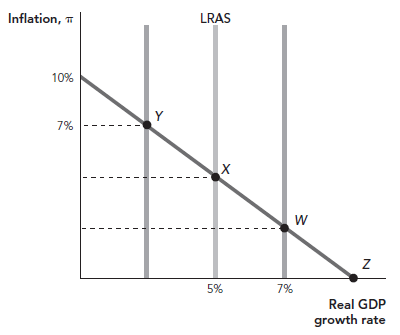
From point X in the accompanying graph, a negative real shock could cause the economy to move to point
Y
What causes a shift in the short-run aggregate supply curve?
a change in the expected inflation rate
In the AD-AS model, what happens to the economy in the short run when consumer spending decreases?
Inflation is lower, and the real growth rate is lower
From an initial equilibrium in the AD-AS model, an increase in consumption growth will initially cause inflation
and real growth to increase
The Fed is the “lender of last resort” because it
lends to financial intermediaries during financial crises
The goal of an open market sale by the Federal Reserve is to
reduce bank reserves and reduce the money supply
Open market operations involve the Federal Reserve
buying and selling government bonds
In the AD-AS model, an increase in the growth rate of the money supply will cause the growth rate of real GDP to increase in
the short run
When aggregate demand decreases, the Fed will want to use its policy tools to
restore aggregate demand to its original level
Deflation is a(n)
negative inflation rate
Disinflation is a(n)
decrease in the rate of inflation
In the short run, a negative real shock will cause the inflation rate to
increase
A negative real shock will cause the economy’s
SRAS and LRAS curves to shift to the left
Monetary policy is
less effective in dealing with real shocks than with aggregate demand shocks
A progressive tax
places higher tax rates on people with higher incomes
The Federal Insurance Contributions Act taxes are paid to fund
Social Security and Medicare
Social Security and Medicare transfer wealth primarily to
the elderly
Social Security operates on a _____ basis
pay-as-you-go
The amount by which expenditures exceed revenue in a given year is known as _____. The total amount owed is the total _____.
a deficit; debt
Suppose the federal government incurred a $1 billion deficit in 2011. What was TRUE of the national debt?
The national debt increased by $1 billion
The annual difference between federal spending and revenues is called the
national deficit
What kind of rising costs will mostly cause US government spending to skyrocket in the future?
health care
The US individual income tax system can BEST be described as a _____ tax system.
progressive
The FICA tax burden is
borne more by the employee even though the employer contributes an equal dollar amount
Fiscal policy involves _____ and is designed to influence business cycle fluctuations.
taxation, government spending, and borrowing
Which of the following fiscal policy action would be MOST effective at fighting a recession if people react to uncertainty by saving all additional money that they earn or receive?
an increase in government spending
To the extent that people behave according to Ricardian equivalence, fiscal policy
is overall less effective
Which of the following is an example of crowding out?
An increase in government spending is partially offset by a decrease in private spending
Crowding out
is the decrease in private spending that can occur when government spending increases
When expansionary fiscal policy increases household income and thus consumer spending, the resulting additional increase in aggregate demand is called the
multiplier effect
An automatic stabilizer is a
government program that is designed to stimulate aggregate demand during recessions without the need for specific actions by policymakers
Fiscal policy is a good option for stimulating the economy when
consumer spending is very low
Fiscal policy is
less effective in dealing with real shocks than with aggregate demand shocks
Which of the following is an example of a “common sense” fiscal policy?
increasing government spending during an expansion