Lec. 5 antibody structure & function
 Call Kai
 Learn
Learn Practice Test
 Spaced Repetition
 Match
Match Flashcards
 Knowt Play
1/45

Earn XP
Description and Tags
Exam 1
Name | Mastery | Learn | Test | Matching | Spaced | Call with Kai | Chat |
|---|
No analytics yet
Send a link to your students to track their progress
46 Terms
What are the 5 antibodies?
IgM, IgD, IgE, IgG, IgA
What two antibodies are also B cell receptors?
IgM & IgD
Antibodies are a 4-chain polypeptide that are held together by disulfide interchain bridges. What two regions does the antibody have?
Variable region - Fab
Constant regions (3-4) - Fc
An antibody has a Fab and Fc region. What do these regions do?
Fab: attaches to antigen in serum
Fc: bound to cell surface or (when floating) can bind compliment
How were the shapes of antibodies discovered? (2 methods, describe them both)
Papain: cleaves above the disulfide bond → creates 2 Fab fragments and 1 Fc fragment
Pepsin: cleaves below the disulfide bond → 1 F(ab’)2 fragment (Fab stays together) & 1 Fc’ (dysfunctional)
Antibodies consist of heavy and light chains. What are the domains of heavy chains called? The light?
Heavy chains: VH, CH1, CH2, CH3
Light chains: VL, CL
VDJ recombination determines if the Ig will be M,D,E,A or G. What chromosome is VDJ found on and what chain type does it affect on the Ig?
Chromosome 14 → affects heavy chain
VJ recombination determines the light chain of an Ig. What chromosomes does VJ recombination occur on?
Chromosomes 2 or 22
What is junctional diversity?
The recombination of VDJ & VJ with help of Rag 1 & 2
What is Somatic hypermutation?
Mutations occur to create a stronger antigen binding (affinity maturation). This leads to Ig class switching → only occurs after T cell help
Antibodies also have a hinge region. Where is this located on the antibody and what does the hinge allow for?
Located between CH1 & 2
Allows for flexibility b/c Fab regions can operate independently
Also allows for cascade signaling
What can the heavy chains of an Ig determine? What two types of light chains exist? Can light chains be mixed & matched?
Heavy chains determine the type of Ig
Lambda & kappa
Cannot be mixed & matched (i.e. lambda goes with lambda, kappa w/ kappa)
Antibodies have valency (how many Ag they can bind). What is the valence for IgG, IgA (in secretion and receptor), IgE, IgD, and IgM (in secretion)?
IgG: 2
IgA: 2, dimer/secretion 4
IgE: 2
IgD: 2
IgM: 10
What are Bence Jones Proteins? Where are they found?
Light chains that are over-produced by cancer plasma cells.
Found in urine (excreted)
What diseases can excess light chains be found in?
Multiple myeloma
Waldenstrom macroglobulinemia
Monoclonal gammopathy
Ig’s have carbohydrates. Where are they found and what is the purpose of them?
between CH2 and H chains
Functions: increases Ig solubility, protects from degradation, enhances activity of Fc
Define isotypes in reference to Ig
The constant region that determines the type of Ig produced (ex. creates IgG/M/D/E/A).
Identical in all people of the same species, different for other species
Define allotypes in reference to Ig
The minor genetic variation in the constant region of Ig (Fc) → differs among the species (acts like a genetic marker)
Define idiotypes in reference to Ig
Affects the variable (Fab) region → gives specificity for Ag binding
IgG is the most predominant in humans. What percentage is found in people? What are the main things IgG does? What can this antibody do that helps in lab testing?
77%
Binds compliment
neutralizes toxins & viruses by acting as an opsonin
Only Ig that can cross the placenta
Testing: can be precipitated and agglutinated
IgG has 4 subtypes. What percent of each subtype is found in the body? What are the functions of the subtypes? (only give % for IgG4)
IgG1: 66% → produced due to protein Ags
IgG2: 23% → fights polysaccharide Ags
IgG3: 7% → Best at compliment
IgG4: 4%
What subtypes of IgG are bad at activating compliment? What 3 subtypes can cross the placenta?
Bad at compliment: 2 & 4 due to short hinge
IgG1, 3, & 4: cross placenta
IgM can exist as a monomer (BCR) and a pentamer (in blood/secreted). What holds the pentameter together? What is the half-life of IgM?
J chain
6 days
What are the functions of IgM?
Activates compliment
agglutinates
Neutralizes bact. toxins & viruses → Acts as an opsonin
primary Ab response → diagnoses acute infection
IgD is a monomer. What is it’s half-life, what is it susceptible to, and what are it’s functions?
1-3 days
Proteolysis
Functions:
May play a role in B-cell activation'
Does nothing else
IgE is a monomer and most heat liable. What are it’s main functions?
Activates mast & basophils (to release their granules)
Binds to eosinophils to fight parasites
Allergy response
IgA is the first line of defense on what body surface? B/c of where they are found, what synthesizes IgA? It can be released as a monomer (BCR) or a dimer (secretion). How is the dimer held together?
Mucosal surfaces
Synthesized by MALT plasma cells
Held by J chain
IgA has 2 subtypes. What are their main functions?
IgA1: Anti-inflammatory → downregs. IgG mediated phagocytosis & cyto release
IgA2: Secreted in mucosa → found in resp. urogenital, & intestinal tract → 1st line of defense (breaks-down toxins & prevents bact. from sticking to mucosa to further enter body)
Can IgA help another person other than the person it comes from? What 2 things can it also do/act as?
Can be passed to baby via breastfeeding
Acts as an opsonin & can trigger alt. complement pathway
What Ig responds first to an infection? Which second? What about when there’s a second infection?
IgM responds first then IgG
2nd infection: IgM responds at the same rate and stays the same strength as the first time around, IgG responds stronger & faster
How do B cells become antibody-producing plasma?
B cell with specific BCR binds to their specific antigen then it differentiates into antibody plasma cell.
What are monoclonal antibodies? What are they used for?
Stem from B cells from the hybrid cell line, “hybridoma”
Used for lab testing & therapy
What is hybridoma production? Explain the process
How the B monoclonal antibody was made.
Mouse injected w/ specific antigen → harvest spleen cells → combine w/ PEG → select combo cells & test for desired Ab → grow Ab cells (harvest)
What are some test monoclonal Ab’s are used in?
Pregnancy tests
Tumors
Cancer therapy (ex. Herceptin, Rituxan - lymphoma)
Therapy for RA and Lupus (MAB)
What is Plasma cell dyscrasias? What is another name for this?
Diseases caused by proliferation of a single abnormal plasma cell w/ either M protein or paraprotein being overproduced.
Monoclonal gammopathies
What are some diseases that occur due to plasma cell dyscrasias? (Hint* 1 has 3 stages)
MGUS → smoldering multiple myeloma → multiple myeloma
Waldenstrom macroglobulinemia
heavy chain diseases
Explain the stages of disease for the monoclonal gammopathy for MGUS → smoldering multiple myeloma → multiple myeloma.
MGUS: precursor
present in 3-4% in those 50 and older
Makes one ab (<3.0 in serum)
Plasma count is <10% (normal is 2%) - overall, asymptomatic
Smoldering myeloma: intermediate stage
Plasma cell makes either IgG or IgA (≥3)
Plasma cells are 10-60% of bone marrow cells
Still asymptomatic but within 5 years, 10% people will have plasma cell malignancy
Multiple myeloma: Active stage (malignancy/cancer of plasma cells)
plasma cells are CD38+, CD56+, & CD138+
Plasma cells make up 10% bone marrow cells (or more)
Single Ig is in serum or urine (>3)
CRAB features
C: hypercalcemia
R: Renal failure (due to extra protein)
A: Anemia
B: Bone lesions
What Ig is the most common for multiple myeloma? What are the other two that can be present?
IgG common (~50%)
IgA or light chains (only in urine)
Waldenstrom Macroglobulinemia (lymphoplasmatic lymphoma) is another disease of plasma cell dyscrasias. Explain what this disease is/what happens. Also list some of the symptoms
B cells or plasma only make IgM → infiltrates BM, spleen & lymph nodes
CD19+, CD20+, CD22+, CD79a+
IgM can clump in cold weather = cold agglutinins
Bence jones in 10% of cases & cryoglobulins in 10-20%
Symptoms: anemia, fatigue, bleeding, plasma hyperviscosity
Heavy chain diseases are another disease caused by plasma cell dyscrasias. Explain what this diseases is/what happens.
B cell lymphoma → produced monoclonal heavy chains
alpha heavy chain is most common (Mediterranean region) → MALT
Gamma heavy chain in localized forms
Mu heavy chains usually resemble CLL
How are immunoproliferative diseases usually identified? (hint* what tests?)
CBC + diff. & immunophenotyping
serum protein electrophoresis (checks Ig)
Immunofixation electrophoresis on serum & urine (checks Ig)
immunosubtraction (checks Ig)
Serum free light chain analysis (sFLC)
cytogenetics & molec. testing
One way to check for immunoproliferative diseases is by doing immunophenotyping via flow cytometry. How does this work?
Checks cell srfc marker expressions
fluorescent Ab is added to sample and flow cytometer is used to check for binding
Can identify abnormalities if a cell gains or losses a normally expressed Ag.
Serum Protein Electrophoresis (SPE) is another way to check for immunoproliferative diseases. How does this test work?
Checks for monoclonal Ig’s but does not inform of specific Ig
Serum proteins separate out by size & charge
All Ig’s like to move to gamma region (to the right) - usually forms a “hill”
Monoclonal Ig forms a spike in that region
Immunofixation electrophoresis (IFE) can also identify immunoproliferative diseases. How is this test read?
A normal row will have blue gradient for each strip. An abnormal test will have a sharp blue line - this will indicate what heavy chain and what light chain is causing the issue.

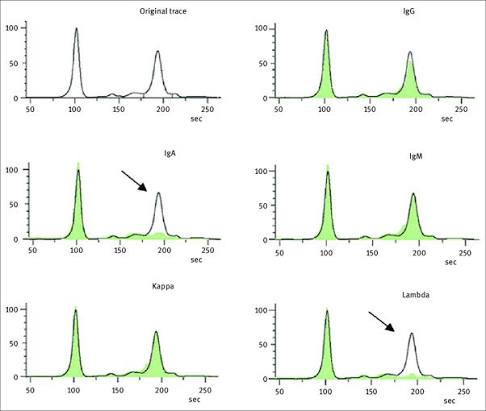
Immunosubtraction (immunotyping) is also used to identify immunoproliferative diseases. Explain how it works.
Capillary electro is used to check for monoclonal Ig
Antisera is added to patient serum
If antisera binds to a monoclonal Ig, peaks in the chart will disappear
In the picture the patient is green → the line is control
Patient green peak disappeared in kappa and lambda
Serum free light chain analysis (sFLC) is another way to check for immunoproliferative disease. What does it specifically measure and what does the ratio need to be to be normal?
Measures light chains (kappa and lambda)
K:L is 0.26-1.65
If ratio is not in range, there is indication of plasma cell malignancy (cancer)