urinary system
 Call Kai
 Learn
Learn Practice Test
 Spaced Repetition
 Match
Match Flashcards
 Knowt Play
1/25

There's no tags or description
Looks like no tags are added yet.
Name | Mastery | Learn | Test | Matching | Spaced | Call with Kai | Chat |
|---|
No analytics yet
Send a link to your students to track their progress
26 Terms
The kidneys
Filter blood to remove waste (urea creatinine excess ions
Maintain fluid, electrolyte, and acid–base balance.
Produce hormones (erythropoietin → RBC production, renin → blood pressure regulation).
Renal Cortex
The outermost part contains portions of the
functional units called nephrons,
where initial stages of filtration occur.
Renal Medulla
The inner part contains cone-shaped
structures (renal pyramids) that create urine
through reabsorption & secretion.
Renal Pelvis
Funnel Shaped collects urine and channels into ureter
Ureters
Muscular tubes that transport urine from kidneys to bladder vi peristalsis
Urinary bladder
Muscular sac that serves as a reservoir for urine, storing it until the body is ready for its elimination
Urethra
Tube that carries urine from the bladder to the outside of the body during urination
Renal artery
Carries oxygenated blood from the heart (via the aorta) into the kidneys for filtration
Renal Vein
Drains deoxygenated, filtered blood from the
kidneys and returns it to the inferior vena cava.
P-Waste
Pressure control
Water balance
Acid base balance
Salt balance
Toxin removal
Erythropoiesis regulation
Pressure control
Kidneys regulate blood pressure
via the renin–angiotensin–
aldosterone system (RAAS), ADH,
and sodium/water balance.
Water balance
Adjusts water reabsorption in
nephrons; ADH increases water
reabsorption → concentrated
urine, while low ADH → dilute urine.
Acid Base Balance
Maintains blood pH by excreting hydrogen ions (H⁺) and reabsorbing bicarbonate (HCO₃).
Toxin Removal
Eliminates nitrogenous wastes (urea, uric acid, creatinine) along
with drugs and other metabolic byproduct
Erythropoiesis regulation
Kidneys release erythropoietin, stimulating red blood cell production in bone marrow when oxygen is low.
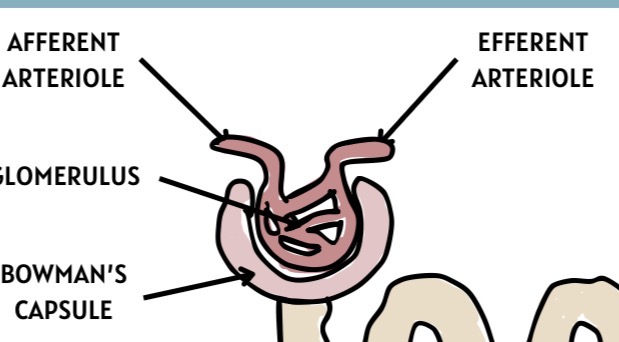
Afferent Arteriole (arrives)
Brings blood into the glomerulus: larger diameter → higher pressure for filtration
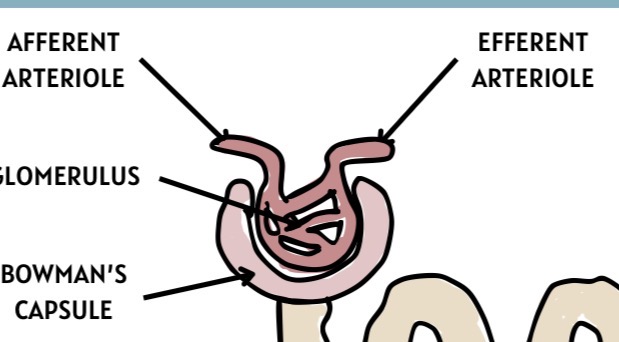
Efferent Arteriole (exits)
Carries blood out of the glomerelus smaller diameter → maintains pressure and leads to peritubular capillaries

Bowman’s Capsule/ Glomerulus
What it is: Filtration unit; glomerulus = capillary tuft,
Bowman
’
s capsule surrounds it.
What happens: Filtration of water, ions, glucose, amino
acids, and wastes (urea, creatinine).
Key Point: Large proteins and blood cells stay in the blood

Proximal Convulated Tubule
What it is: First tubule after Bowman’s capsule; lined with
microvilli and aquaporins for massive reabsorption. Reabsorbed: ~65% of water, glucose, amino acids, sodium, chloride, bicarbonate. Secreted: Hydrogen ions (H⁺), ammonia, and some drugs.
Descending thin limb of loop of henle
What it is: Highly permeable to water, but not to solutes.
Reabsorbed: Water (passive osmosis into hypertonic medulla).
Secreted: None.
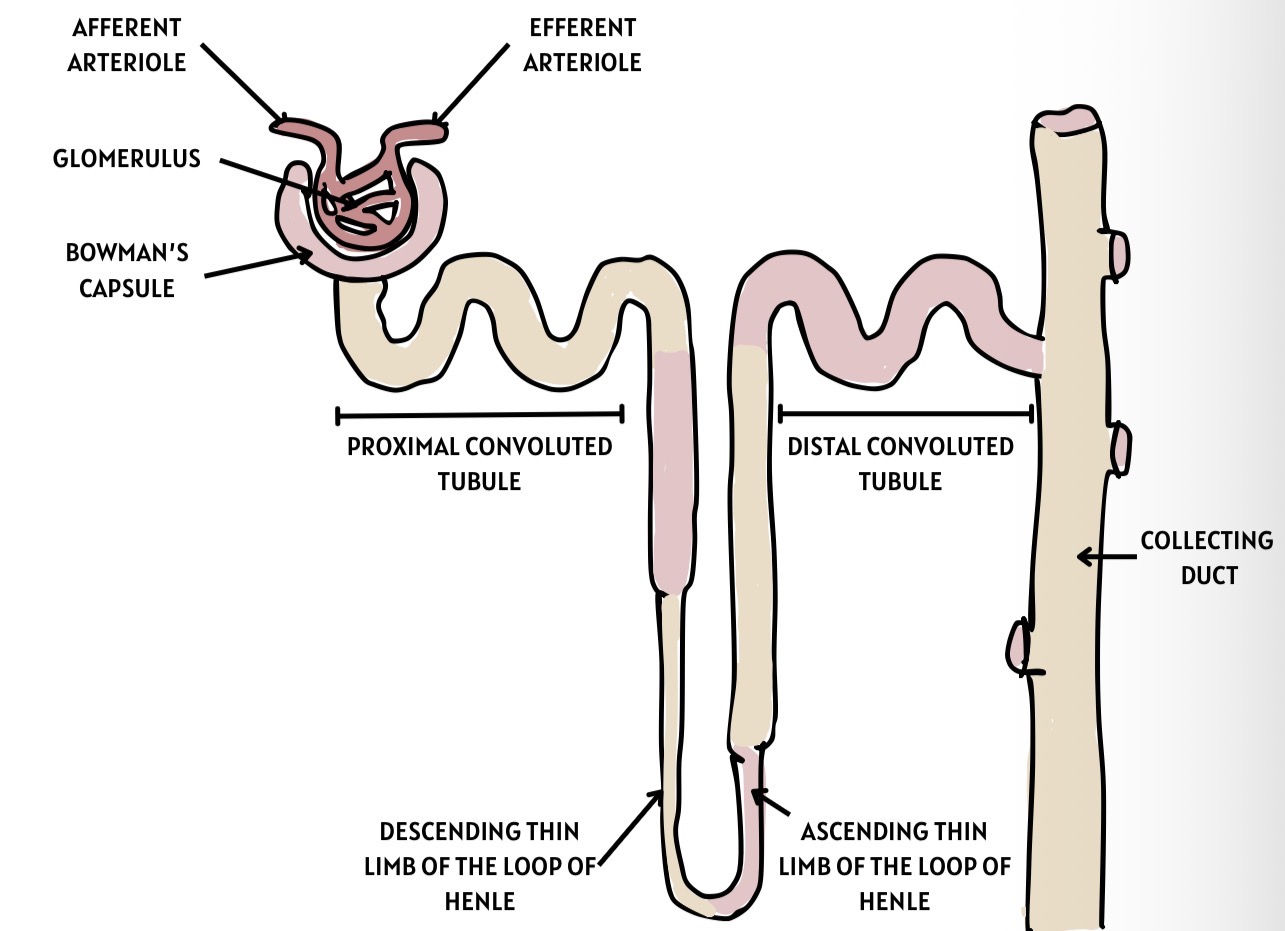
Ascending loop of henle
What it is: Impermeable to water; permeable to solutes.
Reabsorbed: Sodium, potassium, and chloride are
actively transported out.
Secreted: None.

Distal convulated tubule
What it is: Hormone-sensitive segment.
Reabsorbed: Sodium (via aldosterone),
calcium (via PTH), water (if ADH present).
Secreted: Potassium (K⁺), hydrogen ions (H⁺).
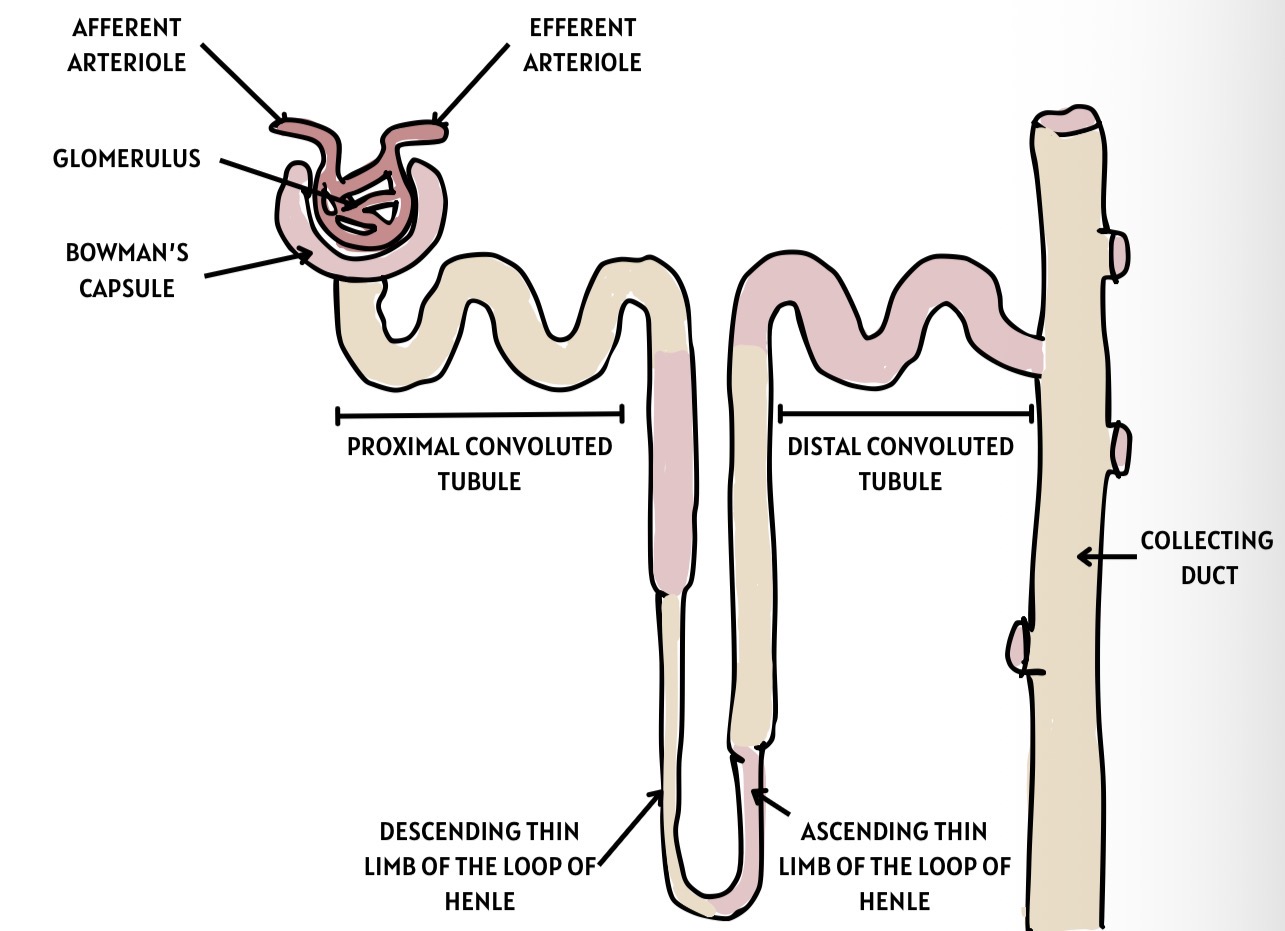
Collecting Duct
What it is: Final urine concentration site; shared by multiple nephrons (hormone controlled)
Reabsorbed: Water (regulated by ADH), urea
(helps medullary gradient).
Secreted: Hydrogen ions (H⁺), potassium (K⁺).
Filtrate
Filtrate is a fluid that has been processed by the glomerulus
through glomerular filtration. It contains water, glucose, amino
acids, urea, & various ions thathave been forced from the blood
into the Bowman's capsule due to pressure. This forms the initial
step of urine production.
Reabsorption
Process that occurs primarily in the
proximal convoluted tubule, loop of
Henle, and distal convoluted tubule
of the nephron, where useful
substances present in the filtrate,
such as water, glucose, and
essential ions, are returned into the
bloodstream. This helps the body to
retain necessary substances and
regulate its fluid balance.
Secretion
Selective transport of certain substances from the blood back
into the tubules of the nephron. Primarily takes place in the distal convoluted tubule and collecting duct. The kidneys excrete
substances like hydrogen ions and potassium ions, thus playing an essential role in maintaining the body's pH balance and electrolyte homeostasis.