Supply Chain management unit 1
 Call Kai
 Learn
Learn Practice Test
 Spaced Repetition
 Match
Match Flashcards
 Knowt Play
1/35

There's no tags or description
Looks like no tags are added yet.
Name | Mastery | Learn | Test | Matching | Spaced | Call with Kai | Chat |
|---|
No analytics yet
Send a link to your students to track their progress
36 Terms
Five Major External Forces - GLOBALIZATION
Globalization creates more economic and political risk, shorter product life cycle, and the blurring of traditional organizational boundaries.
Five Major External Forces - GLOBALIZATION, Why Global?
Reach different sources of supply
Reach more customers
Take advantage of cost
differences
Five Major External Forces - GLOBALIZATION, Resulting Challenges
Communication issues
Currency fluctuation
Political instability
Longer lead-times
Nationalist backlash
Five Major External Forces - TECHNOLOGY
Technology is a facilitator of internal process and supply chain transformation. It is also a major force in changing the dynamics of the marketplace.
Five Major External Forces - TECHNOLOGY, The internet
“Connected” 24/7
Five Major External Forces - TECHNOLOGY, Social networks
Impact on customer demand and the speed of information transfers
Five Major External Forces - TECHNOLOGY, Optimization
Technology helps us design and run supply chains more effectively
Five Major External Forces - TECHNOLOGY, Robotics
Assist, and in some cases, replace human workers with robots
Five Major External Forces - TECHNOLOGY, A.I
Major game-changer…just wait!
Five Major External Forces – ORGANIZATIONAL CONSOLIDATION
During the 1980s and especially the 1990s, economic power and the driving force in supply chains shifted from product manufacturers to the retail end of the supply chain. Now, there is a balance in power and emphasis on collaboration.
Five Major External Forces – ORGANIZATIONAL CONSOLIDATION, (More collaboration among organizations in supply chains)
Win-win, improved services such as:
Scheduled deliveries
“Rainbow” pallets
Advance shipments notices (ASNs)
Shrink-wrapped pallets
Sharing of point-of-sale data to mitigate
“bullwhip effect”
Five Major External Forces – EMPOWERED CONSUMER
Consumers are empowered by exponentially expanded access to product sources and related information and increased buying power due to high income levels.
Five Major External Forces – EMPOWERED CONSUMER, (Increased pressures on supply chain due to increased demands at the retail level in terms of)
Competitive prices
High quality in products and services
Tailored or customized products
Convenience and responsiveness – 24/7 availability with
a minimum of wait time
Flexibility – Omnichannel distribution strategies
Deliver when and where I want!
I’ll return it for ANY reason!
Five Major External Forces – GOVERNMENT POLICY & REGULATION
More competitive environment is a result of the deregulation of several important sectors in the United States that occurred in the 1980s and 1990s.
Five Major External Forces – GOVERNMENT POLICY & REGULATION, The transportation industry.
Allowed price competition.
Expanded services beyond transportation, with providers evolving to outsourcing. Airlines – 1978; Trains and Trucks – 1980.
Five Major External Forces – GOVERNMENT POLICY & REGULATION, The financial sector.
More flexible and responsive to customer needs, making businesses more cognizant of supply chain management impact on efficiency and cash flow. Banking – 1999.
Five Major External Forces – GOVERNMENT POLICY & REGULATION, The communications industry.
A component of the information revolution, leading to dramatic improvements and opportunities in supply chains. Telecom – 1996
Five Major External Forces – GOVERNMENT POLICY & REGULATION, The healthcare industry.
Government response to Covid-19 turned the supply chain world upside down! Covid-19 – 2020.
Five Major External Forces – GOVERNMENT POLICY & REGULATION, Trade Wars.
Global trading lanes and economics up in the air due to US-initiated trade negotiations. NAFTA – 1992; USMCA – 2020; Negotiations now – 2025 and 2026.
Five Major External Forces
• These forces acting on your supply chain are
relentless and ever-changing
• It may seem overwhelming to you now
• As you learn more about supply chain
management you will see how executives
tackle these issues
• Despite the challenges, supply chain
executives achieve great operating
performance and help their companies
achieve great financial results in the market!
• As a supply chain manager, you will play a
role in managing and solving many
challenges like these.

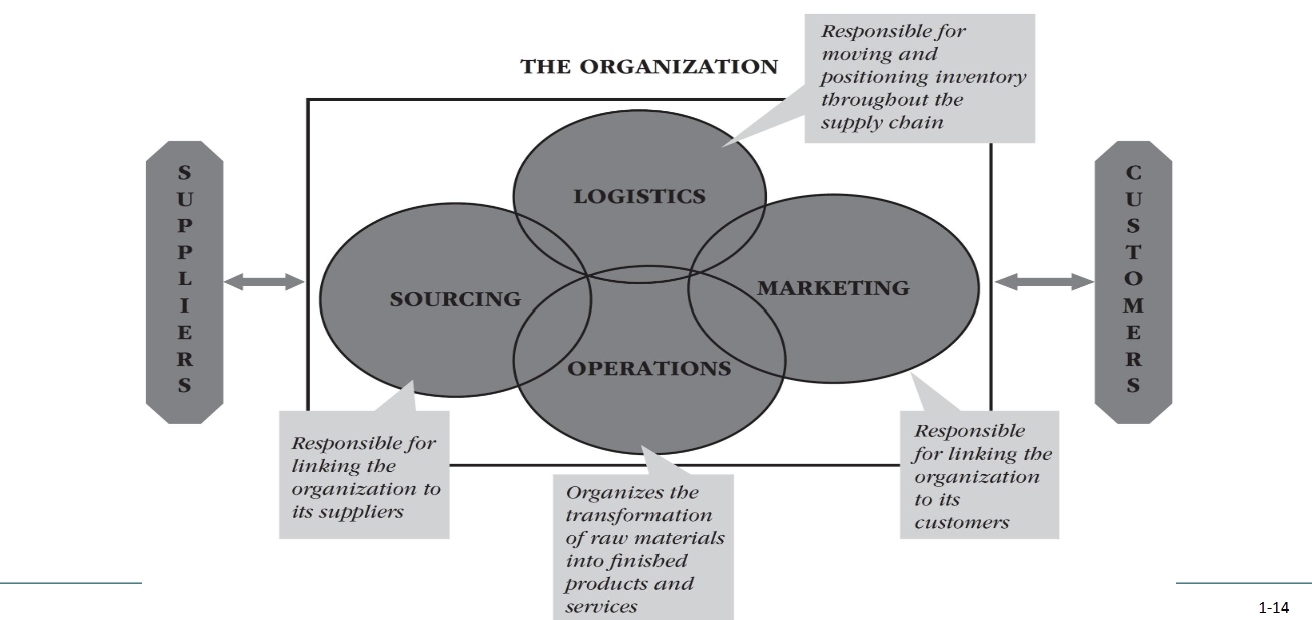
Organizational Integration of Enterprise Functions (How do the main functions of an organization work together in the supply chain?) TESTED
Sourcing connects the organization to suppliers, operations transform raw materials into finished products or services, logistics moves and positions inventory throughout the supply chain, and marketing connects the organization to customers. These functions overlap because they must collaborate to move products from suppliers through the organization to customers.
A Simple Supply Chain
Supply chain management (SCM) is the design and management of flows of products, information, and funds throughout the supply chain A supply chain is the network of all entities involved in producing and delivering a finished product to the final customer

The Bullwhip Effect
• A supply chain is composed of many
different companies, each with their
own objectives
• Fluctuation and distortion of
information increase as it moves up the
supply chain
o This is called the bullwhip effect
• The longer the supply chain, the greater
the opportunity for the bullwhip effect
• The way to combat the bullwhip effect
is to share point-of-sale information
with all members of the supply chain
Major Issues in Supply Chain Management, Supply Chain Network
The challenges
Network system (facilities and
supporting transportation
services) must be capable and
flexible to respond and
change with market
dynamics.
Major Issues in Supply Chain Management, Complexity
The challenges
Increased requirements in
simplifying and
continually evaluating
areas of complexity in the
various aspects of supply
chains
Major Issues in Supply Chain Management, Inventory Deployment
The challenges
Increased requirements for
coordination or integration
to reduce inventory levels on
horizontal (single-firm) and
vertical (multiple-firms)
levels in the supply chain.
Major Issues in Supply Chain Management, Information
The challenges
The sharing of information
along the supply chain
The discipline to ensure the
integrity of the vast amount of
data collected and stored
Major Issues in Supply Chain Management, Cost and Value
The challenges
Striking the right balance
between cost and value
The prevention of sub-
optimization.
Major Issues in Supply Chain Management, Organizational
Relationships
The challenges
Internal collaboration
(marketing, sales, operations,
finance, etc.)
External collaboration
(vendors, customers,
transportation companies,
3PLs)
Major Issues in Supply Chain Management, Performance
Measurement
The challenges
Connecting lower-level
metrics in an organization
directly to the high-level
performance measures of the
organization and the supply
chain
Major Issues in Supply Chain Management, Technology
The challenges
Evaluate, strategically plan,
and successfully implement
the technology to make the
improvements desired
Major Issues in Supply Chain Management, Transportation
Management
The challenges
Transport “perfect storm.”
Transport market changes;
driver shortages; equipment
shortages; fuel costs;
infrastructure constraints; and
regulatory changes
Major Issues in Supply Chain Management, Supply chain security
The challenges
Risk of disruptions, vulnerability, and
exposure to terroristic threats
exacerbated by distance and
complexity in global supply chain
Major Issues in Supply Chain Management, Talent management
The challenges
Attract, develop, and maintain the
appropriate pool of talent from
entry level to executive level
Characteristics of a Competitive Supply Chain
1. Responsiveness: The ability to respond to customers’
requirements in ever-shorter time frames has become critical.
2. Reliability: Supply chain coordination and sharing of real-time
data and information through information technology has
resulted in greatly improved supply chain reliability. Without
real-time visibility, supply chain disruptions occur.
3. Relationship Management: An important characteristic of
competitive supply chains is their focus on relationship building
and collaboration, rather than the arm’s-length adversarial
relationships that had been dominant in the past.
Gartner “Difference-Makers” in the Supply Chain Game
•Autonomous operations help supply chain organizations create
value and mitigate risk – “According to the 2025 Gartner CEO and Senior Business Executive Survey, within 3 years we will see a shift to 100% automated systems and processes operated without human involvement across many areas”
•Agentic AI introduces a new dimension of supply chain
transformation – “equipped to conduct complex tasks in dynamic environments”
•Leading supply chains are differentiated by well-defined water
stewardship strategies – “Leading companies demonstrate their leadership by integrating water considerations into strategic decisions like site selection and supply chain design.” Issues: droughts, contamination, restrictions, inflated costs, increased demand especially due to data center growth