- Economics 17
 Call Kai
 Learn
Learn Practice Test
 Spaced Repetition
 Match
Match Flashcards
 Knowt Play
1/19

Earn XP
Description and Tags
2/12/25 Regulation Pt 2 - 8/12/25 Government Intervention - 9/12/25 Taxes
Name | Mastery | Learn | Test | Matching | Spaced | Call with Kai | Chat |
|---|
No analytics yet
Send a link to your students to track their progress
20 Terms
Define price floors (a.k.a minimum price)
Keep the price above a certain point, below which it is illegal to trade.
What is the main common purpose of price floors
To increase the price of demerit goods
Is a price floor set above or below the free market price
ABOVE
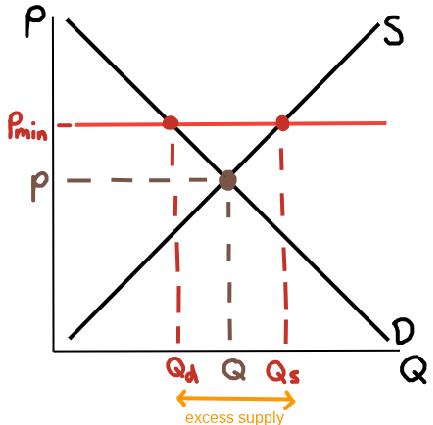
Show a price floor
PQ to PminQd, PminQs
List the advantages of price floors (2)
Ensures fair price for producers, and guarantees supply (“food security”).
If the price is correct for demerit goods, the higher price can internalise the externality.
List the disadvantages of price floors (3) (min.2)
Overproduction (surplus) of the good/service, which leads to wastage.
For demerit goods (inelastic PED), unlikely to have much change on quantity demanded.
Extra cost for the government, because they have to purchase the excess.
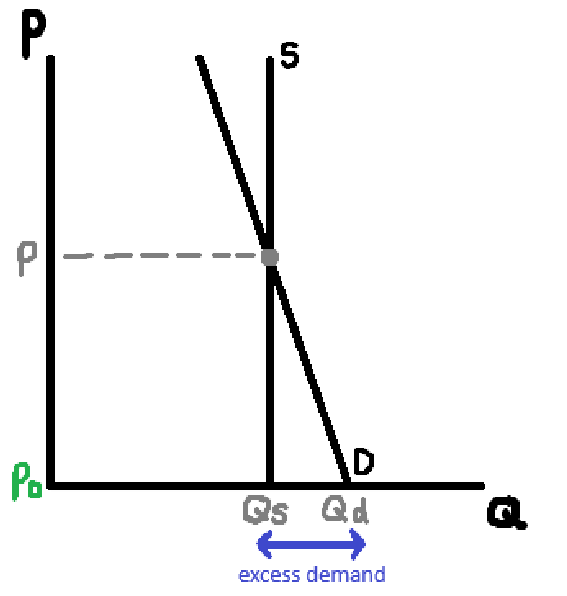
Define direct provision
When the government directly provides a good or service, using tax payers’ money.
List examples of where direct provision is used (min. 2)
Bridges/roads
Public services
NHS
Police
Show direct provision
Define Pro-Free market economists
Economists who believe the free market mechanism works efficiently.
Define Interventionist economists
Economists who believe that too often, markets are uncompetitive and are prone to market failure.
Define indirect tax (again)
A tax on a good or service, rather than income or profits.
Name the two types of indirect tax
Specific
Ad Valorem
Define Specific tax
Fixed amount of tax per unit (e.g. tax on fizzy drink is 30p per unit)
Define Ad Valorem
Taxes charged as a proportion of the price (e.g. VAT is 20% of price).
List the objectives of indirect taxation (3)
Discourage the production/consumption of goods with negative externalities, and produce/consume at the social optimum output.
Internalise the externality, by making economic agents who benefit from the good/service account for the true cost to society.
Use the taxation revenue to offset the effects of the externalities.
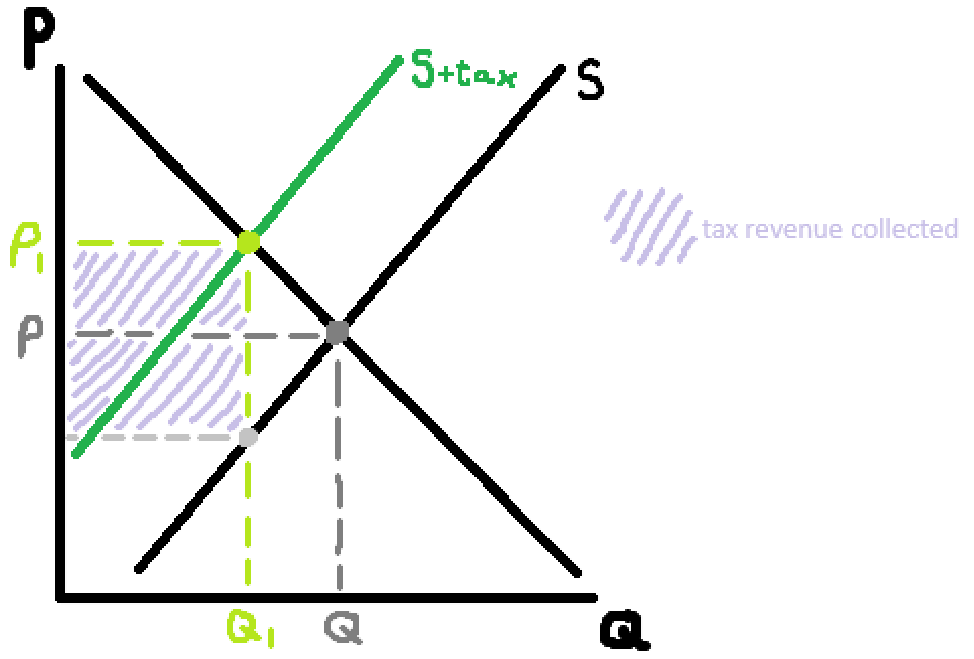
Show an indirect tax
List the 5 STAGES of how indirect taxes work
Tax duty increases cost per unit produced (affects the s curve).
Cost of production (CoP) increases, so S curve shifts to the left - profit incentive reduced.
Equilibrium price INCREASES and output DECREASES.
Vertical distance between S curves is the tax per unit.
Shaded area is the total tax collected by the government.
Define incidence of tax
The proportion of tax that is passed on to the consumer.
Regarding PED, what do producers have to consider when determining the greatness of the incidence of tax to pass on
Producers have to consider the good’s elasticity:
ELASTIC) pass on low to none, as it would have a huge impact on qd.
INELASTIC) can pass the entirety of it, as it will have little impact on qd.