bio mod 4
 Call Kai
 Learn
Learn Practice Test
 Spaced Repetition
 Match
Match Flashcards
 Knowt Play
1/86

There's no tags or description
Looks like no tags are added yet.
Name | Mastery | Learn | Test | Matching | Spaced | Call with Kai | Chat |
|---|
No analytics yet
Send a link to your students to track their progress
87 Terms
potential energy
in cells this is stored as chemical bonds, concentration gradients or charge imbalance
kinetic energy
energy in motion
covalent bonds
these bonds store potential energy the amount of which reflects the positions of the electrons in the bond
non-polar bonds
Store more potential energy since electro negative atoms are stabilized by the opposing positive nucleus so they have less potential energy.
entropy
the measure of disorder/randomness in a system unless energy is applied to a system it tends toward disorder → it requires energy to impose order on a system
Gibbs Free energy equation
Δ𝐺=Δ𝐻−𝑇Δ𝑆 where total energy=Enthalpy (H), Usable energy=Free energy (G), Temperature C+273(T), Entropy (S)
Enthalpy
is the total number of heat content in a thermodynamic system
Exerogenic
A chemical reaction where the change in the free energy is negative (Delta G < 0), meaning energy is released.
ATP hydrolysis
more likely to be couple with exergonic
ATP formation
type of reaction associated with endergonic reactions
active site
a substrate binds toa physical location on an enzyme called the
enzymes
what class of biological molecule might be a cellular catalyst
relationship between enzymes
increases the rate at which a reaction reaches equilibrium by lowering activation energy.
enderogonic
a non-spontaneous chemical process that requires the absorption of free energy from its surroundings to proceed, resulting in a positive change in Gibbs free energy (Δ𝐺>0)
activation energy
(𝐸𝑎) is the minimum energy required to initiate a chemical reaction, acting as a potential barrier between reactants and products. Enzymes lower activation energy by forcing substrates to adopt transition states
transition states
contorted configuration of reactions that allows bonds to be made and broken
induced fit
an active site changes shape when a substrate binds, maximizing the enzyme function. The enzyme maintains the same chemical reaction before and after catalysis E+S→ES→E+P
hydrogen and covalent bonds
enzymes are held together by
how do enzymes lower activation energy
An enzyme binds tightly to one or more molecules and holds them in a precise configuration that LOWERS the ACTIVATION ENERGY.
coenzymes
also known as cofactors non-protein, organic molecules—often derived from vitamins—that bind to enzymes to facilitate catalytic reactions, essential for metabolism
prosthetic groups
non-protein, tightly bound organic or inorganic molecules (such as metal ions, heme, or vitamins) that are essential for the biological function of enzymes and proteins.
irreversible inhibitor
inhibitor molecules covalently bond to the active site which permanently inactivates it
reversible inhibition
inhibitor bonds non covalently to the active site and prevents the substrate from binding
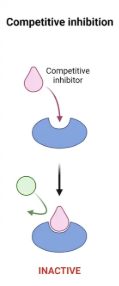
competitive inhibitor
compete with the neutral substrate for binding sites, binds before substrate. Slow down reaction rate but do not affect the maximal rate (v max). They have a very similar structure to the enzyme substrate
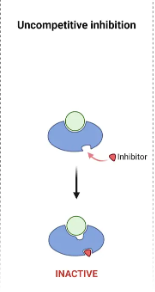
uncompetitive inhibitor
binds to the enzymes substrate complex, preventing the release of products. Binds AFTER substrate binds
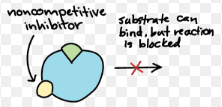
noncompetitive inhibitors
bond to the enzyme at a different site
allosteric regulation
a non substrate molecule binds to the enzyme at a site different form the active site, which thereby changes the shape turning the enzyme on or off
catalytoc subunits
contain the active site
allosteric activator
a molecule that binds to an enzyme at a site other than the active site (the allosteric site), causing a conformational change that increases the enzyme’s affinity for its substrate.
allosteric activator
molecule that binds to an enzyme at a site other than the active site (the allosteric site), causing a conformational change that increases the enzyme’s affinity for its substrate
allosteric inhibitor
a molecule that binds to an enzyme or protein at a site other than the active site (the allosteric site), inducing a conformational change that reduces or halts the protein's activity.
regulatory subunits
a protein component of a multi-subunit complex that binds to, modifies, or controls the activity of a catalytic subunit, often in response to cellular signals. in allosteric regulation, inhibitor and activators bond on regulatory sites on polypeptides
substrate
the base layer, surface, or underlying material upon which an organism lives, a chemical reaction occurs, or a manufacturing process takes place
feedback inhibition
the product of a metabolic pathway turns the pathway off by inhibiting an upstream enzyme that carries out the step that commits the substrate
glucose catabolism
incrementally strip c of non polar bonds (h and C) replacing them with polar bonds o=c=o.
the metabolic breakdown of glucose () to produce energy (), typically involving glycolysis, the citric acid cycle, and oxidative phosphorylation. It oxidizes glucose into and , releasing energy to synthesize ATP.
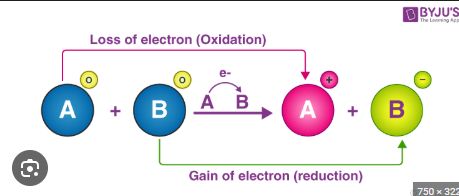
oxidization reduction reactions
chemical processes involving the transfer of electrons between species, characterized by changes in oxidation numbers
cellular respiration
the essential metabolic process wherein cells convert biochemical energy from nutrients (primarily glucose) into adenosine triphosphate (ATP), releasing waste products like carbon dioxide and water
glycolyosis
a series of chemical rearrangements in which glucose is converted to two molecules of pyruvate
pyruvate
the essential, three-carbon end product of glycolysis that links sugar metabolism to cellular energy production
net product of glycolysis
2 atp 2 nadh 2 pyruvate
5 principles of metabolic pathways
(1) comp[lex transformations occur in a series of metabolic reactions. (2) each reaction is catalyzed by a specific enzyme (3) many metabolic pathways are compartmentalized by specific organelles . (4) many metabolic pathways are similar in organisms (5) key enzymes can be inhibited or activated to alter the rate of the pathway
NAD+ becomes NADH
through a reduction reaction, where it accepts two electrons and one proton (hydride ion) during metabolic processes like glycolysis and the Krebs cycle
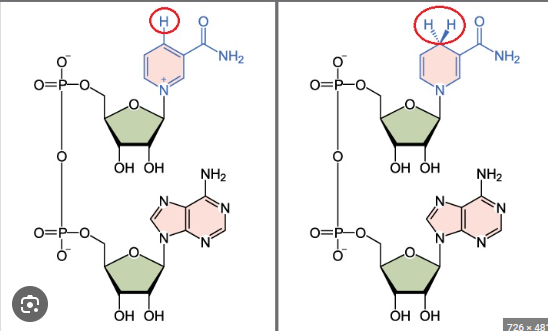
NAD
a vital coenzyme found in all living cells, serving as a key molecule for energy metabolism (converting food to energy), DNA repair, and cell signaling
NADH
the reduced, energy-carrying coenzyme form of NAD+
less
the more oxidized a molecule the ___ energy it stores
reducing agent
substance that loses electrons and causes the reduction of another species in a redox reaction
oxidizing agent
a substance that facilitates oxidation by accepting electrons from another species in a redox reaction, becoming reduced in the process.
oil rig
oxidiation
is
loss of electrons
Reduction
is
gain
Anabolism
Pathways that consume energy to build complex molecules (e.g., photosynthesis).
Catabolism
Pathways that release energy by breaking down complex molecules
Substrate-Level Phosphorylation
The direct transfer of a phosphate group from a substrate to ADP (occurs in glycolysis and the Citric Acid Cycle).
Glycolysis
The first stage of cellular respiration occurring in the cytosol. It involves the partial oxidation of one glucose molecule (6C) into two molecules of pyruvate (3C). Energy Phases: Consists of the Energy Investment Phase (requires ATP to rearrange glucose) and the Energy Payoff Phase (produces ATP and NADH).
Glycolysis Net Yield
2 Pyruvate
2 ATP (via substrate-level phosphorylation)
2 NADH
Pyruvate Oxidation
The process of converting pyruvate into Acetyl CoA before entering the mitochondrial matrix.
Steps: 1. A carboxyl group is removed (released as CO_2).
2. The remaining fragment is oxidized, and NAD^+ is reduced to NADH.
3. The oxidized fragment (acetyl) is attached to Coenzyme A.
Citric Acid Cycle
A series of reactions in the mitochondrial matrix that completes the breakdown of glucose by oxidizing Acetyl CoA to CO_2. Start/End Point: It begins when Acetyl CoA combines with Oxaloacetate. Because it is a cycle, oxaloacetate is regenerated in the final step.
FADH2
An electron carrier produced specifically in the Citric Acid Cycle. It is functionally equivalent to NADH but enters the electron transport chain at a lower energy level.
CAC yield
4 CO_2 (released as waste)
6 NADH
2 FADH2
2 ATP (or GTP): Note that ATP and GTP are functionally equivalent in the cell.
Electron Transport Chain (ETC)
Located in the inner mitochondrial membrane. NADH and FADH2 drop off their high-energy electrons here.
Chemiosmosis
As electrons move down the chain, they power "proton pumps" that push H^+ into the intermembrane space. This creates a gradient that flows back through ATP Synthase to generate roughly 26–28 ATP.
Oxygen's Role
the final electron acceptor. It grabs the spent electrons and H^+ to form H_2O. Without it, the whole chain (and the Citric Acid Cycle) stalls.
oxidative phosphorylation
the final, high-yield stage of cellular respiration in mitochondria, where NADH and 𝐹𝐴𝐷𝐻2 are oxidized to drive ATP synthesis. It involves electron transport through complexes (I-IV) to oxygen (the final acceptor), creating a proton gradient that powers ATP synthase to generate approximately 30-32 ATP per glucose
aerobic
environments containing free oxygen, essential for the survival of aerobic organisms and for driving processes like aerobic respiration, oxidation, and decomposition. 4 metabolic pathways open
anaerobic
environments lacking oxygen, characterized by low redox potential, where only organisms capable of surviving without oxygen (anaerobes) can thrive
electron transport chain
a series of protein complexes and electron carriers embedded in the mitochondrial inner membrane, crucial for cellular respiration. It accepts high-energy electrons from NADH and FADH2, passing them through redox reactions to pump protons r𝐻+) into the intermembrane space. electron carriers are oxidized and o2 is reduced.
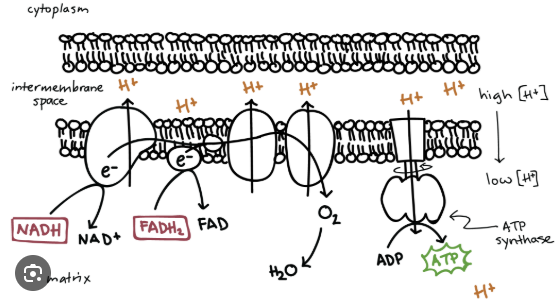
too much
passing electrons from glucose to o2 would result in ______ energy being released at once
I,II,III,IV
what are the names of the 4 large protein complexed that contain electron carriers and associated electrons that carry out electron transfer.
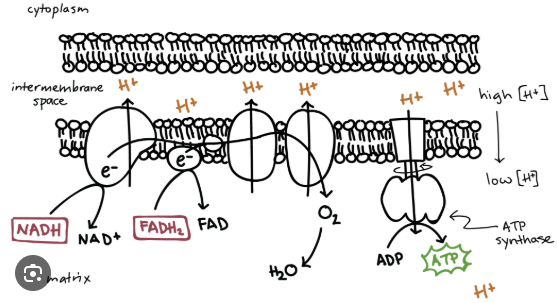
chemiosmotic theory
explains that ATP synthesis in cells is driven by an electrochemical gradient of protons (h+) across specialized membranes. Electron transport chains (ETC) pump protons across the mitochondrial or thylakoid membrane, creating a Proton Motive Force (PMF) that drives the enzyme ATP synthase to produce ATP
proton motive force
the electrochemical energy stored across a membrane—usually the mitochondrial inner membrane or bacterial membrane—as a proton () gradient. Generated by electron transport chains or ATPases, this "tiny battery" combines a pH gradient and electrical potential to drive ATP synthesis, molecular transport, and bacterial motility
ATP synthesis
this exists to create a universal, immediate energy currency that powers all cellular activities, such as muscle contraction, nerve impulses, and chemical synthesis.
reducing electron carriers
More free energy is harvested during the citric acid cycle than during glycolysis, but only 1 mole of ATP is produced for each mole of acetyl CoA that enters the cycle. Most of the remaining free energy released during the citric acid cycle is..
lactic acid fermentation
It begins with glycolysis, where one glucose molecule is broken down into two molecules of pyruvate, producing 2 ATP and 2 NADH. In the absence of oxygen, pyruvate is converted into lactic acid, and NADH is oxidized back into NAD+ raised to the positive power 𝑁𝐴𝐷+ to allow the cycle to continue.
mitochondrial uncoupler
a molecule that disrupts oxidative phosphorylation by dissipating the proton gradient across the mitochondrial inner membrane, reducing ATP synthesis efficiency and releasing energy as heat.
alcohol fermentation
s an anaerobic metabolic process where microorganisms, primarily yeast (Saccharomyces cerevisiae), break down sugars into ethanol and carbon dioxide to produce ATP energy. Occurring in the absence of oxygen, it acts as a crucial pathway for energy production, converting sugars such as glucose to alcohol, regenerating NAD+, and releasing heat, often utilized in brewing and baking
phosphofructokinase
a key regulatory enzyme in glycolysis, catalyzing the irreversible transfer of a phosphate group from ATP to fructose-6-phosphate to produce fructose-1,6-bisphosphate and ADP. It acts as the primary rate-limiting step, accelerating energy production when ATP is low and slowing it when ATP/citrate are high, essentially controlling the pace of glucose metabolism
catabolic interconversion
a metabolic process where complex molecules (carbohydrates, fats, proteins) are broken down into simpler ones, releasing energy stored as ATP.
beta oxidation
the metabolic process of breaking down fatty acids into acetyl-CoA in the mitochondrial matrix (and peroxisomes) to generate energy. It operates through a four-step cycle—oxidation, hydration, oxidation, and thiolysis—removing two-carbon units per cycle to produce energy-rich acetyl-CoA, NADH, and FADH2, mainly in the heart, liver, and kidney
anabolic interconversion
metabolic pathways that use energy (ATP) to convert small precursor molecules into larger, complex macromolecules, such as synthesizing proteins from amino acids or glycogen from glucose. These endergonic, building processes are essential for growth, repair, and tissue maintenance, acting as the reverse of energy-releasing catabolic reactions.
fatty acid biogenesis
the anabolic process of constructing fatty acids from acetyl-CoA, primarily occurring in the cytosol. Key steps include the rate-limiting carboxylation of acetyl-CoA to malonyl-CoA by acetyl-CoA carboxylase (ACC), followed by iterative condensation cycles catalyzed by fatty acid synthase (FAS), using NADPH as a reducing agent to form palmitate
Complex I (NADH: ubiquinone oxidoreductase)
Oxidizes to , transfers electrons to Coenzyme Q (ubiquinone), and pumps four protons () into the intermembrane space.
Complex II (Succinate dehydrogenase)
Oxidizes to and transfers electrons to Coenzyme Q. It is the only complex that does not pump protons, resulting in lower ATP yield from .
Complex III (Cytochrome complex)
Receives electrons from ubiquinol () and passes them to cytochrome c, while pumping four protons into the intermembrane space via the Q cycle.
Complex III (Cytochrome complex):
Receives electrons from ubiquinol () and passes them to cytochrome c, while pumping four protons into the intermembrane space via the Q cycle.
Complex IV (Cytochrome c oxidase)
Receives electrons from cytochrome c and transfers them to molecular oxygen (), the final electron acceptor, reducing it to form water () while pumping two protons across the membrane
Coenzyme Q
(Ubiquinone): Moves electrons from Complex I and II to Complex III.
Cytochrome C
Moves electrons from Complex III to Complex IV.