Chapter 03 - AP Environmental Science (Friedland)
 Call Kai
 Learn
Learn Practice Test
 Spaced Repetition
 Match
Match Flashcards
1/51

There's no tags or description
Looks like no tags are added yet.
Name | Mastery | Learn | Test | Matching | Spaced | Call with Kai | Chat |
|---|

52 Terms
Biosphere
The region of our planet where life resides, the combination of all ecosystems on Earth.
Producer
An organism that uses the energy of the Sun to produce usable forms of energy. Also known as Autotroph.
Autotroph
An organism that uses the energy of the Sun to produce usable forms of energy. Also known as Producer.
Photosynthesis
The process by which producers use solar energy to convert carbon dioxide and water into glucose.

Cellular respiration
The process by which cells unlock the energy of chemical compounds.
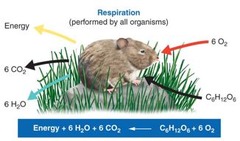
Aerobic respiration
The process by which cells convert glucose and oxygen into energy, carbon dioxide, and water.
Anaerobic respiration
The process by which cells convert glucose into energy in the absence of oxygen.
Consumer
An organism that is incapable of photosynthesis and must obtain its energy by consuming other organisms. Also known as Heterotroph.
Heterotroph
An organism that is incapable of photosynthesis and must obtain its energy by consuming other organisms. Also known as Consumer.
Herbivore
A consumer that eats producers. Also known as Primary consumer.
Primary consumer
A consumer that eats producers. Also known as Herbivore.
Carnivore
A consumer that eats other consumers.
Secondary consumer
A carnivore that eats primary consumers.
Tertiary consumer
A carnivore that eats secondary consumers.
Trophic levels
The successive levels of organisms consuming one another.
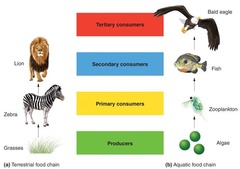
Food chain
The sequence of consumption from producers through tertiary consumers.
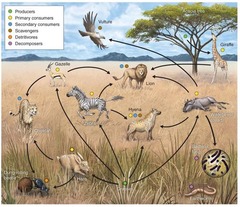
Food web
A complex model of how energy and matter move between trophic levels.
Scavenger
An organism that consumes dead animals.
Detritivore
An organism that specializes in breaking down dead tissues and waste products into smaller particles.
Decomposers
Fungi and bacteria that convert organic matter into small elements and molecules that can be recycled back into the ecosystem.
Gross primary productivity (GPP)
The total amount of solar energy the producers in an ecosystem capture via photosynthesis over a given amount of time.

Net primary productivity (NPP)
The energy captured by producers in an ecosystem minus the energy producers respire.

Biomass
The total mass of all the living matter in a specific area.
Standing crop
The amount of biomass present in an ecosystem at a particular time.
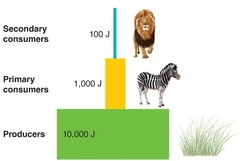
Ecological efficiency
The proportion of consumed energy that can be passed from one trophic level to another.
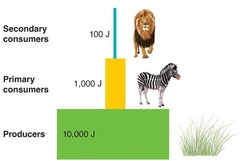
Trophic pyramid
A representation of the distribution of biomass, numbers, or energy among trophic levels.
Biogeochemical cycles
The movements of matter within and between ecosystems.
Hydrologic cycle
The movement of water through the biosphere.

Transpiration
The release of water from leaves during photosynthesis.
Evapotranspiration
The combined amount of evaporation and transpiration.
Runoff
Water that moves across the land surface and into streams and rivers.
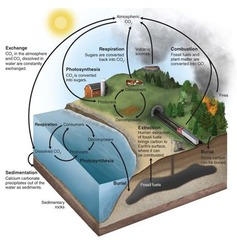
Carbon cycle
The movement of carbon around the biosphere.
Macronutrient
One of the six key elements that organisms need in relatively large amounts: nitrogen, phosphorous, potassium, calcium, magnesium, and sulfur.
Limiting nutrient
A nutrient required for the growth of an organism but available in a lower quantity than other nutrients.
Nitrogen cycle
The movement of nitrogen around the biosphere.
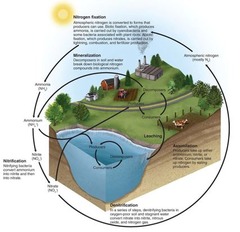
Nitrogen fixation
A process by which some organisms can convert nitrogen gas molecules directly into ammonia.
Nitrification
The conversion of ammonia (NH4+) into nitrite (NO2-) and then into nitrate (NO3-).
Assimilation
The process by which producers incorporate elements into their tissues.
Mineralization
The process by which fungal and bacterial decomposers break down the organic matter found in dead bodies and waste products and convert it into inorganic compounds.
Ammonification
The process by which fungal and bacterial decomposers break down the organic nitrogen found in dead bodies and waste products and convert it into inorganic ammonium (NH4+).
Denitrification
The conversion of nitrate (NO3-) in a series of steps into the gasses nitrous oxide (N2O) and, eventually nitrogen gas (N2), which is emitted into the atmosphere.
Leaching
The transportation of dissolved molecules through the soil via groundwater.
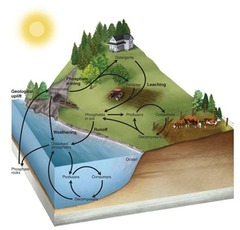
Phosphorous cycle
The movement of phosphorous around the biosphere.
Algal bloom
A rapid increase in the algal population of a waterway.
Hypoxic
Low in oxygen.
Sulfur cycle
The movement of sulfur around the biosphere.

Disturbance
An event, caused by physical, chemical, or biological agents, resulting in changes in population size or community composition.
Watershed
All the land in a given landscape that drains into a stream, river, lake, or wetland.

Resistance
A measure of how much a disturbance can affect the flow of energy and matter in an ecosystem.
Resilience
The rate at which an ecosystem returns to its original state after a disturbance.
Restoration ecology
The study and implementation of restoring damaged ecosystems.
Intermediate disturbance hypothesis
The hypothesis that ecosystems experiencing intermediate levels of disturbance are more diverse than those with high or low disturbance.
