CBNS 108 lectures 6-7
 Call Kai
 Learn
Learn Practice Test
 Spaced Repetition
 Match
Match Flashcards
 Knowt Play
1/53

There's no tags or description
Looks like no tags are added yet.
Name | Mastery | Learn | Test | Matching | Spaced | Call with Kai | Chat |
|---|
No analytics yet
Send a link to your students to track their progress
54 Terms
How were genetic screens used to determine developmental genes?
Mutagenesis screens. studying mutations that cause birth defects.
How are the A-P and D-V axes are established in the Drosophila egg?
Maternal determinants
What are the stages of embryo development in drosophila?
Cleavage –> Cellular blastoderm –> Gastrulation and segmentation –> Organogenesis
What is a syncytium?
a single mass of cytoplasm containing multiple nuclei that is not divided into separate cells
After 9-10 division cycles, what happens to most of the drosophila nuclei?
most nuclei move outward to lie just beneath the plasma membrane, forming a syncytial blastoderm.
What is unique about Drosophila cleavage divisions?
They occur without cellular division, meaning all the dividing nuclei share a cytoplasm.
In drosophila, which cells are first to form? Where do they form?
Pole cells (Primordial Germ Cells); posterior pole
How is the the cellular blastoderm formed in drosophila?
Plasma membrane invaginates between nuclei, extending to separate each nucleus from the other. The membranes around each nucleus extend towards each other, and the gaps are closed to cellularize all nuclei simultaneously
During gastrulation of the drosophila, cells of which germ layer(s) are internalized and which one(s) remain(s) outside?
The mesoderm and endoderm are internalized; the ectoderm remains outside
What occurs during segmentation?
The body is defined into segments: head, thorax, abdomen
The process by which cells in a developing embryo acquire identities in a well-ordered spatial pattern is called:
Pattern formation
What conclusion did Nusslein-volhard and Weischaus make about genetic mechanisms controlling early development of multicellular organisms?
They are highly conserved
What are the two broad classes of pattern formation mutations identified in drosophila?
Maternal and zygotic
What is the general function of maternal effect genes?
establishing initial polarity and positional information along the primary body axes (A-P and D-V)
Describe the effect of maternal effect genes.
Embryos from a mutant mother will develop a patterning defect, even if the embryo has a normal copy of that gene
What is the general function of zygotic genes?
pattern formation along the A-P and D-V axes that were established by maternal genes
What happens to embryos that are homozygous for mutant zygotic genes?
They will develop a patterning defect
Which drosophila segment is considered anterior?
Head and thorax
Which drosophila segment is considered posterior?
abdomen
What are the function of terminal genes?
required for patterning anterior and posterior extremities
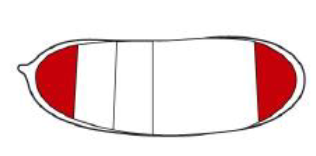
Bicoid is an __________ determinant.
Anterior
Nanos is an __________ determinant
Posterior
Transcriptional activator of a gene called hunchback
Bicoid
Translational repressor of hunchback mRNA
Nanos
What happens to embryos from bicoid mutant mothers (no functional bicoid in the embryo)?
develop with defects in anterior segments
What happens to embryos from nanos mutant mothers (no functional nanos in the embryo)?
develop with defects in posterior segments
Where in the drosophila larvae are bicoid mRNAs localized?
Anterior side
Where in the drosophila larvae are nanos mRNAs localized?
Posterior side
How do we know Bicoid is necessary for anterior development?
Bicoid mutant larva don’t have bicoid in the anterior(break it experiment)
The _______ ___________ experiments led to the idea that Bicoid and Nanos act as anterior and posterior determinants, respectively
Protein localization
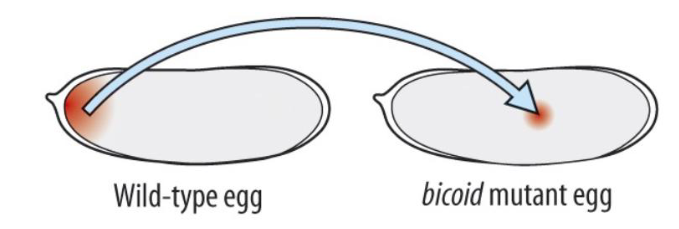
What would you expect if you place Bicoid in a different region of a mutant embryo?
The region with the highest amount of Bicoid adopts anterior-most fate
What happens if you increase the maternal dosage(# of gene copies) of bicoid in a larva?
stronger gradient of Bicoid protein, the location of the cephalic furrow moves posteriorly
True or false: bicoid is a morphogen.
True
The A-P cytoplasmic gradient of Bicoid protein becomes an A-P _______ gradient of Bicoid protein
Nuclear(meaning in the nucleus)
How does Bicoid instruct different fates at different concentrations in the nucleus?
Bicoid regulates the transcription of many target genes, and different target genes are activated by different threshold concentrations of Bicoid
What is the effect of bicoid on the hunchback gene?
Hunchback is transcriptionally activated by Bicoid in the anterior of the embryo
What happens to hunchback in the absence of nanos?
Hunchback accumulates in both anterior and posterior regions, leading to no posterior fates
How is maternal hunchback mRNA distributed in the egg?
Uniformly
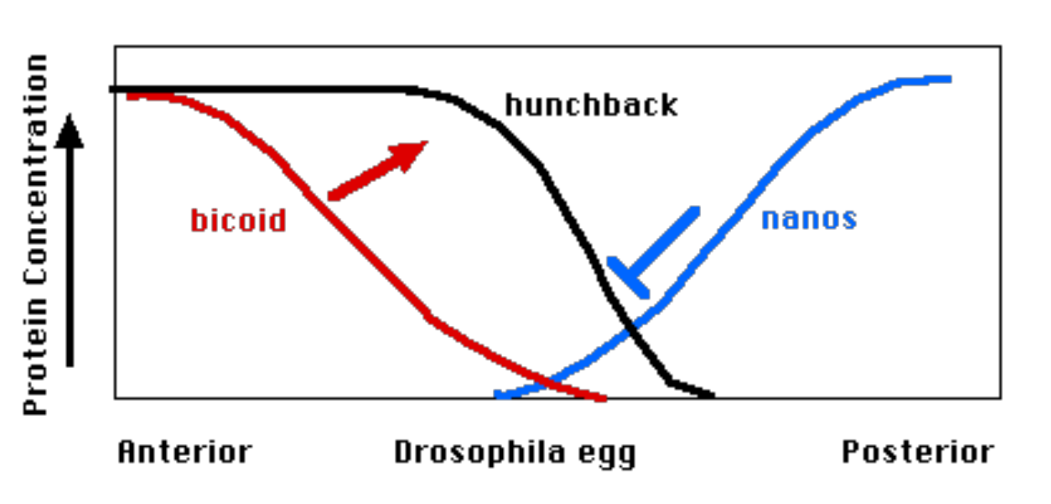
How do Bicoid and Nanos generate an A-P gradient of Hunchback protein?
Bicoid, which is concentrated in the anterior region, transcriptionally activates Hunchback. Nanos, which is concentrated in the posterior region, translationally represses hunchback. As a result, Hunchback is activated in a gradient that in concentrated in the anterior region.
How many segments is the fly body plan divided into?
14
Identify the AP and DV axis, thorax, and abdomen on a fly larva.
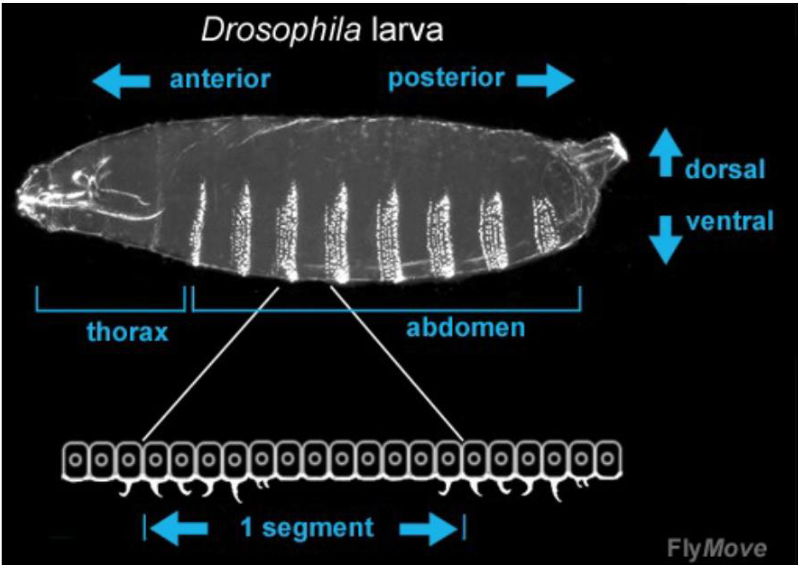
Each segment of the drosophila larvae has polarity along which axis?
A-P
How does drosophila larva divide in response to zygotic gene expression?
Progressive division of the embryo, first into broad zones and then into 14 parasegments (each with a posterior and an anterior half)
What is a transcription factor cascade? What initiates it?
activation of transcription factors in series; maternal determinants
What are zygotic patterning mutations?
mutations in zygotic patterning genes of the embryo that affect its development
Name the 4 classes of zygotic genes are involved in segmentation along the A-P axis
GAP genes
PAIR-RULE genes
SEGMENT POLARITY genes
SEGMENT IDENTITY genes
Mutations in these genes affect the number or polarity of segments:
GAP genes
PAIR-RULE genes
SEGMENT POLARITY genes
Mutations in these genes affect the identity of segments
SEGMENT IDENTITY genes
What defect occurs in Kruppel mutant embryos?
Missing segments T1-A5
Define gap gene mutants.
Mutant embryos are missing one or more Continuous segments
Name 3 types of gap genes.
Hunchback, knirps, kruppel
What was the first gap gene to be expressed in the Drosophila embryo?
Hunchback