Cardio Exam 3L Simplified Tsu (VHD/Shock/IHD)
 Call Kai
 Learn
Learn Practice Test
 Spaced Repetition
 Match
Match Flashcards
 Knowt Play
1/26

There's no tags or description
Looks like no tags are added yet.
Name | Mastery | Learn | Test | Matching | Spaced | Call with Kai | Chat |
|---|
No analytics yet
Send a link to your students to track their progress
27 Terms
Stenosis = ______
Regurgitation = ______
______ is by far the most common type of valvular disorder
narrowing or tightening, insufficiency or leaking, aortic valve stenosis
Surgical Treatment & Procedures
Balloon Valvuloplasty
______
pre-procedureal ______ to rule out ______ formation
______ if pt is ______-risk for ______
Valve repair
Valve repair ______ replacement
Valve replacement: Open-heart cardiac surgery, Transcatheter aortic valve implantation (TAVI)
______ replacement
______ BUT ______ (need replacement in ______)
Best for RFs for ______ and pt refuses or C/I to ______
Ex.
______
______
______ replacement
______ BUT ______ → ______ AND ______
Best for ______
Ex.
1st Gen: ______
2nd Gen: ______ tilting disk
3rd Gen: ______ tilting disk
Mitral stenosis, TEE, thrombus, aortic stenosis, too high, cardiac surgery, preferred over, Bioprosthetic, less thrombogenic, low durability, 5-10 years, bleeding, anticoags, Porcine (Pig), Bovine (Cow), Mechanical, High durability, highly thrombogenic, lifelong anticoag, clicking sound, young pts, Ball and Cage, Single, Bileaflet
Antithrombotic Therapy Summary
Aortic
BioProsthetic (Porcine or Bovine)
ASA: ______
Warfarin: ______
Mechanical (Any Generation)
ASA: ______
Warfarin: ______
Baby ASA (add clopidogrel if transcatheter), NONE, NONE, INR 2.5-3.5 for 3 months only
Antithrombotic Therapy Summary
Mitral
BioProsthetic (Porcine or Bovine)
ASA: ______
Warfarin: ______
Mechanical (Any Generation)
ASA: ______
Warfarin: ______
Baby ASA if additional TE RFs, INR 2-3, Baby ASA if additional TE RFs, INR 2.5-3.5
Use of DOACs in valvular disease
______ (DARE)
Use is C/I with ______
Studies show increased risk of ______ compared to ______
Dabigatran, Apixaban, Rivaroxaban, and Edoxaban, mechanical heart valves, TE and bleeding, Warfarin
Pregnancy and VHD
______ generally preferred
If mother is willing, ______ could be continued in ______ if daily dose is ______
Most choose to use ______
It ______ cross placenta
______
Bioprosthetic Valve, Warfarin, 1st trimester, <5 mg, LMWH injection, does not, BID SQ
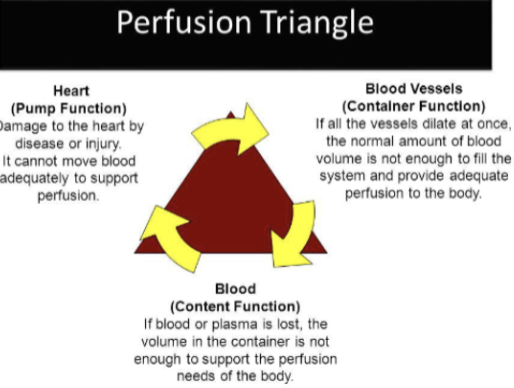
Shock
______ of ______
______ mmHg OR reduction of at least ______ mmHg from ______ with ______
inadequate perfusion, critical organs, SBP <90, 40, baseline, perfusion abnormalities
Goals and Monitoring of Shock (KNOW)
MAP ______ mmHg
Adequate perfusion to critical organs
perfusion and oxygenation of entire body
systemic BP, oxygen tension, lactate
organ-specific oxygen delivery and utilization
coagulation abnormalities, impaired renal or hepatic dysfunction, cool extremities, cardiac ischemia, etc.
>65
Types of Shock
______
______
______
______
Cardiogenic, Obstructive, Hypovolemic, Distributive
Types of Shock
Cardiogenic
Heart ______
Ex. ______
General Treatment: ______
fails to pump out blood, HF and Valve dysfunction, Increase CO and Inotropes
Types of Shock
Obstructive
Heart ______
Ex. ______
General Treatment: ______
pumps well, but outflow is obstructed, PE and Tamponade, Treat obstruction
Types of Shock
Hypovolemic
Heart ______
Ex. ______
General Treatment: ______ (______)
pumps well, but not enough blood volume to pump, blood and fluid loss, IV fluids, crystalloids, colloids, and blood
Types of Shock
Distributive
Heart ______
Ex. ______
General Treatment: ______
pumps well, but there’s peripheral vasodilation, Anaphylaxis and Sepsis, IV fluids, then vasopressors
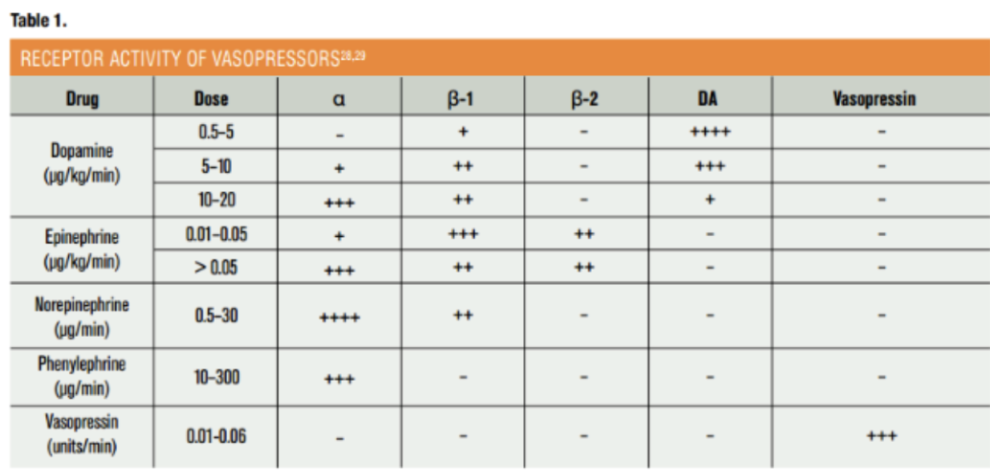
Review of Receptor Physiology
Blood Vessels
Alpha-__ → ______
Beta-__ → ______
Heart
Beta-__ → ______
Other
Beta-__ → ______
DA → ______
Vasopresin
V1 → ______
V2 → ______
1, Vasoconstriction, 2, Vasodilation, 1, Increased inotropy and chronotropy, 2, bronchodilation, vasodilation in kidneys, vasoconstriction, Reabsorption water in kidneys
Vasopressors to treat Shock (treat ______ shock (______) AFTER ______)
______
______ (Levophed)
______
______ (Neo-Synephrine)
______
distributive, anaphylaxis and sepsis, IV fluids, EPI, NE, DA, Phenylephrine, Vasopressin
Vasopressors to treat Shock (treat distributive shock (anaphylaxis, sepsis) AFTER IV fluids)
EPI
______ agonist
______
______ activity
Most common vasopressor used in ______ situations (______, pt is ______)
alpha-1, beta-1, and beta-2, Vasoconstriction, Increased inotopic/chronotropic, life-threatening, cardiac arrest, dead
Vasopressors to treat Shock (treat distributive shock (anaphylaxis, sepsis) AFTER IV fluids)
NE (______)
Primarily ______ agonist, secondarily ______ agonist
______
______ activity
Preferred vasopressor in ______
Most common vasopressor in ______
Levophed, alpha-1, beta-1, vasoconstriction, increased inotropic/chronotropic, sepsis, ICU
Vasopressors to treat Shock (treat distributive shock (anaphylaxis, sepsis) AFTER IV fluids)
DA
______ agonist (depends on dosing!)
______ (______ dose)
______ activity (______ dose, for ______)
______ (______ dose)
Primarily used for ______
DA, beta-1, and alpha-1, increased renal blood flow, low, increased inotropic/chronotropic, medium, bradycardia, Vasoconstriction, high, cardiogenic shock in ICU
Vasopressors to treat Shock (treat distributive shock (anaphylaxis, sepsis) AFTER IV fluids)
Phenylephrine (______)
______ agonist
______
______ vasopressor IF ______ from ______
Neo-Synephrine, pure alpha-1, Vasoconstriction, Alternative, tachyarrhythmias, NE or DA
Vasopressors to treat Shock (treat distributive shock (anaphylaxis, sepsis) AFTER IV fluids)
Vasopressin
______ to ______ in ______ (NOT as ______)
______
Adjunctive agent, NE, sepsis, monotherapy, Vasoconstriction
General Adverse Effects of Vasopressors
______
______
______, Especially ______ → ______
Arrhythmias, Tachycardia, Tissue Ischemia, digit ischemia, long-term (ICU)
Stable Ischemic Disease
______-acting nitrates
______
Indications:
______ (______)
______
Taken ______ to activity
______-acting nitrates
______
Indications:
______ therapy to ______ if ineffective
______ only if ______ C/I or intolerable
Will cause compensatory ______
Short, sublingual tablets or spray, infrequent attacks, few times a month, Prophylaxin, 5-10 mins prior, Long, Oral or transdermal patches, add-on, BB or CCB, Monotherapy, BB or CCB, tachycardia
Stable Ischemic Disease
Monitoring: ______
Counseling
______
______ interval at least ______
______
Keep in ______ (______ canister)
Call 911 if ______
Newer recommendations to call after 911 after ______ IF NO relief of Sxs
Interventional
______
______
BP and HR (reflex tachycardia), Headache, Nitrate-Free, 8 hours every day, Sublingual Tablets, original container, brown, persistent chest pain after 3 tablets/sprays, 5 mins of 1st dose, PCI, CABG
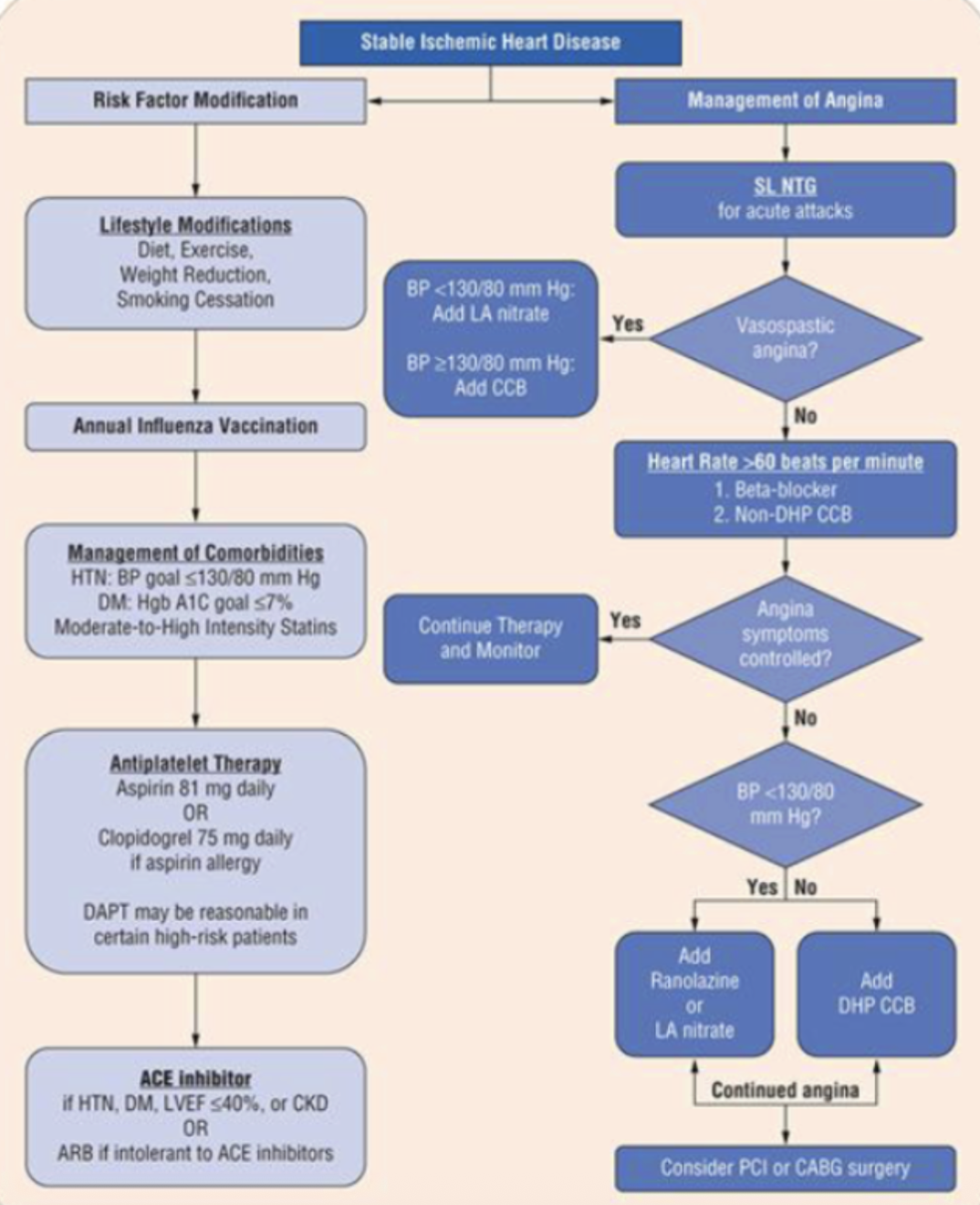
KNOW IMAGE
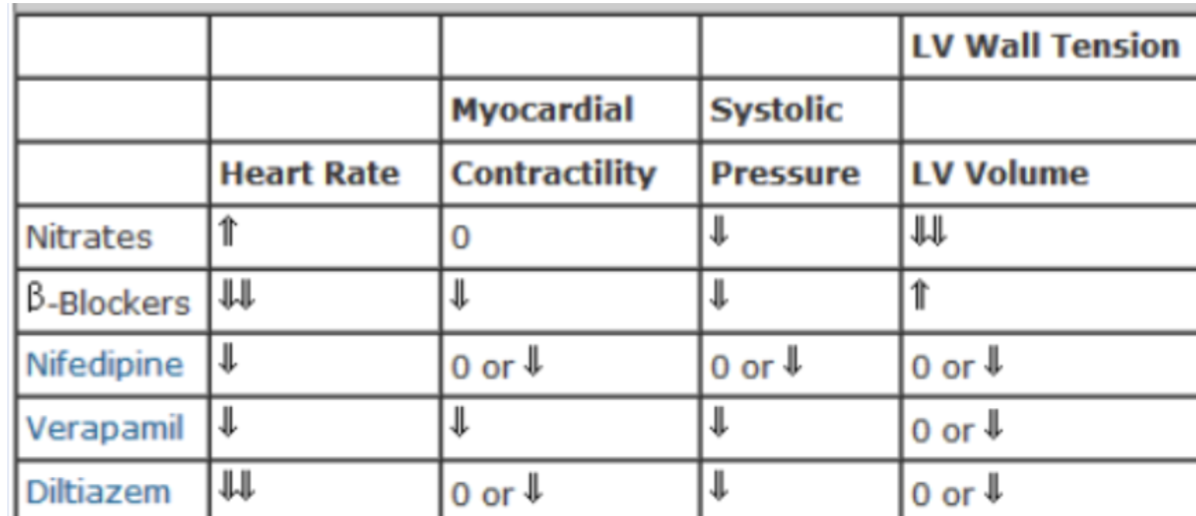
Nitrates = increase HR + greatly decrease LV Volume
BBs and Verapamil WILL decrease myocardial contractility
Nifedipine may or may not decrease systolic P
BBs WILL Increase LV Volume
KNOW IMAGE
Ranolazine
______ in ischemic myocyte by inhibiting ______ (Ina)
C/Is
Pre-existing ______
______
______
Reserved for pts with inadequate response to other ______
Does NOT affect ______, ______, ______, or ______
Monitor ______
Reduces Ca, late Na current, QT prolongation and QT-prolonging meds, liver impairment, Potent 3A4 inhibitors, anti-anginal meds, HR, inotropy, hemodynamics, coronary blood flow, QT prolongation
A 58 year-old male presents to your pharmacy with a new prescription for nitroglycerin SL tablets. Fill in the following instructions regarding nitroglycerin.
Place 1 tablet (______ mg) under your ______ at start of chest pain.
You can repeat this ______ times, ______ mins apart.
Keep your tablets in the ______ container
Do not take within ______ hours of erectile dysfunction medications.
If you are using this to prevent chest pain prior to exercise, take ______ mins before activity
0.4, tongue, 2, 5, original, 24-48, 5-10