Chemistry: SAT 3 Revision
 Call Kai
 Learn
Learn Practice Test
 Spaced Repetition
 Match
Match Flashcards
 Knowt Play
1/75

There's no tags or description
Looks like no tags are added yet.
Name | Mastery | Learn | Test | Matching | Spaced | Call with Kai | Chat |
|---|
No analytics yet
Send a link to your students to track their progress
76 Terms
What is the formula to calculate how many particles are in a substance?
6.02 × 10²³ multiplied by substance mols
What is the formula to calculate molar mass?
The sum of all relative atomic masses per atom within the substance
What is relative atomic mass?
The weighted average of all naturally occurring isotopes an element, usually the mass number of the element on the periodic table.
How to calculate the relative atomic mass?
Mass number of the isotope times its abundance (%)
What is the unit of measurement for molar mass?
g/mol
State the general formula for alkanes and alkenes
Alkane: C_nH_2n + 2
Alkenes: C_nH_2n
State the definition of solubility
A measure of the mass of solute that will dissolve in a solvent at a given temperature
State the definitions for solute and solvent
Solute: the substance dissolved in a solvent to form a solution
Solvent: the substance that dissolves the solute to form a solution
State the definition of solution
A homogeneous mixture formed when a solute dissolves into a solvent
State the definition of miscibility
The ability for two or more substances to dissolve and create a homogenous mixture
What is a kink?
A physical bend or structural distortion in a long molecular chain
At room temperature, what is the physical state of fats and oils?
Fats are solids; oils are liquids.
Why is oil a liquid at room temperature
It is an unsaturated compound, which has loose packing of dispersion forces that require little energy to overcome
What does concentration measure?
The quantity of solute dissolved in a solvent.
What does molar concentration measure?
The quantity of solute dissolved in a solvent but in moles per unit volume (mol/L).
Explain the difference between concentration and molar concentration
Concentration is a general term whereas molar concentration is a specific measurement of concentration using moles per litre.
State the formulas for concentration and density in this respective order
c = m/V
p = m/V
Solubility describes the ability of solid, gas, and liquid solutes to dissolve in a solvent whereas miscibility describes the ability of a liquid to dissolve into another liquid.
The particles of the solvent must separate and fully surround the particles of the solute.
Atoms, molecules, and ions.
The secondary forces created between solute and solvent molecules must be stronger or equally strong to the secondary forces between solvent molecules and solute molecules.
Hydrogen bonding and dipole-dipoles
Solvent molecules are attracted together with dispersion forces and induced dipoles to form intermolecular attraction with solute molecules. Dissolution occurs as solute-solvent molecule intermolecular forces are equal in strength to solvent-solvent molecules.
Fats (triglycerides), oils, and lipids
Ion dipoles
Oil is a non-polar liquid whereas water is a polar solvent. Oil will form induced-dipoles with water using dispersion forces but these interactions are weaker than the hydrogen bonding between water molecules. Thus, dissolution does not occur and the two liquids are immiscible.
No. The polarity of molecules can be determined by observing whether the polar or non-polar regions are larger.
Short hydrocarbon chain alcohols have smaller non-polar regions, making the molecule overall polar. Polar solutes dissolve in polar solvents. Conversely, long hydrocarbon chain alcohols have larger non-polar regions, making the molecule overall non-polar. Non-polar solutes do not dissolve in polar solvents.
By adding an amphiphilic compound
Emulsifier and surfactant
Molecules that have both polar and non-polar regions
Surfactants are substances that lower surface tension between liquids, solids, and gases whereas emulsifiers are a type of surfactant that stabilises a mixture of two immiscible liquids.
Soap and detergent
A spherical structure that is formed by amphiphilic compounds trapping solutes in solvent with opposite polarity.
Water containing high concentrations of magnesium and calcium
It has a hydrophobic tail and hydrophilic head.
What does hydrophobic and hydrophilic mean?
Hydrophobic: molecular regions in amphiphiles that avoid or repel water molecules due to weak dispersion forces
Hydrophilic: molecular regions in amphiphiles that attract water molecules via secondary interactions
An insoluble product formed by reacting soap molecules with hard water
Non-polar tails interact with non-polar solutes via dispersion forces. Polar heads interact with polar solvents via strong secondary interactions (dependent on solvent). Non-polar tails pull non-polar solutes inwards and polar heads push polar solvents outwards, creating a spherical shape.
When soap is added, it lies at the boundary between oil and water with hydrophobic tails in the oil and hydrophilic heads in the water. During agitation, like scrubbing, oil layer is broken into tiny droplets. Soap molecules surround these oil solutes and traps them with their hydrophobic tails via dispersion while hydrophilic heads bind surrounding water molecules via hydrogen bonds.
Soap = carboxylate ions (-COO^-)
Detergent = sulfonate (-SO_3^-) or sulphate
Carboxylate ions create insoluble scum with calcium or magnesium ions because of their opposite charges.
No insoluble precipitate is formed when sulfonate interacts with calcium or magnesium ions
Compare which compound is better for the skin: soap or detergent
Soap
When fats like triglyceride react with NaOH
Define stoichiometry
It describes the relationship between the amount of reactant to the amount of products or amount of other reactants in a chemical reaction, determined by a balanced equation.
How do you use mole ratio?
Find the balanced equation between your known and unknown chemical substances.
The coefficients of the two chemical substances is their ratio.
Convert your known chemical substance to moles
Find the moles of the unknown chemical substance using mole ratio equation
What is internal energy?
The stored chemical energy in reactants and products.
Where does external energy go during reaction?
It is always absorbed by reactants to break chemical bonds
How is internal energy released during reaction?
When dissociated atoms bond to create new substances
What is enthalpy?
The sum of a thermodynamic system's internal energy and the product of its pressure and volume
When pressure and volume are constant, enthalpy is the...
Chemical energy stored
The enthalpy change of a reaction is the change in....
heat energy in a system where a physical or chemical change occurs.
When is pressure constant?
When reactions occur in open atmospheres
If change in enthalpy is negative, the reaction is?
Exothermic
Outputs from change in enthalpy equations must always be written with...
a positive or negative sign and in kj/mol
What is the formula for enthalpy in solution?
Change in enthalpy = lattice energy + hydration energy
What is lattice and hydration energy?
Lattice energy is the energy required to break the ionic bonds in the lattice whereas hydration energy is the energy released when dissociated ions form secondary interactions with water molecules.
What is the enthalpy in solution specifically applicable to?
Dissolving ionic solutes in water
When lattice energy is greater than hydration energy, the reaction and change in enthalpy is...
Endothermic and positive
When hydration energy is greater than lattice energy, the reaction is...
Exothermic and negative
What do thermochemical equations must have?
States of matter at room temperature
Be balanced
The enthalpy of reaction at the side
What do the coefficients in chemical equations represent?
The number of moles in reactants combined to form the number of moles in products
State the two equations for change in enthalpy (general case).
Change in enthalpy = enthalpy products - enthalpy reactants
Change in enthalpy = Q over 1000 x n (if measured enthalpy in kj and Q in J)
What does Q represented?
The energy released or absorbed.
What is the specific heat capacity of water?
4.18 J/g
What is a calorimeter?
The instrument used to measure changes in enthalpy.
What does a calorimeter assume?
All heat is transferred to water when it could be lost to the environment or its contents.
The maximum and minimum temperatures are reached before heat is lost to the environment.
All solutions have the same heat capacity and density as water.
What is the chemical equation for incomplete combustion?
Hydrocarbon + oxygen → carbon monoxide + water + carbon
What is the molar mass of 2Fe and Fe_2?
The first is 55.85g/mol whereas the latter is 111.7g/mol
What is an emulsion?
A mixture of two immiscible liquids
What is the difference between emulsifier and emulsion?
Emulsion is a mixture of two immiscible liquids and emulsifier stabilises an emulsion by allowing oil droplets to remain dispersed in water longer.
What are the characteristics of a dilute solution?
Low number of solute particles in a fixed volume of solvent
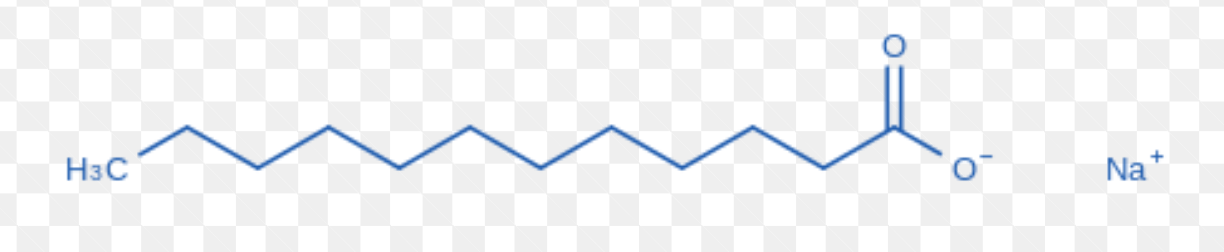
This is an image of sodium dodecanoate. What type of compound is this? Provide evidence.
It is a soap molecule because it has a carboxylate ion (-COO^-) attracting a positively charged sodium ion through ion-dipole forces.
Which is better at absorbing energy and why?
A salt with highly positive enthalpy change but low solubility
vs.
A salt with not so positive enthalpy change but high solubility
A salt with high solubility but not so positive enthalpy change because it would yield a greater total absorption of energy for energy is only absorbed when the salt dissolves.
Which applies to an endothermic reaction and what does it mean?
H products < H reactants
vs.
H products > H reactants
H products > H reactants.
More energy is required to break bonds in reactants than form new bonds.