XRAY Tube, Discovery and protection, and Essential concepts RAD 130
 Call Kai
 Learn
Learn Practice Test
 Spaced Repetition
 Match
Match Flashcards
 Knowt Play
1/98

There's no tags or description
Looks like no tags are added yet.
Name | Mastery | Learn | Test | Matching | Spaced | Call with Kai | Chat |
|---|
No analytics yet
Send a link to your students to track their progress
99 Terms
energy or matter
All things in the universe exist as one of what two things?
anything that occupies space and has mass
What is matter?
how much matter there is
What is mass?
Kg
What is the basic unit (SI) for mass?
ability to do work
What is energy?
joules and electron volts
What units are used for energy?
Electromagnetic, thermal, kinetic, potential, nuclear, electrical
What are the types of energy?
photons
xrays travel in bundles of energy called
radiation
Energy emitted through space is referred to as
exposed or irradiated
When an object is exposed by radiation, we call that
ionizing radiation is high enough to knock an electron out of it's orbit
What is the difference between radiation and ionizing radiation?
the ability to ionize
What makes one form of electromagnetic energy harmful vs another form?
an electron has been knocked out of it's orbit
When an atom has become ionized, what happens?
ion pair
When an electron has been knocked out of orbit (ionized), the atom and ionized electron are referred to as what?
natural/environmental and manmade
What are the 2 main sources of ionizing radiation?
-cosmic
-terrestrial
-internal deposited radionuclides
-radon
What are the 4 natural sources of ionizing radiation?
diagnostic - xray
Which type of man-made radiation is considered to be the largest source?
energy of position; stored energy
What is potential energy?
energy of motion
What is kinetic energy?
energy from electron moving through a potential difference (voltage)
What is electrical energy?
energy of motion of molecules
What is thermal energy?
energy contain in the nucleus
What is nuclear energy?
energy from electromagnetic spectrum, travel in waves known as photons
What is electromagnetic energy?
electromagnetic
What energy type is an xray?
energy
radiation is the transfer of
negative ion
When an electron is ionized and knocked out of orbit, it becomes a
positive ion
When an atom is ionized and loses an electron, it becomes a
radon
What is the largest source or terrestrial radiation?
radioactive gas produced by radioactive decay of uranium in the earth
What is radon?
Diagnostic Xray
nuclear power
research applications
industrial sources
What are the 4 types of manmade radiation?
electromagnetic
Xrays are a form of ____ radiation
neutral
Xrays are electrically negative, neutral, or positive?
False
True/False: Xrays are affected by electric or magnetic fields.
energies and wavelengths.
Xrays can be produced over a wide variety of ____ and ____.
very small
Xrays release small or large amount of heat upon passing through matter?
straight
Xrays travel in ____ lines
3x10^8 m/s
Xrays travel at the speed of light, which is _____, in a vacuum.
False, it is always the same speed.
True/False: increased energy will increase the speed in which an xray travels.
ionize
Xrays can _____ matter
fluorescence
Xrays can cause ____ of certain crystals.
cannot
Xrays can or cannot be focused by a lense?
photographic
Xrays affect _____ film
ionization and excitation
Xrays produce chemical and biological changes in matter through
secondary and scatter
xrays produce ___ and ____ radiation
the patient
Scatter radiation comes from ____
Radiography
Flouroscopy
Computed Tomography
What are the three general types of xray exams?
static / still picture
Radiography images are____
dynamic / motion /video
Flouroscopy images are ____
3D
Computed Tomography images are _____
Wilhelm Roentgen, November 8 1895
Radiography (xray) was discovered by who, and what date?
Thomas Edison, 1898
Flouroscopy was developed by who and when?
Godfrey Hounsfield, 1972
CT was invented by who and when?
Clarence Daly, 1904
Who was the first Xray fatality in the US and when did he die?
Erythema - skin damage
What is the first sign of radiation effect?
-Erythema - skin damage
-Alopecia - hair loss
-Anemia - low red blood cell count
-Leukemia
What are effects of radiation?
Anemia - low red blood cell count
When radiation is getting deeper due to longer exposure, it can cause ____
Leukemia
Which effect of radiation can occur years after exposure to unsafe amount of radiation?
National Council on Radiation and Measurements (NCRP) 1987
Who set acceptable Dose Limits for radiation, and when did this take place?
As Low As Reasonably Acheivable
What is ALARA?
Time - short
Distance - Long (at least 6 ft from patient)
Shield - often
What are the 3 cardinal principals of radiation protection?
-Limit repeat imaging
-collimate
-shield
-appropriate positioning and centering
-appropriate technical factors
What can we do to limit the exposure patient receives?
-understand and apply cardinal principles (time, distance, shield)
-Don't allow familiarity to result in false security
-Never stand in primary beam
-always wear protective apparel when not behind protective barrier
-always wear dosimeter outside of shields
-never hold patient during exam. Use mechanical device, or patient's family if possible.
- person holding patient must wear apron and gloves
-use gonadal shield if childbearing age or younger, if possible
- avoid pelvic and abdominal exam on pregnant patients
-collimate to smallest field appropriate
What are the ten commandments of radiation protection?
-Xray travels in straight lines
-xrays always travel at the speed of light
-xrays can effect photographic film
-xrays produce a small amount of heat
-xrays are electromagnetic radiation
-xrays can not be focused with a lens
- xrays can ionize
What are Roentgen's Original Properties of Xray? (name 3)
Crookes Tube
What is the name of the first Xray tube
Partially evacuated
The Crookes tube has a _______ _______ glass tube.
Coolidge Tube
What is the name of the xray tube that is used today?
Vacuum Sealed
The Coolidge tube has a ____ _____ glass or metal tube.
Ceiling
What type of support system is most widely used?
No cart, no ER
What are the limitations of the floor support system?
C Arm
What type of support system is often used in surgery?
Tube stays centered to IR
What is the benefit of the C arm system?
Emission of xrays - all directions
Isotropic =
vacuum tube
The glass or metal envelope maintains what?
It becomes "gassy", meaning air is in the tube. Electrons his air molecules
What happens if vacuum seal is broken?
Anode and Cathode
What are the 2 electrodes called?
filaments and focusing cup
The main components of the cathode are the
negative
The cathode is the ____ side of the tube
Thermionic, boiling off electrons
The cathode uses ______ emission. What does this cause?
positive
The Anode is the ____ side of the tube
Where the electrons strike and produce xrays
The anode includes the target, which is what?
Kvp - kilvolts
Voltage is measured in
mA - milliAmperes
Current is measured in
50-150 kv
The normal range of kilovolts is
50-1000 mA
The normal range of milliamperes is
mA x time (seconds)
mAs =
99% heat, 1% xray
When an e- hits the target, 99% of energy created is _____ and 1% is ____
The coolidge tube is fully vacuum sealed, whereas the crookes is partially evacuated.
What is the difference between a Crookes and Coolidge xray tube?
-ceiling
-floor to ceiling
-floor
-c arm
What are the 4 common support systems for xray tubes?
Lead (Pb), because lead stops xrays from going through and this protects from unnecessary exposure
What material is the protective housing made of? Why?
useful beam
What is the xray beam called that exits the window?
leakage radiation
What is the xray beam called that exits another area of the tube other than the window?
Glass or metal envelope
Which component maintains the vacuum?
thermionic emission
What is the process of boiling off electrons on the cathode side of the tube called?
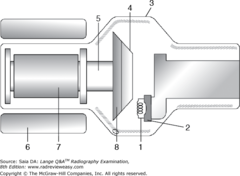
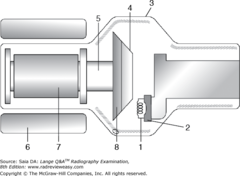
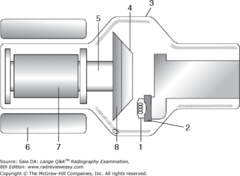
target
What is the area on the anode called that useful e- strike?
anode
What is 7?
target
What is 8?
glass or metal envelope
What is 3?

cathode
1&2 make up the negative side of the tube, which is the ___

filament
What is 1?