Cell Bio ch 4-16
 Call Kai
 Learn
Learn Practice Test
 Spaced Repetition
 Match
Match Flashcards
 Knowt Play
1/21

There's no tags or description
Looks like no tags are added yet.
Name | Mastery | Learn | Test | Matching | Spaced | Call with Kai | Chat |
|---|
No analytics yet
Send a link to your students to track their progress
22 Terms
Enzyme Rate of Disassociation and Association “Turnover Rate”
Bond strength
How tightly packed the molecules are
How often they collide
How much substrate exists in the cell
Enzyme activity
Quantity of enzyme
Highly Regulated !!!
Accessibility of enzyme/substrate
Subcellular location
Scaffolding proteins
Feedback Inhibition
An enzyme acting early in a reaction is stopped by a late product in the pathway
Often acts allosterically
Negative Feedback
Ex: When an amino acid is synthesized, it inhibits the reaction. When the amino acid is used up, the cell stops the inhibition to remake the amino acids.
Positive Feedback
What does Ligand Bonding do?
It stabilizes conformation in order to increase enzyme activity
Allosteric Feedback inhibition
Many proteins are allosteric
They can adopt 2+ slightly different conformations
Allosteric binding shifts protein from one form to another ( active v inactive )
Can regulate activity
binding sites for ligands are altered when protein changes shape
Chemical Modifications
Can act as an on/off switch
Phosphorylation is the most common form of this. The addition of a PO4 group can “flip” polarity
Also known as Post Translational Modification
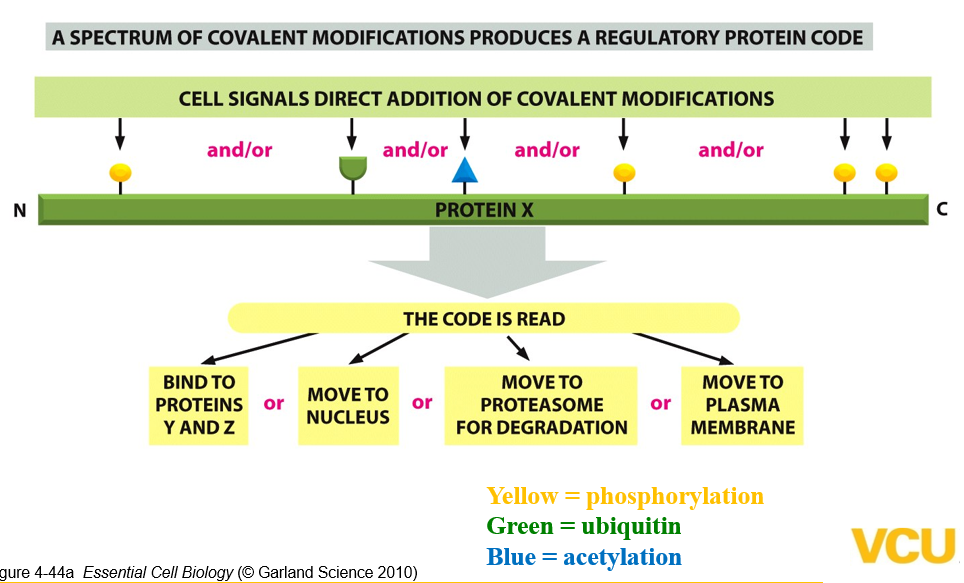
Covalent Modifications
Control location + assembling of proteins

Post translational Modification
Forms “Regulatory Protein Code” aka the protein to do list
20 Modifications = a lot of combos = the behavior of the proteins can be altered in MANY different ways
Protein Machines
Large complexes
Individual proteins which collaborate for a specific task (Quaternary)
Ex: Unwinding DNA in a damaged area
GTP Binding Proteins
Regulated by the cycle of the phosphate group being gained and lost
Protein whose conformation + activity is determined by its association with GTP or GDP
Resetting the switch requires the tightly bound GDP to dissociate, a slow step that is greatly accelerated by specific signals
Active and Inactive formation fall under this
Active Formation
GTP bound
Inactive Action
Protein hydrolyzes GTP to GDP → Releases phosphate and flips to inactive conformation
Nucleotide Hydrolysis
Conformational changes occur in response to it
Hydrolysis of GTP causes a small shift in structure (0.1 nm), but this gets exaggerated due to the shape of the protein allowing the complex to open and release the tRNA
GTP hydrolysis releases an intramolecular bond, like a ‘latch’ (red arrows), which allows domain 2 & 3 to rotate and release tRNA (from slides, unsure which parts we need to know)
Protein Movement
Proteins walk by using ATP Hydrolysis
Signaling Cascade
Cells send signals and it ends with making proteins which can function in various ways

Endocrine
Hormonal
Long distance, goes in bloodstream
Ex) Epinephrine
Paracrine
Localized
Within 1 organ
Neuronal
Neurons
Very fast
Electrical signaling

Contact Dependent
Must be touching