Bio 418 Unit 1
 Call Kai
 Learn
Learn Practice Test
 Spaced Repetition
 Match
Match Flashcards
 Knowt Play
1/153

Earn XP
Description and Tags
A bunch of random questions to test vocab and fundamental concepts!
Name | Mastery | Learn | Test | Matching | Spaced | Call with Kai | Chat |
|---|
No analytics yet
Send a link to your students to track their progress
154 Terms
Define latent period
The time between when a person gets infected to when they are infectious (think infectious L(atent)aughter)
Define incubation period
The time between when a person gets infected to when they are symptomatic (think i for itchy symptoms)
Define generation time
The total period of infection
T/F The latent and incubation period are always aligned
False, they can overlap and one can be shorter/longer than the other
What would a long latent period and short incubation period indicate?
a. Infected people will be infectious very quickly, and show symptoms very quickly
b. Infected people have a long time before they are infectious, and won’t show symptoms for a while
c. Infected people will be infectious very quickly, but won’t show symptoms for a while
d. Infected people have a long time before they are infectious, but show symptoms very quickly
d.
T/F Generation time describes infectiousness
False, it just describes infection time
Describe the difference between a micro/macro parasite
Microparasites are pathogens that replicate within the host, macroparasites are parasites that replicate outside of the host
Define infection
An invasion of a host by a transmissible communicable agent
Define disease
The clinical manifestation of an infection (symptoms)
Why is “infectious disease” an inaccurate statement?
An infection can cause a disease (physical symptoms), but it can also be asymptomatic. The pathogen is infectious, not the disease. (You don’t catch a sneeze from someone who has a cold, you catch the virus causing it.)
Define incidence
The rate of new infections in a population
Define prevalence
The proportion of a population that is infected (PPP: prevalence, proportion, population)
Prevalence = ? x ?
Incidence x duration
T/F Incidence is always a rate
True
T/F Prevalence is a rate in a population
False
Would four new infections describe prevalence or incidence?
Neither it’s not a rate or a proportion
In a closed system, when prevalence remains constant what does that tell you about infections and deaths?
No new infections and no new deaths
Looking at a graph, what would an increase in incidence do to the prevalence curve?
It would increase it since the proportion of infected people grew
T/F On a closed system graph, if incidence drops prevalence will immediately also drop
False, the amount of people who are infected hasn’t changed, but it will decrease over time as people enter recovered
Define epidemic
A rapid, unexpected rise in the prevalence of a pathogen in a region
Define endemic
Little variation in the presence of that pathogen in a region
Define disease dynamics
The change in infection abundance across space and time
T/F The pathogen determines whether it’s epidemic or endemic worldwide
False, a pathogen can be an epidemic in some regions but endemic in others.
What determines whether a pathogen is endemic or epidemic
Transmission dynamics, changes in host population or pathogen characteristics
T/F Once a region experiences an epidemic it will always be an epidemic there
False, the region can become endemic if the pathogen becomes stable again
Define these variables N = S+I+R
N = total population
S = susceptible population
I = infected population
R = recovered/removed population
What happens to N in a basic SIR model?
It remains constant
What causes people to leave the susceptible compartment?
Immunization or infection (and death unless it’s closed)
What causes people to leave the infected compartment?
Recovery or death
T/F In an SIR model (where immune stay in recovery) people move unidirectionally in the model
True
What is β? What is it the product of?
Transmission rate, the product of probability of contact between S and I and the likelihood of a transmission event at SI contact
What does a cross mean in an SIRS model
Death
What is the difference between an SIR and SIRS model
SIR assumes permanent immunity, SIRS accounts for lost immunity
Match the following action to the SIR compartment for a transmission bottleneck:
Isolate
Immunize
Quarantine
Quarantine S, isolate I, immunize S to R
Define herd immunity
Threshold of immunity for indirect protection of people’s contacts
Define R0 (aka basic reproductive number)
The average number of people that a single infected individual will infect in a completely susceptible population (try to memorize this)
What factors influence R0
Pathogen characteristics, host population characteristics, and the environment
T/F R0 accounts for outliers
False
T/F R0 includes a population with immunized, but not recovered people
False, includes neither
T/F R0 is theoretical
True
What does a high R0 mean
The pathogen is a good transmitter
What pathogen has the highest R0
Measles, R0 of 12-20
Define Re
Average number of people one infected person will infect in a population with immunity
What’s the difference between Re and R0
R0 is theoretical with no immunity, while Re is the actual number with immunity
T/F Re is what R0 effectively is
True
What happens to Re as immunity increases?
It decreases (since there are less people to infect)
What happens when R0 is less than 1 (typically)
Transmission bottleneck → the number of infected people declines → the pathogen will eventually fadeout
T/F Pathogens can still persist if their R0 is less than 1
True, polio is an example of this
What does an epidemic curve represent? What is it determined by?
Number of new cases overtime, determined by latent and infectious period
T/F In an epidemic curve the light gray area is the minimum of the latent period
True
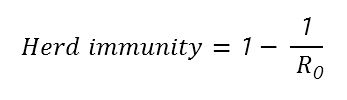
What is the herd immunity threshold equation
Pc = 1 -(1/(R0))
Define eliminated
A disease that has been removed from a region
Define eradicated
A disease that is removed worldwide
T/F You can eliminate diseases you can’t eradicate
True
T/F You cannot eliminate a disease without eliminating the pathogen
False, you can remove disease without the pathogen (like polio, or rabies in dogs)
Define direct transmission
A pathogen is passed directly from host to host
Define indirect transmission
Pathogen passed through intermediate contact
Select all that are examples of direct transmission
a. sexual transmission
b. water transmission
c. airborne transmission
d. nonspecific (surface/fomite) transmission
a, c, d
Select all that are examples of indirect transmission
a. environmental transmission
b. water transmission
c. bloodborne transmission
d. soil transmission
a, b, d
What are the three components of the epidemiological triangle? What do they explain?
Environment, host, pathogen; together they explain disease ecology
Give three examples of environment factors
Population density, landscape, political/economic resources, access to resources
T/F There is no correlation between GDP and % of deaths caused by preventable diseases
False
What are two major consequences of removing stable services that fight preventable diseases?
Removes trust in a population and increases cases of preventable disease
Define horizontal outreach
A public health strategy focusing on large issues that indirectly address multiple smaller problems. (think of a blanket being spread horizontally to encompass all of the problems)
Define vertical outreach
A public health strategy that focuses on only one aspect of a problem. (think of a vertical finger only pointing at one thing)
What is a criticism of verticle outreach?
It doesn’t address the underlying cause of the problem it’s solving
The smallpox vaccination campaign is an example of which outreach type
Vertical
List two horizontal outreach examples
Improving health care, water sanitation, targeted education programs, food programs
What contributed to the 2009 Burkina Faso measles outbreak?
The true population size was unknown
The calculated threshold for herd immunity was incorrect (because of above)
Large pool of susceptible people accumulated
What is the infectious agent of smallpox? How is it transmitted?
Variola major/minor, directly transmitted, airborne and fomites
What genus does smallpox belong to
orthopox
T/F The smallpox virus is single stranded, which makes it less stable
False, it’s double stranded which makes it stable
Which smallpox variant (V. major or minor) is more severe?
V. major
T/F Smallpox has an animal reservoir
False, it only has human to human transmission
What does cross-immunizing mean
Getting one strain of a pathogen means you’ll be immune to another strain
T/F Pathogens in the orthopox genus (smallpox, cowpox, etc) are cross immunizing
True
What observation was made about dairy workers that were infected with cowpox?
They were immune to smallpox
What do vaccines do?
Prime the immune system for an antigen with a weakened (inactivated or attenuated) version of a pathogen
What is variolation? Why was it important?
A method for infecting people with smallpox by exposing them and inducing immunity. This reduced the fatality rate since the amount of virus was smaller and more controlled.
List aspects of “pathogen” for smallpox that helped eradicate it
human to human transmission (no animal reservoirs)
strongly immunizing
cross immunizing
List aspects of “host” for smallpox that helped eradicate it
cross immunity
lasting immunity
early onset of recognizable symptoms
List aspects of “environment” for smallpox that helped eradicate it
thermostable vaccine
bifurcated needle needed
Why was a thermostable vaccine important for smallpox?
It didn’t require a cold chain so it could reach remote places
Why was the bifurcated needle important for smallpox?
It required minimal training, and left an identifying scar
What vaccination technique helped the eradication of smallpox? Explain it.
Ring vaccination, when one person gets infected, you vaccinate everyone around them to prevent the spread

What were some of the ethical concerns about the smallpox vaccination campaign?
vaccinators were forceful with their vaccinations, they didn’t always ask for consent
no other help was given to communities, vaccinators came in, vaccinated, then left
Define spillover
When a pathogen jumps from an animal host to a human host
What are some differences between mpox and smallpox
Mpox is less severe, and is a spillover from monkeys
What contributed to the mpox outbreak in 2017?
low vaccination rate against smallpox
sustain transmission through marginalized populations like gay men
What genus does measles belong to
morbillivirus
T/F Measles is highly transmissible, strongly immunizing, and directly transmitted
True
T/F Measles is double stranded, making it very stable
False, it’s single stranded making it unstable
What impact does measles have on the immune system after an infection?
Lose diversity and specificity of antibodies, basically resets immune system to 0 which is especially dangerous for kids
How does school affect the seasonality of measles?
Higher rates when school starts, with a drop over winter break
Define term-time forcing
the increase in childhood disease transmission associated with kids going back to school
Why do measles outbreaks typically skip a year?
To allow time for the susceptible pool to replenish
Define persistence
The proportion of weeks a disease is absent from a population
What does the Bartlett model describe
how local population size affects pathogen persistence
What would low measles persistence indicate
High amount of yearly measles
Would a large city population be more likely to have epidemic or endemic measles? What about a small town?
Large town would be endemic: higher population → higher birth rate→ consistent susceptible population→ consistent outbreaks.
Small town would likely be epidemic: lower population → lower birth rate → growing susceptible population → one kid gets sick → entire town gets sick in an epidemic