AP US History: Colonization & Settlement, American History Alan Brinkley Chapters 1-3
 Call Kai
 Learn
Learn Practice Test
 Spaced Repetition
 Match
Match Flashcards
 Knowt Play
1/111

There's no tags or description
Looks like no tags are added yet.
Name | Mastery | Learn | Test | Matching | Spaced | Call with Kai | Chat |
|---|
No analytics yet
Send a link to your students to track their progress
112 Terms
Jamestown
1st permanent English settlement in North America in 1607.

John Smith
A captain famous for world travel. As a young man, he took control in Jamestown. He organized the colony and saved many people from death the next winter and coined the phrase "he who shall not work, shall not eat". He also initiated attacks on Natives.

John Rolfe
He was one of the English settlers at Jamestown (and he married Pocahontas). He discovered how to successfully grow tobacco in Virginia and cure it for export, which made Virginia an economically successful colony. Eventually, he was killed in a Pequot attack.

Pocohontas
An American Indian princess who saved the life of John Smith and helped form more peaceful relations with the Powhatan when she married John Rolfe but died of smallpox in England on a visit to Rolfe's family. Her remains are still there as the English government refuses to send her remains back to North America.

Mayflower Compact
1620 - The first agreement for self-government in America. It was signed by the 41 men on the Mayflower and set up a government for the Plymouth colony

John Winthrop
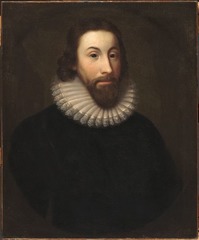
As governor of Massachusetts Bay Colony, Winthrop (1588-1649) was instrumental in forming the colony's government and shaping its legislative policy. He envisioned the colony, centered in present-day Boston, as a "city upon a hill" from which Puritans would spread religious righteousness throughout the world.
Puritans
A religious group who wanted to purify the Church of England. They came to America for religious freedom and settled Massachusetts Bay.

Pilgrims
English Puritans who founded Plymouth colony in 1620

Massachusetts Charter
Allowed Puritans to take a charter with them and establish their own government in the New World.
Loss of Massachusetts Charter
Revoking of Mass. Charter by King George II due to the colonists refusal to obey by the Navigation Acts leading to anti-British feeling in the New England region.
New Amsterdam
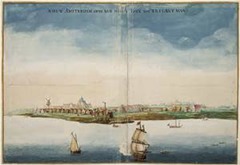
A settlement established by the Dutch near the mouth of Hudson River and the southern end of Manhattan Island as a trade port for the Dutch trade empire.

Great Migration of Puritans
1630s- 70,000 refugees left England for New World increasing population of New England.

New York
It was founded by the Dutch for trade and furs and became an English Colony in 1664, when the English were determined to end Dutch trade dominance, and took over the colony by invading New Amsterdam without having to fire a shot.
Peter Stuyvesant
The governor of the Dutch colony of New Amsterdam, hated by the colonists. They surrendered the colony to the English on Sept. 8, 1664.

House of Burgesses
1619 - The Virginia House of Burgesses formed, the first legislative body in colonial America. It was made up of two representatives from teach town voted on by men who owned property. Later other colonies would adopt the Houses of Burgesses concept creating self-governing bodies in the colonies.

Headright system
Headrights were parcels of land consisting of about 50 acres which were given to colonists who brought indentured servants into America. They were used by the Virginia Company to attract more colonists.
Indentured servants
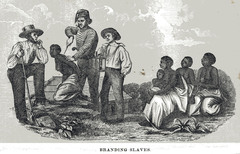
Colonists who received free passage to North America in exchange for working without pay for a certain number of years

Bacon's Rebellion
1676 - Nathaniel Bacon and other western Virginia settlers were angry at Virginia Governor Berkley for trying to appease the Doeg Indians after the Doegs attacked the western settlements. The frontiersmen formed an army, with Bacon as its leader, which defeated the Indians and then marched on Jamestown and burned the city. The rebellion ended suddenly when Bacon died of an illness.
King Phillip's War
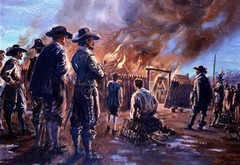
Under the leadership of Metacom, or King Phillip, the Wampanoag destroyed colonial towns, the colonists destroyed native farms, leading to the most deadly of Indian Wars. The war was disastrous for the natives leading to few surviving the war, and those that did left New England.

royal colony
A colony ruled by governors appointed by a king

proprietary colony
English colony in which the king gave land to proprietors in exchange for a yearly payment
town meetings
A purely democratic form of government common in the colonies, and the most prevalent form of local government in New England. In general, the town's voting population would meet once a year to elect officers, levy taxes, and pass laws.

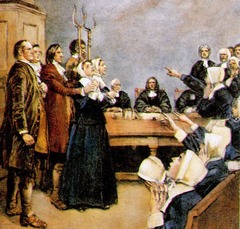
Salem Witch Trials
1629 outbreak of witchcraft accusations in a Puritan village marked by an atmosphere of fear, hysteria, and unfounded accusations in courts with Puritan ministers who served as judges. 19 women were executed.
Roger Williams
A dissenter who clashed with the Massachusetts Puritans over separation of church and state and was banished in 1636, after which he founded the colony of Rhode Island to the south.

Intolerant
Not willing to accept ways of thinking different from one's own. The expansion of colonies in New England was a direct result of Puritan intolerance as dissenters were exiled and created new settlements.
Anne Hutcheson
One of the dissenters in Puritan Massachusetts held bible studies at her house and believed in a personal relationship with god. She moved to New Hampshire where she died along with her children from an Indian attack.

Thomas Hooker
A Puritan minister who led about 100 settlers out of Massachusetts Bay to Connecticut because he believed that the governor and other officials had too much power. He wanted to set up a colony in Connecticut with strict limits on government. He wrote the first written constitution "The Fundamental Orders of Connecticut". This would become a cherished ideal of the colonial settlers that laws were written not arbitrary.
Sir William Berkeley
The royal governor of Virginia. Adopted policies that favored large planters and neglected the needs of recent settlers in the "backcountry." One reason was that he had fur trade deals with the natives in the region. His shortcomings led to Bacon's Rebellion
William Penn
Established the colony of Pennsylvania as a "holy experiment". Freemen had the right to vote, provided leadership for self- government based on personal virtues and Quaker religious beliefs. His colony was religiously tolerant leading to diversity in the region.
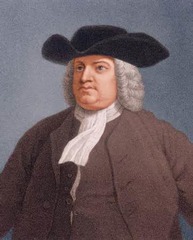
James Oglethorpe
Founded colony of Georgia as a chance for poor immigrants who were in debt to have a second chance at a comfortable life
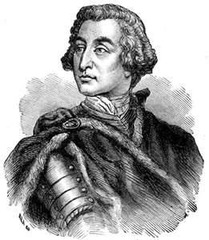
Lord Baltimore
1694- He was the founder of Maryland, a colony which offered religious freedom, and a refuge for the persecuted Roman Catholics.

Fundamental Orders of Connecticut
It has the features of a written constitution, and is considered by some as the first written Constitution. The Fundamental Orders of Connecticut is a short document, but contains some principles that were later applied in creating the United States government. Government is based in the rights of an individual, and the orders spell out some of those rights, as well as how they are ensured by the government. It provides that all free men share in electing their magistrates, and uses secret, paper ballots. It states the powers of the government, and some limits within which that power is exercised.

Halfway Covenant
A Puritan church document; In 1662, the Halfway Covenant allowed partial membership rights to persons not yet converted into the Puritan church; It lessened the difference between the "elect" members of the church from the regular members; Women soon made up a larger portion of Puritan congregations.
Dominion of New England
1686 - The British government combined the colonies of Massachusetts, Rhode Island, New Hampshire, and Connecticut into a single province headed by a royal governor (Edmund Andros). The Dominion ended in 1692, when the colonists revolted and drove out Governor Andros.

Acts of Trade and Navigation
Three acts that regulated colonial trade: 1st act: closed the colonies to all trade except that from English ships, and required the colonists to export certain goods, such as tobacco, to only English territories, 2nd act: (1663) demanded that everything being shipped from Europe to the colonies had to pass through England so they could tax the goods. 3rd act: 1673, was a reaction to the general disregard of the first two laws; it forced duties on the coastal trade among the colonies and supplied customs officials to enforce the Navigation Acts.

Mercantilism
An economic policy under which nations sought to increase their wealth and power by obtaining large amounts of gold and silver and by selling more goods than they bought.

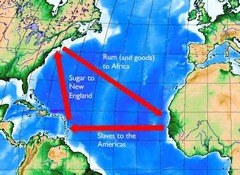
Triangular Slave Trade
A practice, primarily during the eighteenth century, in which European ships transported slaves from Africa to Caribbean islands, molasses from the Caribbean to Europe, and trade goods from Europe to Africa.
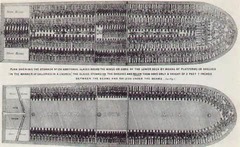
Middle Passage
A voyage that brought enslaved Africans across the Atlantic Ocean to North America and the West Indies. The conditions on the ships from Africa to the west led to the loss of hundreds of thousands of lives.
Social mobility
Movement of individuals or groups from one position in a society's stratification system to another
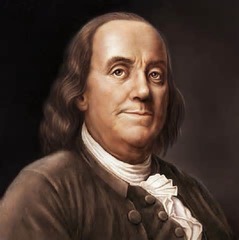
Ben Franklin
A colonial businessman and scientist who was an example of American social mobility and individualism. He was a delegate from Pennsylvania in colonial meetings, and proposed the "Albany Plan of the Union" as a way to strengthen the colonies in the French and Indian War. He was a leading figure in the movement toward revolution, and as a diplomat to France to get help during the American Revolution
Great Awakening
(1730s and 1740s) Religious movement characterized by emotional preaching (Jonathan Edwards & George Whitefield). It established American religious precedents such as camp meetings, revivals, and a "born again" philosophy. The first cultural movement to unite the thirteen colonies. It was associated with the democratization of religion, and a challenge to existing authorities and was an influence leading to the American Revolution.

Jonathan Edwards
A leading minister during the Great Awakening, he delivered the famous sermon "Sinners in the Hands of an Angry God" promising that evildoers would pay a price on judgement day.

African American Culture
Slave communities were rich with music, dance, basket-weaving, and pottery-making. Enslaved Africans brought them the arts and crafts skills of their various tribes.

Cotton Mather
Puritan Theologian who heard, from his slave, of practice of deliberately infecting people with mild smallpox to establish resistance. Through his recommendations to friends and Bostonians during epidemic of 1720s, this method of inoculation was popularized first. By mid 18th century, it was more so, becoming common medical practice
Covenant
Structure of towns in Puritan New England, binding its residents in a religious and social commitment; included village houses and a meetinghouse arranged around a central area called a commons; outlying fields and woodlands was also divided; more people in a family received more land, but all were close to one another to foster a sense of community
George Whitefield
Open air preacher, influential in Great Awakening, later became leader of Calvinist Methodists after John Wesley. Made evangelistic tours through the colonies and drew large crowds
Great Awakening
Revival of religious fervor and belief in the colonies, started out of concern of declining piety and growing secularism in many regions in members of many faiths in the early 18th century. Purposefully made to appeal to women (majority of converts) and young sons (those who would inherit land, etc.) Emphasized the potential for everyone to break away from constraints of the past, start life anew in their relationship with God (perhaps similar to those with wish to break away from their families, etc.) John and Charles Wesley helped spread it (who founded Mass.)
Gullah
A hybrid language of English and African used to communicate between slaves so that white masters couldn't understand
Huguenots
French Calvinists; early, non-English immigrants to New England after Edict of Nantes(est. 1598) which allowed them to basically establish a state w/in Roman Catholic France, was revoked in 1685, to which they began leaving (300,000 left in following decades)
Indentured Servitude
Temporary Servanthood in New World. Work for master for 4-5 years, receive passage, food, and shelter; after term were set free. Most were voluntary; provided a means of coping w/severe labor shortage during colonial period in New World. Was an important source of population growth into 18th century, started mid 1600's. Fell out of favor as many former servants began to cause social unrest with no work, slavery became more preferable
Indigo
West Indian plant which was source of blue dye in high demand in Europe. Staple crop contributing strongly to South Car. economy as it could be grown on land unsuitable for rice cultivation. Became a popular export.
Jeremiad
Puritan sermons of despair, deploring the signs of waning piety to the church, and the lessening of its power and influence
John and Charles Wesley
Founders of Methodism, powerful evangelists from England, were influential in Great Awakening of believers in the Colonies
John Peter Zenger
New York publisher trialed for criticizing the government, defended and changed policy for freedom of press, change in legal philosophy that was subtle at the time, but influential in the long run.
Jonathan Edwards
Deeply orthodox Puritan but original theologian, attacked doctrines of easy salvation, preached Puritan ideals of absolute sovereignty of God, predestination, and salvation ONLY by God's grace. Vividly described hell, was very influential in the Great Awakening
Middle Passage
"The journey to America"; describes the passage of slaves back and forth from African colonies and slaveholders to the North American colonies, being cramped in tiny spaces on ships, with varying conditions. Some were more spacious, some were packed so tight that they could hardly breathe, some were victims of sexual abuse. Those who died on the way were thrown overboard, those who survived had the difficulty of living in a new home subjected to a master.
Primogeniture
The passing of all inherited property to the firstborn son. Did not take root in New England as it did in England. Instead, a father divided his land among all his sons equally, as an inheritance. Young women were more mobile than their brothers, as they did not inherit land and weren't tied down in that way
Saugus Ironworks
Ironworks established in _______, Massachusetts; 'first' effort to establish a significant metals industry in the colonies. Was a financial failure; began operating 1646, ceased operations in 1668
Scots-Irish
Scottish Presbyterians who had settled in northern Ireland (in province of Ulster) in early 17th cent. Had some economic, polit., cult. setbacks in years of early 18th cent., Parliament preventing trade with them, Eng. gov. prohibiting Presbyterian worship, after 1710 long term leases expired and rents soared, causing many to leave for Americas where they took land with little regard to who owned it.
Slave Codes
In early 18th cent., colonial assemblies began to pass these, limiting rights of blacks in law and ensuring almost absolute authority to white masters. One factor determined subjectivity to these; skin color.
Stono Rebellion
Important, first during colonial period, rebellion of slaves against harsh masters in South Car. in 1739; about 100 Africans rose up up, seized weapons, killed several whites, and attempted escaping south to Florida. Whites quickly captured and killed the participants, but it was an important event in the conceptualization of equality and people's power
Triangular Trade
Elaborate commercial system in which Colonies sold to West Indies (rum, agricultural products, meat, fish) and bought sugar, molasses, and slaves from Caribbean markets in return. Linked NA colonies in intricate network of commerce with England, continental Europe, and west coast of Africa
The Enlightenment
A product of scientific and philosophical discovery in 17th cent. Europe. Human reasoning was embraced, seen as a method of innovation, Morality was introduced, God was not always needed to turn to with a moral compass. Almost in competition to the Great Awakening. Helped undermine traditional authority, like the Great Awakening. Emphasis on education, politics to further society, promote greatness. Many argued it supported, not undermined, Christianity's teachings
Anne Hutchinson
Puritan, moved to Boston from England with Husband 1634. Argued Massachusetts clergy members had no right to be spiritual leaders. Challenged role of females in society at the time, as well as religious views and social order in Mass. Banished, moved to RI then New Netherland, died 1643.
Antinomianism
From Greek; "Hostile to the Law", AH's teaching that clergy had no right to religious authority.
Bacon's Rebellion
Part of history known for realization of struggle to define boundary between Indian and white lands. Revealed potential of instability in the Colony's large population of free, landless men.
*saw the royal governor of Virginia forced to resign.
Dominion of New England
Created by James II combined Mass. govt w/rest of govt's of rest of New England Colonies, NY and NJ as well.
George and Cecilius Calvert
1st lord Baltimore, founder of Maryland Colony for retreat for English Catholics and for Real Estate ; 2nd lord Baltimore, received charter on fathers death including parts of Pennsyl., Delawa., Virginia, Maryland, but were to hold as "absolute lords and proprietaries"
Glorious Revolution
Bloodless coup in which James II fled to France and William (of Orange) and Mary (James' daughter) assumed control of England
*saw an English king, James II, flee to the European continent.
Headright (System)
50 acre grants of land which new settlers acquired in different ways (each settler received 50 acres, each person already established received 100 acres) in order to incentivize settlement of the colonies in the Chesapeake, and for tobacco growth
Jacob Leisler
German Immigrant to NY, merchant. Resented exclusion of ruling class. Captured NY w/militia, captured fort, drove Cpt Francis Nicholson out, proclaimed himself new head of GVT in NY.
James Oglethorpe
General, member of parliament, military hero. Part of founding of Georgia, expeditions of it. Wanted it to be a place for people to rest.
John Smith
Famous world-traveler, had travel narratives, led Jamestown and survived it. Became council president in 1608, whereby he imposed order on the community. Organized Indian raids to keep Jamestown alive.
John Winthrop
Affluent, educated, elected governor of Massachusetts Bay Company, organized migration of Puritans to New England
King Philip's War
Beginning 1675, Wampanoags organized w/guns terrorized string of Mass. towns, destroyed 20, caused death of 1000; weakened society and econ. of Mass. Mohawks and English fought back eventually
Massachusetts Bay Company
Organized as a trading company by Puritan merchants seeking opportunities in North Amer. Est 1630
Mayflower Compact
Document 41 male pass. signed, establishing a civil government and proclaimed allegiance to the King.
Metacomet
"King Philip" ; Chieftain of Wampanoag's
Middle Ground
Area in borderlands in which white settlers existed and Indians as well, with complex trade relationships between the groups.
Navigation Acts
Adopted to regulate colonial commerce more strictly than were previously. 1660 : closed colonies to all trade besides that of English church, trade item restrictions. 1663: All goods must pass through England if going through Europe. 1673 : provided for enforcement of Navigation acts
**encouraged the colonists to create an important shipbuilding industry of their own.
Pequot War
Friction over land caused conflict between English settlers in Connecticut valley and Pequot Indians. Many Indians died, stories and drawings depicted fierceness of the English.
Plymouth Plantation
Plantation founded by Separatists from hamlet of Scrooby, in interest of free worship. Eventually settled in just North of Cape Cod.
Powhatan
Indians whose chief was captured by Sir Thomas Dale, Pocahontas was his daughter
Quakers
"The Society of Friends", orig. mid-17th cent. preached to by George Fox and Margaret Fell. "Tremble before the Lord". Unlike Puritanism; Rejected predestination and orig. sin. All who cult. divinity could attain salvation. Granted women position in church almost equal to men
Quitrent
Founder of Rhode Island. Engaging, controversial minister lived in Salem, Mass. Separatist, argued Mass. church should abandon allegiance to church of England. Called for complete cleavage of Church from State - to protect church from Secular world. Early advocate of religious freedom, for members of different religions to live together in one place
Sir William Berkeley
Appointed Governor of Virginia by King Charles I. Sent explorers across Blue Ridge Mountains to open up Western Interior of Virginia. Organized force that quelled 1644 Indian uprising. Prohibited settling of whites to West of line negotiated w/tribes
Theocracy
"God-government"; Government based on a religious belief, can involve taxation to fund the church, legal enforcement to participate in religious services.
Virginia House of Burgesses
Meeting-place of first elected legislative meeting in what was to be the US. Is today the oldest legislative body in the US
William Bradford
Governor of Plymouth Plantation for many terms. Persuaded Council for New Eng. to allow them legal permission to live there. Ended Standish's communal labor plan, distributed land to settlers there. Coined 'light on a hill'
William Penn
Became Quaker Evangelist, visited European continent w/George Fox, brought Old world seeking new world travelers, ended up establishing Pennsylvania for the profit of his family and as a "holy experiment". Agreed to Charter of Liberties for the Colonies that established representative assembly, permitted lower counties to establish their own assembly, which became Delaware.
Ireland
First overseas colony of Britain. It's capture was an early model/practice for how Great Britain carried out conquering of the New World
Which of the following was not a crop that europeans first encountered in the new world
sugar
what explains the brutality the conquistadores treated native people
the conquistadors thought the natives were savages and less than human, also the conquistadores were accustomed to waging war in a ruthless maner
openly challenged the authority of the roman catholic church
martin luther
before europeans arrived, the batives of the new world had very few animals that were
domesticated
which of the following diseases did europeans introduce to the bew world when they arrived in the 1500s
smallpox, chicken pox, measles, influenza
according to richard hakluyt, which of the following were important benefits of new world colonies
they reduced poverty, unemployment, and overcrowding,... They created new markets for english goods... They fostered economic independence for england
between 1500 and 1800, about __ of the people who arrived in the new world were african.
one-half
Before the european migration to the new world, west africans sold large numbers of slaves to all of the following areas except
the indian subcontinent
what best describes the puritans and their beliefs
they called for sweeping reforms of the church of england