Prostate and penile anatomy, USA, and pathology
 Call Kai
 Learn
Learn Practice Test
 Spaced Repetition
 Match
Match Flashcards
 Knowt Play
1/84

There's no tags or description
Looks like no tags are added yet.
Name | Mastery | Learn | Test | Matching | Spaced | Call with Kai | Chat |
|---|
No analytics yet
Send a link to your students to track their progress
85 Terms
Prostate anatomy
Flattened cone shaped, retroperitoneal organ
Base is superior portion of gland sitting below inferior margin of bladder
Apex is inferior portion that sits superior to the urogenital diaphragm
Prostate is bordered by
Bladder superiorly
Urogenital diaphragm inferiorly
Pubic bone anteriorly
RectuM posteriorly
Anterior prostatic fat/fascia separates the prostate anteriorly form…
The pubic bone
Levator Ani and ____________ support the gland laterally
Obturator internus
_________________ separates prostate from rectum
Denovillier fascia
Anterior prostate is attached to the symphysis pubis and pubic bone by
Puboprostatic ligaments
Each _____________ empties spermatic fluid into an ejaculatory duct of the ipsilateral seminal vesicle
Vas deferens
Right and left ejaculatory ducts pass through __________ of prostate and into the urethra
Central zone
Verumontanum
Longitudinal ridge within urethra that holds the openings from the ejaculatory ducts
Internal iliac artery - Inferior vesicular arteries:
Small perforating arteries
Perforating arteries follow nerve branches for erection, form__________
Neurovascular bundles
Anterior plexus of __________ merges with dorsal penile vein to drain venous blood into the internal iliac vein
Santorini
Prostate Zone 1: Transitional
5% of the glandular tissue
Central zone surrounding proximal prostatic urethra
2 lobes, one on each side of the urethra
Superolateral to verumontanum - area where ejaculatory ducts enter urethra
20% of cancers originate here
95% of BPH originates in this zone
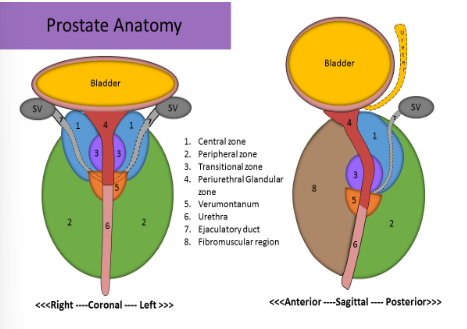
Prostate Zone 2: Central zone
20% of glandular tissue
At base of glands, posterior to urethra
Narrows to a peak at the area posterior to verumontanum
Seminal vesicle and vas deferens ducts merge to form ejaculatory ducts
Ejaculatory ducts coarse through this region to join the urethra
10% cancers originates in this zone
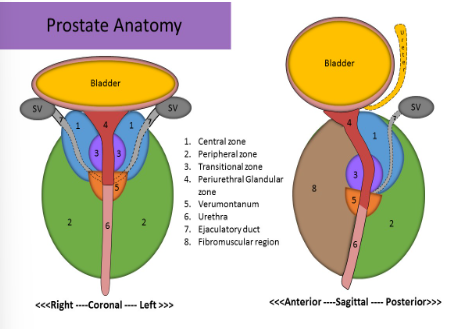
Prostate Zone 3: Peripheral zone
70% of glandular tissue
Posterior and lateral to the distal prostatic urethra
70% of cancers originate here
Less common site for BPH
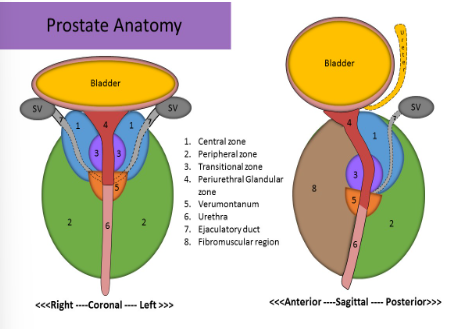
Prostate Zone 4: Periurethral Glandular zone
Glandular tissues that line the proximal prostatic urethra
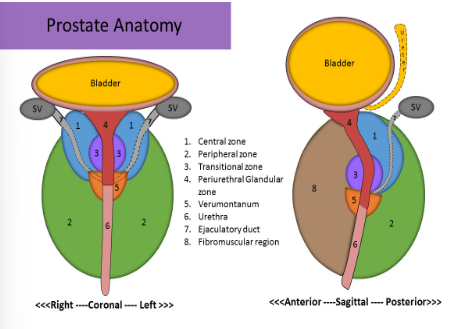
Fibromuscular region
Previously called the anterior zone
Thick sheath covering entire anterior prostate surface
Size of the sheath equates to up to 1/3 the size of the gland
Made of smooth muscle and fibrous tissues
NO glandular tissue = NOT affected by cancer, inflammation or BPH b/c it is NON FUNCTIONAL prostatic tissue
Prostate physiology
Secretes an alkaline fluid that is included in the male ejaculate
Acinar cells produce PSA which is measured to assess prostate health
Prostate-specific antigen (PSA)
Produced by acinar cells
Measured to assess increasing levels of benign and/or malignant tissue
Normal levels usually range from 0ng/ml to 4ng/ml
Levels >10ng/ml usually related to malignancy
Varies with patient age, gland volume, BPH or malignancy
Cancer elevates the PSA much more significantly than BPH
True/False: Not all prostate cancers cause an elevation of PSA
True
Prostatic acid phosphatase (PAP)
Elevated with prostatic cancer
Seminal vesicle anatomy
Paired pouch-like glands that the base of the bladder
Superior and posterior to prostate
Posterior inferior to the bladder and anterior to the rectum
Store sperm and secrete fructose for ejaculation
Secretions mix with prostatic fluid to form semen during ejaculation
Seminal vesicle physiology
Secretes fructose to provide an energy source for sperm and alkalinity to enhance sperm mobility
TA prostate evaluation required a ________ bladder
Full
Transrectal prostate approach
Usually performed only as a Bx guidance since PSA screening was started
Position for Transrectal ultrasound
Pt placed in LLD or lithotomy position
Prostate volume equation
Length x Width x Height x 0.52
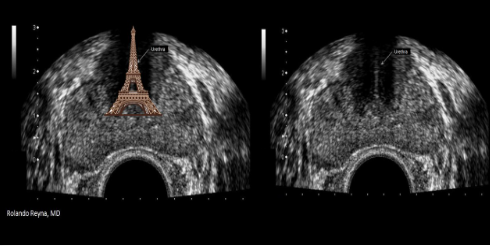
USA prostate
Homogenous mid-level grays
Symmetric oval shape
Smooth
Peripheral zone appears slightly hyperechoic to adjacent parenchyma
Eiffel tower sign
Normal prostate volume
<30mL
USA seminal vesicles
Hypoechoic compared to prostate
Diamond or oval shape
Irregular borders
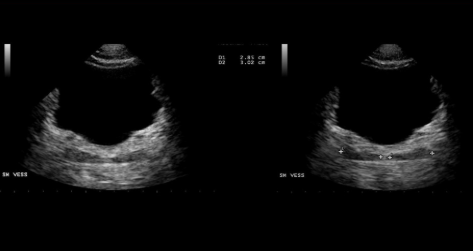
Seminal vesicles
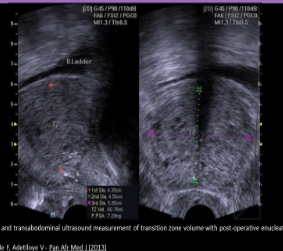
Transrectal prostate
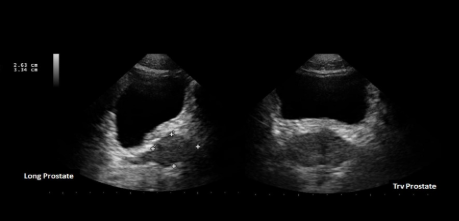
Transabdominal prostate
Benign prostatic hypertrophy (BPH)
Begins as early as 30 yrs of age
Related to testosterone
95% occurs in transitional zone
Increase in gland size
Formation of nodules, may have cystic changes
Corpora Amylacea - benign calcs in central gland caused by waste products collecting acinar cells
Benign prostatic hypertrophy (BPH) Symptoms
Urinary frequency, nocturia, weak urine system, incomplete emptying
Benign prostatic hypertrophy (BPH) causes increase in _____ levels
PSA
Normal PSA levels
0ng/mL - 4ng/mL
USA Benign prostatic hypertrophy (BPH)
Early stages - Inner gland more coarse than peripheral/central zones
Punctate calcifications
Diffuse enlargement
Later stages - nodularity more evident, more calcs, necrosis of cysts
Increased color Doppler in inner gland
Eval kidneys - enlarged prostate can cause urine retention in bladder and hydro
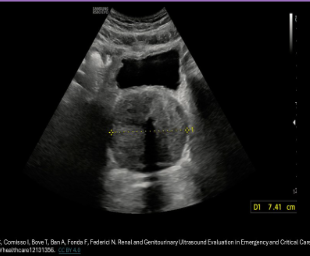
Benign prostatic hypertrophy
Inflammation/Prostatitis
Bacterial or non-bacterial cause
Prostadynia
Fever, pain, urinary frequency/urgency/difficulty
USA Inflammation/prostatitis
Heterogeneous peripheral gland
Hypoechoic halo at the periurethral area
Abscess formation can occur later
Marked hypervascularity
Eval kidneys
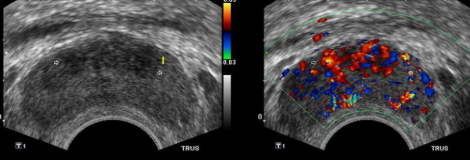
Prostatitis
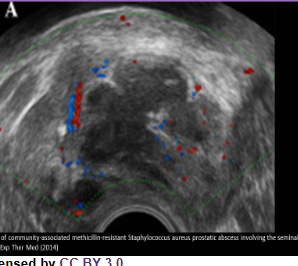
Prostate abscess
Cysts in prostate
Congenital or acquired
Ejaculatory duct cyst can lead to infertility
Simulate cancer on manual rectal exam
Typical cystic characteristics, round, smooth border, anechoic with posterior enhancement
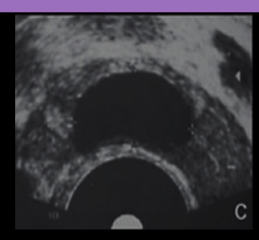
Prostate cyst
Calcifications
Corpora amylacea refers to calcs commonly seen in central zone
Can be related to prior infection
Can be single or multiple
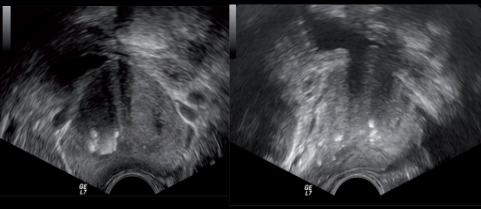
Corpora amylacea
Extra-capsular carcinoma
Limits treatment and decreases survival
PSA levels significantly elevates
PAP levels elevates
Most common after 65yrs and in African American men
Family Hx increases risk
70% in peripheral zone, 20% in transitional zone, 10% central zone
Trans rectal used to measure prostate volume and guide for Bx
Most frequently diagnosed malignancy in a male
Extra-capsular prostate carcinoma
PSA levels 4-10ng/mL
Suspicious for malignancy
PSA levels >10ng/mL
Highly suspicious for malignancy
Prostate Bx
INR levels should be <1.5 to prevent increased risk of hemorrhage from Bx
Pt is placed in decubitus position
Spring loaded Bx device is used to obtain the sample
UTI is contraindication
USA Extra-capsular prostate carcinoma
Focal mass
Most commonly hypoechoic
Only 50% of hypoechoic prostatic masses are cancer
Mat see some shadowing from dense masses
Peripherally oriented mass formation (peripheral zone)
Intra-capsular prostate cancer
Difficult to diagnose
Usually detected by four quadrant Bx
Intra-capsular prostate cancer USA
Bulging of capsule
Disruption of tissues
Hypervascularity
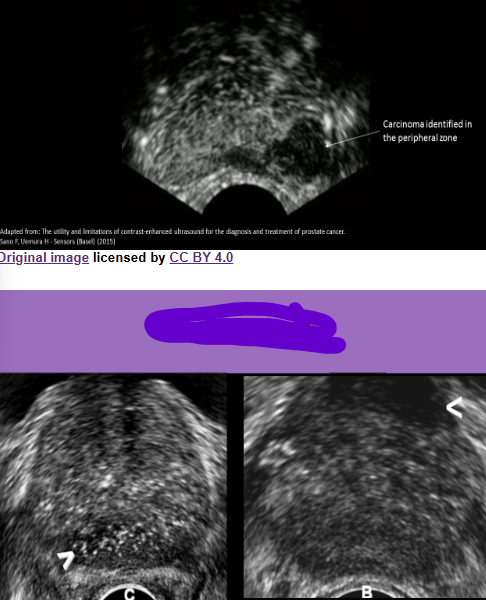
Prostate cancer
Brachytherapy
Used in non-aggressive in situ cancers
Surgical implantation of radioactive seeds into prostate
Sequential scan performed to obtain volume and shape of prostate
Determines number of seeds and seed distribution
Identifies arch interference that limits access to gland for seen implantation
US used to monitor
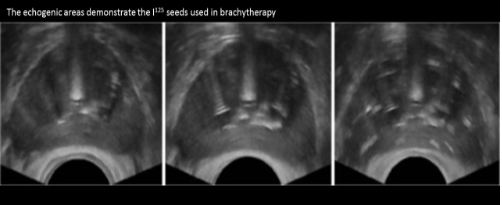
Brachytherapy
Corpus cavernosa
Two main erectile structures of the penis
Sinusoids fill with blood during erection
Covered by tunica albuginea
The right and left cavernosal arteries course through the right and left CC
Glans penis extends over ends of corpora cavernosa
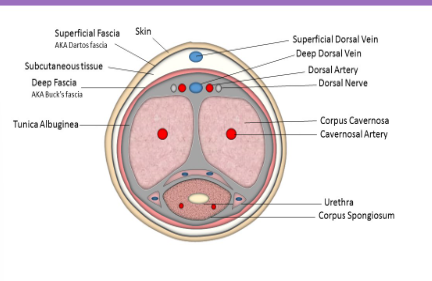
Corpus spongiosum
Urethra and urethral arteries travel through this portion
Covered by tunica albuginea
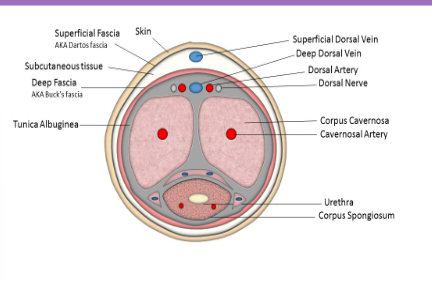
Internal iliac arteries give rise to the internal pudendal arteries, bulbourethral artery, and ___________
Penile arteries
The penile artery branches into the _____________ and cavernosal arteries
Dorsal
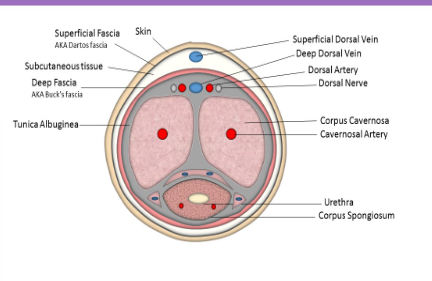
Right and left cavernosal arteries enter the right and left ___, respectively
CC
The __________ arteries are multiple tiny branches of the cavernosal arteries that penetrate tissue
Helicine
Superficial dorsal vein and ________ vein provide the primary venous outflow
Deep dorsal
Indications for penile exam
Erectile dysfunction, priapism, peyronie disease, palpable areas, trauma
Erectile dysfunction
Inability to achieve a full and persistent erection
Can be caused by vascular insufficiency
Other causes include obesity, diabetes, metabolic syndromes, certain medications, peyronie disease, enlarged prostate
Cavernosal artery diameters and velocities are evaluated before and after injection of vasoactive substance
Dorsal vein is also evaluated after injection
Priapism
Unwanted, persistent, painful erection that lasts more than 4 hours
Spontaneous or caused by certain medications
Excessive arterial inflow with inadequate venous outflow
PW used for diagnosis
Requires immediate treatment
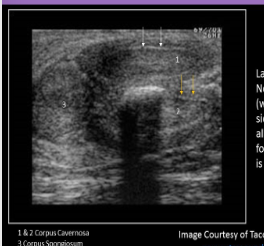
Peyronie disease
Development of scar tissue and fibrous plaque formation that usually involves the tunica albuginea
Causes restriction and curvature of the affected side of the penis during erection
Can be painful
Hyperechoic areas along the outer margins of the corpus cavernosa
Peyronie disease
Penile cancer
Identified on the glans penis or on the foreskin in uncircumscribed men
Most common cancer to affect penis is SQUAMOUS CELL carcinoma
Focal mass is present
Solid and hypoechoic with irregular borders and internal vascularity
Penile cancer Symptoms
Focal area of skin thickening, palpable lump, an ulcer that may bleed, reddish, velvety rash under foreskin, flat, bluish-brown growths, odorous discharge or bleeding underforskin
Penile trauma
Fracture of penis can occur with blunt force during an erection
Corpus cavernosum on one or both sides can be fractured causing subcutaneous bleeding and significant pain
Pts usually describe a pooping sound that occurred curing intercourse followed by significant pain
Ultrasound can be helpful in identifying damage to the soft tissues, vascular and urethra structures
The base of the prostate is just inferior to the _________, while the apex is just superior to the ________
Bladder, urogenital diaphragm
Blood supply to the prostate comes from
Internal iliac arteries
Benign prostatic hypertrophy is most commonly identified in the _________zone, while prostatic cancer is most commonly identified in the_____________zone
Transitional, peripheral
What portion of the prostate is unaffected by inflammation and cancer
Fibromuscular
What is the minimum PSA level that indicates prostatic cancer?
>10ng/mL
The seminal vesicles secrete:
Fructose
_________ should be taken before a prostate Bx, while ________ should be stopped at least 5 days before the procedure
Antibiotics; warfarin
Term used for the shadowing created by dense tissues in the area of the urethra and verumontanum
Eiffel tower sign
The Gleason score is used to classify:
Aggressiveness of carcinoma
2 primary arteries that supply the penis with blood
Dorsal and cavernosal
2D imaging of the penis is used to evaluate _________, while PW Doppler is used to identify ________.
Peyronie disease; Vascular insufficiency
What structure is fractured in cases of penile trauma
Corpus cavernosum