Movement analysis of gait
 Call Kai
 Learn
Learn Practice Test
 Spaced Repetition
 Match
Match Flashcards
 Knowt Play
1/36

There's no tags or description
Looks like no tags are added yet.
Name | Mastery | Learn | Test | Matching | Spaced | Call with Kai | Chat |
|---|
No analytics yet
Send a link to your students to track their progress
37 Terms
In normal gait, during the pre-swing phase the knee flexes to 40 degrees, this is achieved by:
activation of rectus femoris and sartorius during pre-swing
activation of iliopsoas during terminal stance
activation of semimembranosus during pre-swing
none of the above
none of the above - the knee flexes passively
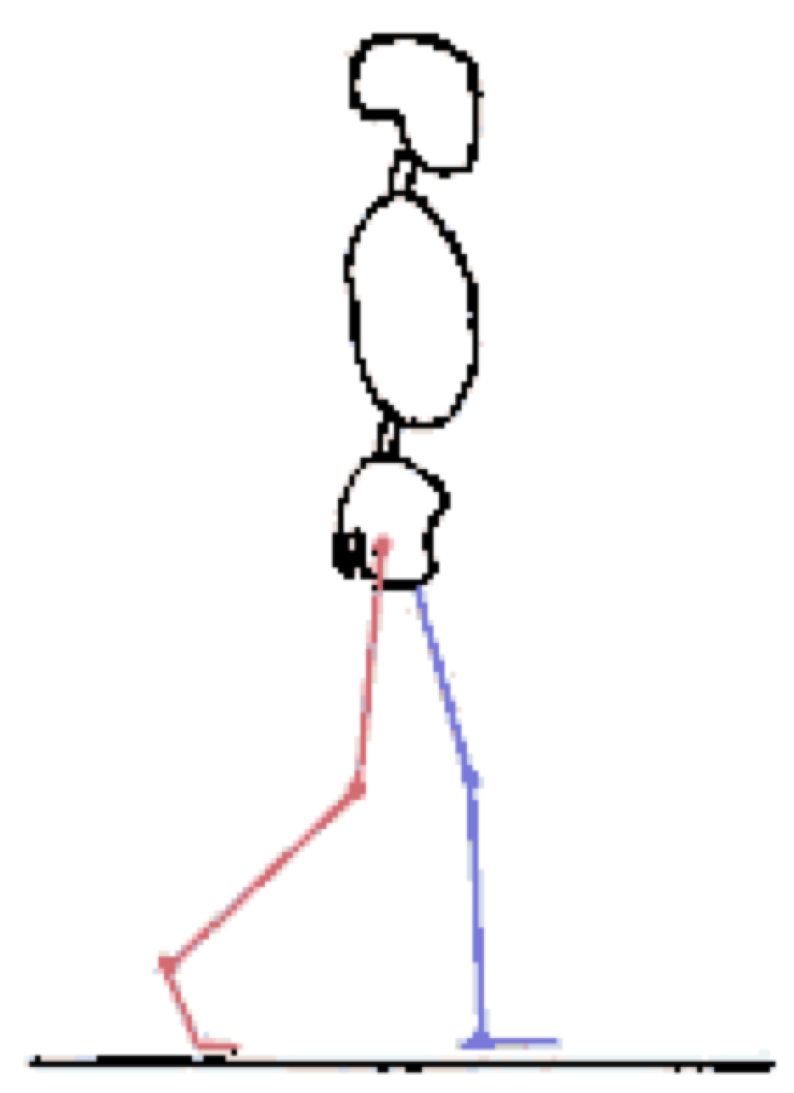
Phase 5: Pre-swing (aka toe off)
the second double stance interval in the gait cycle
ground contact by the blue leg causes the red leg to increase ankle plantar flexion, increase knee flexion, and decrease hip extension
hip: 10 deg hyperextension - adductors
knee: 40 deg flexion - no MM activity
ankle: 15 deg pf - no MM activity of PF - toe rocker)
What is a possible cause of increased plantar flexion seen during stance phase?
excessive knee flexion
weak df
hip flexion contracture
weak hip abd
hip flexion contracture - DF only active in loading - tight hip flexors = torso flexes, hips stay back, knee extends, ankle pf
Three functional tasks of normal gait
weight acceptance
single leg stance
limb advancement
weight acceptance
initial contact (IC) and loading response (LR)
shock absorption, forward progression and stability
single leg stance
midST, terminal stance
forward progress & stability
limb advancement
PSw, ISw, MSw, TSw (all swing phases)
foot clearance and limb advancement
gait deviations
aspects of gait that are not normal
gait parameters
parts of gait we can measure
Ranchos Los Amigos observation gait analysis
compare to norm
perform segmentally
ID major deviations during swing and stance phase (use RLA form)
comment on overall gait parameters (speed, step length, path deviation)
add variations to bring out deviations
hypothesize what impairments may be causing these deviations (atypical movements)
Plantar flexion weakness - stance phase
extensor thrust in MSt to TST (usually chronic)
excessive df (crouched: knee flex) (acute) - knee buckling
Extensor thrust
snapping knee back to genu recurvatum
Quadriceps weakness - stance phase
hyperextension of the knee early in stance (IC or LR)
not very common - quads are first to come back after stroke
hip extensor weakness - stance phase
excessive hip flexion at IC, LR, beginning of midstance
hip abductor weakness - stance phase
trendelenburg/reverse trendelenburg
dorsiflexion weakness - stance phase
foot flat contact or foot slap in LR (beginning of stance)
anterior tib weakness - swing phase
poor clearance - steppage gait
knee flexor weakness - swing phase
difficulty at initial swing
knee extensor weakness - swing phase
doesn’t achieve full extension at TSwing
hip flexor weakness - swing phase
poor swing and limb clearance
absent or decreased HS in stance limb
impairments:
PROM restriction or spastic pf
weak df
sensory dysfunction
excessive df in stance limb
weak pf
comes with increased knee flex
hamstring contracture
excessive pf in stance limb
PROM restriction, spastic, weak pf
hip flex contracture
weak quads (early)
spastic quads
knee hyperextension (thrust) in stance limb
PROM restriction, spastic, weak pf - midstance
quad weakness - loading
hip flex contracture
knee wobble in stance limb
weak pf
quad weakness
sensory dysfunction
Impaired motor control
lack of selective control
alterations in tone
Lack of selective control
co-activation
emergence of primitive synergy patterns
mass flexion or extension patterns (stage 3 motor recovery)
Alterations in tone
hypotonicity or hypertonicity
you observe an extensor thrust (recurvatum) of the knee that occurs during midstance. A possible cause would be?
hamstring weakness
PF weakness
quadriceps weakness
all of the above
PF weakness - calf muscles don’t fire, so the tibia snaps back
causes of gait deviations during WA and SLS
excessive knee hyperextension or extension thrust
recurvatum
pf spasticity
pf contracture (PROM restriction)
weak (poor motor control) of PF if occurring at MSt
weak quads if occurring early in cycle
hip flexion contracture
quadriceps hypertonicity
impaired proprioception at knee
terminal stance places the __________ at any joint during the gait cycle
greatest muscle demand
terminal stance - calf muscle activity _____ and allows _______
peaks, the heel to rise (stops the tibia from going forward)
terminal stance - tibia and ankle become ______ and _______
a rigid lever, push knee into flexion
terminal stance - where stance and _____ are linked
swing
if terminal stance does not happen correctly, neither will ______
pre swing
Forward trunk lean during WA or SLS - causes
intentional to reduce demand on quadriceps
necessary to progress over an excessively pf ankle
use of assistive devices
limited trunk ext ROM (spinal stenosis)
weak hip extensors
hip flexion contracture (restored PROM)
to substitute visual input for impaired proprioception
abdominal pain
movement analysis of task
slide 19