Lecture 5: Control of Microbial Growth + Activity in Food
 Call Kai
 Learn
Learn Practice Test
 Spaced Repetition
 Match
Match Flashcards
 Knowt Play
1/86

Earn XP
Description and Tags
Aka. How to store a ham sandwich
Name | Mastery | Learn | Test | Matching | Spaced | Call with Kai | Chat |
|---|
No analytics yet
Send a link to your students to track their progress
87 Terms
Lecture Outcome: Students will be able to recognize how extrinsic factors influence microbial growth and survival in foods. Students will know to utilize extrinsic factors to control microbial populations in food.
Rubrics for exam questions for intrinsic and extrinsic factors:
Grade A: Students are able to use their knowledge of intrinsic and extrinsic factors to discuss preservation of foods that were not presented in class. Students outline how one extrinsic / intrinsic factor can be replaced by another, or interact (hurdle concept), and describe the consequences for food quality.
Grade B: Students are able to use their knowledge of intrinsic and extrinsic factors to discuss preservation of foods. Students understand the consequences for food quality.
*****What are Extrinsic vs. Intrinsic factors
define
What are they controlled by?
Give examples (4 for Extrinsic) (6 for Intrinsic)
Extrinsic = properties of the environment → CONTROLLED BY the storage environment/ Where you put them
Temp
Presence + Concentration of gases
Relative humidity (rh)
Presence of competing microorganisms
Intrinsic = properties of the food (or plant and animal tissue) → CONTROLLED BY the raw materials (plant, tissues) or by the product formulation/What you put in the food
Physical structures
pH
Moisture content (aw)
Oxidations - Reduction potential (Eh)
Content of nutrients or antimicrobial constituents
(Presence of other microorganisms ONLY FOR ENDOPHYTES of PLANTS )
***EXTRINSIC FACTORS: Questions to Consider/ Key Points
Temp:
What temps do pathogens + spoilage microbes grow at?
Psychrotroph, psychrophile, mesophile, thermophile
DANGER ZONE
Psychotropic bacteria (3)
What happens to microorganisms between 0-100 degrees?
Are there other effects temp can have on food systems
Gaseous environment
Can we suffocate bacteria or molds?
Competing microorganisms
Do micrbs influence each other?
How do I store a ham sandwich
****What are the 3 CARDINAL TEMPERATURE PARAMETERS (important factor determining growth of microorganisms in food) for controlling bacterial growth
MINIMUM temp (T min)
OPTIMUM temp (T opt)
MAXIMUM temp (T max)
These parameters are specific for the conditions + the bacterial species
*****What is the T min, opt + max for E.coli?
min = 7-8 Celsius
opt = 39 (around body temp_
max = 45-58

*****What are the 5 classifications of bacteria based on temperature req.?
Define each
What is the optimum temp for each
Psychrophiles: LOVE cold (<20)
Psychrotroph: TOLERATE cold (optimum >20 but can grow at 5)
Adapted to “Ambient” temp in the Environment
Mesophiles: Love Ambient (30-40)
Adapted to VERTEBRATE animals
Thermophiles: Love Warmth (>~45)
Hyperthermophiles: love extreme warm (>80)
******Where are Psychrophiles Relevant in food? Are they common in food?
WHY?
NOT COMMON in food but relevant in COLD WATER FISH
WHY?
the anomaly of water which has the highest density @ 4 degrees Celsius
*****What is an example of a Psychrotrophic PATHOGEN vs. SPOILAGE micrb?
Pathogen = LISTERIA monocytogenes
Soilage = Pseudomonas spp.
****True or false: Most foodborne pathogens are MESOPHILES
Why or why not?
TRUE
their optimal growth temperature range matches both body temperature and standard room conditions
********What is the MIN vs .MAX temp that a Mesophile can grow at?
MIN = 7 (no growth at refrigerator temps)
MAX = 40-60 Celsius
****What are 2 examples of Mesophiles
E. coli
Staph. aureus
*****Where are Thermophiles Relevant in food? Give an example of a Thermophile
Relevant for spoilage in TROPICAL CLIMATES where the temp can get to ~45 degrees celsius
eg. Geobacillus stearothermophilus
******Are Hyperthermophiles relevant in food? WHY?
NO
they cannot grow or survive at the temperatures where food is processed, stored, and consumed
******What is the DANGER ZONE?
What is the Temp range in both Celsius + Fahrenheit
What is the MAX # of hours in the danger zone?
4-60 C or 40-140 F MAX HRS = 4
Majority of Microbes are mesophiles thus the danger zone is this range
****What are 7 key temps in both C + F?

***When are C + F the same temp?
-40

********What happens to microorganisms between -20 -120 degrees?
>100-121 C = DESTRUCTION of most Bacterial endospores (Req, High Temp)
60-80+ C = Vegetative cells killed (above 60 = no mesophile growth)
Below 4 = Growth of most pathogens Inhibited
-20 = PARASITES KILLED however bacteria are NOT (they can survive but are not growing)
Freezing food = Inhibit growth of parasites b/c no water available

******What are 3 MICROORGANISMS that can still Grow (Albeit slowly) at 4 degrees or below?
Listeria Monocytogenes
Yersinia Enterocolitica
Clostridium botulinum group 2 (type E)
****What is the IDEAL + LOWEST temp to store MEAT without freezing it?
-1.5 C
freezing meat compromises quality

*******What is the MAX number of CELLS you can have in 1 gram or mL?
HOW IS THIS CALCULATED?
MAX in 1 gram/mL = 10^12
1 bacteria = 1 micrometer
1 cm = 10 000 micrometers = 10^4 bacteria max/cm
1cm² = 10^4 × 10^4 = 10^8 = 10^8 bacteria max/cm²
1cm³ = 1ml = 1g = 10^4 × 10^4 x 10^4 = 10^12 bacteria max/cm³
******What are the 3 magic numbers of food Microbiology
What do each of these 3 numbers mean/represent?
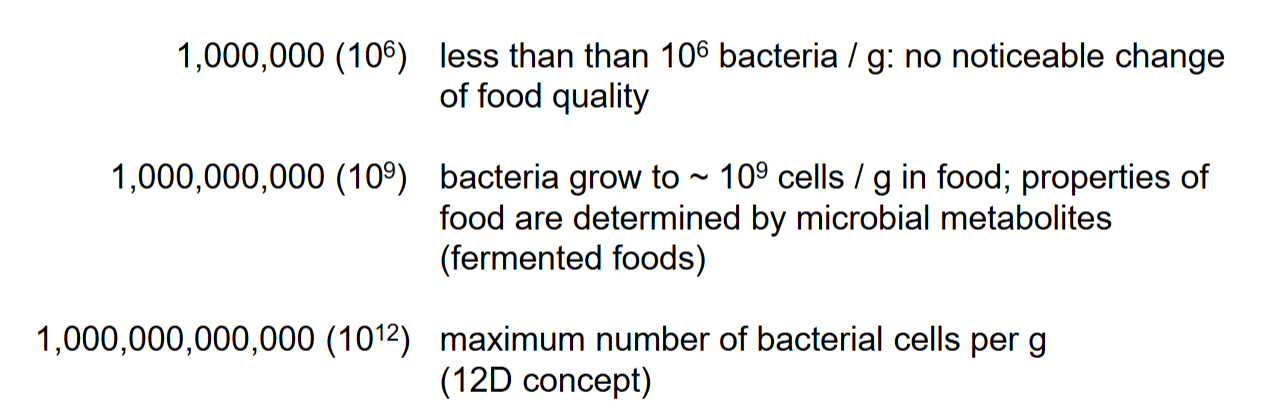
******How does YEAST relate/compare to Microbes in terms of these 3 Magic numbers?
yeast = 20-50x greater SA → corresponding numbers are 20-50x’s smaller
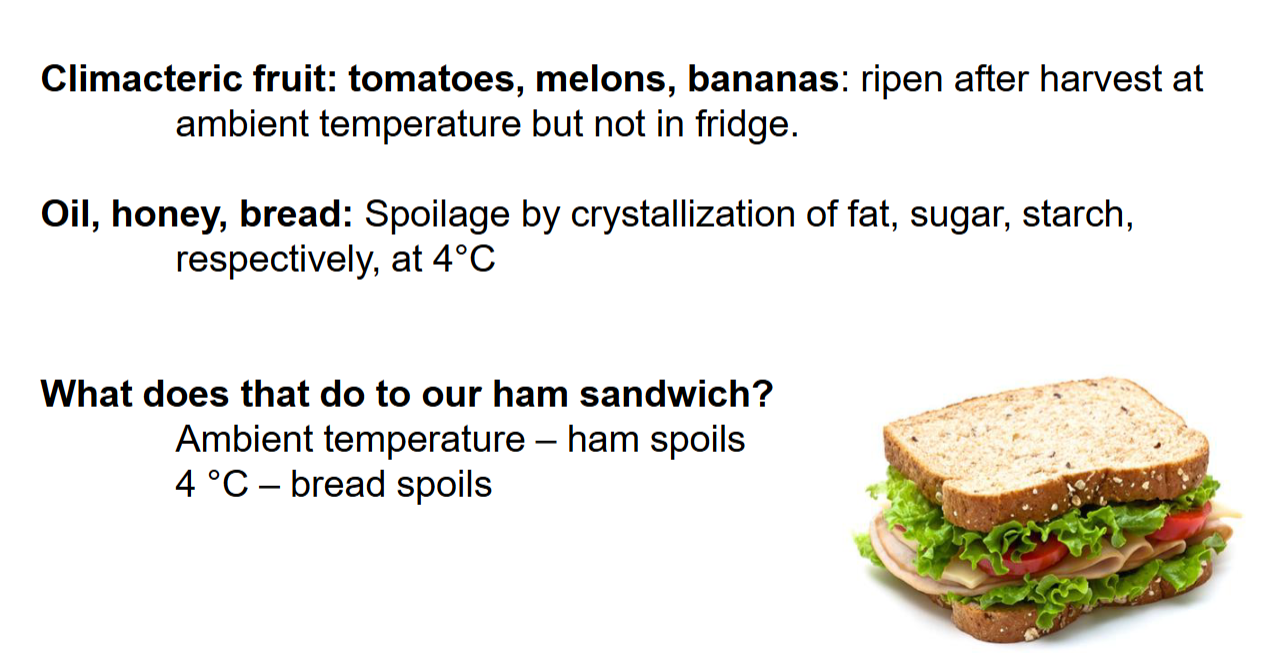
*****What are some examples of Foods NOT to refrigerate + WHY?
What does that do to our ham sando?
Fungi Conidiospores + Ascospores vs. Bacterial endospores
Fungal spores are primarily built for reproduction and spreading
bacterial spores (endospores) are strictly survival pods
****How to kill/destroy spores (fungal + bacterial)
Bacterial = HEAT RESISTANT
cannot be destroyed by tools in the household
must use: High pressure, Autoclave, UV, radiation etc.
Fungal spores = most are HEAT SENSITIVE as vegetative cells however there are exceptions
******What are the 3 Fungal species that can WITHSTAND PASTEURIZATION?
What foods/ processes are they associated with?
Byssochlamys fulva
B. nivea
Aspergillus fischeri
***Only associated with FRUIT JUICE processing
***Extrinsic factor: Gaseous environment → What are the AMBIENT conditions of O2 + N?
20% O2
80% N
***What are 2 ways to MODIFY the atmosphere/gaseous environment?
What types of organisms does each way inhibit?
Take away O2 (Anaerobic): Vacuum or N2 inhibits growth of Aerobic organisms
Add CO2 (>10%): Inhibit growth of aerobic but NOT LAB(lactic acid bacteria)
*****You are preserving Fresh meat 2 ways 1) Aerobic 2) anaerobic
Does it spoil faster under AEROBIC or ANAEROBIC conditions?
Does the type of Microorganism + type of Spoilage change? If so how: which bacteria and what type of spoilage?
Food spoils FASTER under aerobic conditions
YES the type of Microorganism + type of Spoilage changes
Aerobic = aerobic bacteria = Putrefaction + Off odors due to the release of AMMONIA + Other VOLATILE compounds
Anaerobic = LAB = SOURING due to the production of acid during their metabolism

****AEROBIC REGRIGERATED storage of meat. What is the main spoilage organism?
How does it spoil the meat
What things are produced?
PSEUDOMONAS spp.
OXIDATIVE breakdown of proteins + Lipids
Odor + slime after cell count 10^7 (remember that 10^6 is the minimum number of microbes /g or mL to have any real effect
****AEROBIC REGRIGERATED storage of meat. What is themain type of spoilage organism? give examples of 2
How does it spoil the meat
What things are produced?
LAB
Carnobacterium (doesn’t really change the meat) + Leuconostoc (sucrose → slime)
Fermentation of carbs → lactic + acetic acid
Sulphide odors due to conversion of A.A.
The result of spoilage is strain specific but most have no noticeable change
*****How do ANAEROBIC conditions affect our ham sandwich? Is Anaerobic the best method of storage?
Anaerobic =
Inhibit growth of Putrefying meat spoilage bacteria
Inhibit fungal spoilage of bread (fungi = mild strict aerobes)
Salad is living tissue that requires O2
salad will wilt in days in anaerobic conditions
*****Extrinsic factor: rh (relative humidity) how does this effect the quality of the food?
It changes the water activity of food (see intrinsic factors)
the Water activity will equilibrate to the rh of the room

****Does HIGH or LOW Rh + Refrigeration Support local mold growth? Why?
HIGH Rh + Refrigeration = Condensation = mold growth
Hot air holds more water than cold (cooling warm air = condensation) Presence of water = bacterial growth
*****Extrinsic factor: Competing microorganisms what role do they play in the shelf life of foods?
They COMPETE with potential harmful spoilage microorganisms + PREVENT GROWTH
eg. B. cereus + B amyloliquefaciens

********LAB is a PROTECTIVE CULTURE against Which pathogenic Microorganism?
Knocks out LISTERIA
LAB (non-pathogenic) grows faster = inhibit listeria growth
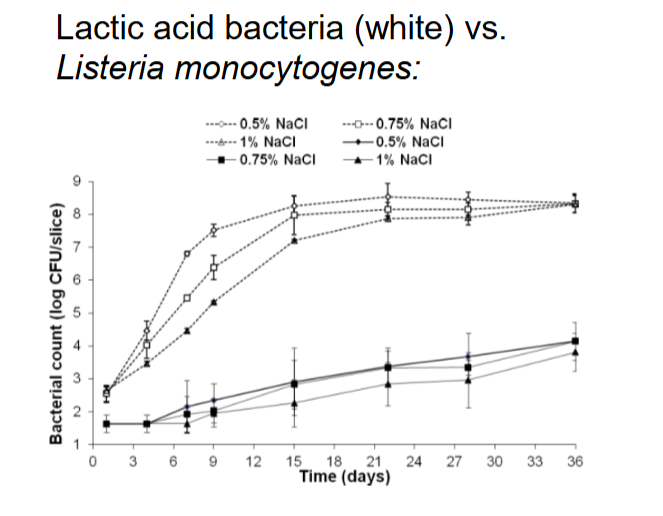
What are 2 other examples of Competing microorgnisms?
LAB + Staph. aureus
Bacillus subtilis + Mycelial molds
*****What are the 6 Intrinsic Factors again?
Properties of food (or plant + animal tissue) that are inherent part of the food system
Physical structures
pH
Moisture content (aw)
Oxidations - Reduction potential (Eh)
Content of nutrients or antimicrobial constituents
(Presence of other microorganisms ONLY FOR ENDOPHYTES of PLANTS )
*****What are some examples of PHYSICAL barriers? How do they contribute to the shelf life of a food?
Natural barriers → shells + peels
Manufactured packages → cans + cartons
Meat Tissue → Muscle tissue is always sterile on the inside only the surface may contain bacteria
These LIMIT ACCESS of microorganism
Water droplets in butter = important for microbial stability of butter

****How are the water droplets in BUTTER a Physical barrier to microbial growth?
The water droplets are SMALL (<10 micrometers)
This is too small for bacteria to grow ← 1 microbe is 1 micrometer thus only 10 cells possible and 10^6 cells are required to cause any detectable change to the food quality
****Intrinsic Factors: Nutrients + Antimicrobial compounds. How do Nutrients affect the shelf life/ microbial growth of a food?
Does the food have everything needed for microbial growth and are these nutrients available to the microorganisms?
****Enzymes produced by a microorganism influence its ability to utilize different E sources
Starch utilization requires what type of enzymes?
What about lactose utilization?
What about proteins?

****Fastidious vs. Frugal organisms
Give an example of each
Frugal/non fastidious = don’t need much to grow (Inorganic N + CO2)
eg. Pseudomonas spp. → grows in ionized water
Fastidious = Require a lot of sugars, complex a.a. and vitamins
eg. LAB
(prob don’t need to know this detailed) Classify the nutritional fastidiousness of Gram-negative bacteria, Gram-positive bacteria, and Lactic Acid Bacteria (LAB)
Gram-negative bacteria (e.g., Pseudomonas, E. coli): Non-fastidious; can synthesize essential nutrients from simple carbon/nitrogen sources.
Gram-positive spore-formers (e.g., Bacillus): Moderately fastidious.
Lactic Acid Bacteria (LAB) (e.g., Lactococcus, Lactobacillus): Highly fastidious; require pre-formed amino acids, B-vitamins, and nucleic acid bases due to limited biosynthetic pathways. ==
****Intrinsic Factors: Nutrients + Antimicrobial compounds. List the 5 Antimicrobial compounds mentioned in the slides + Their main mechanism
Lysozyme= Hydrolyze cell wall (peptidoglycan → make them good at gram + targets b/c no outer membrane to protect the peptidoglycan)
Lactoperoxidase system = SCN- + H2O2 → OSCN- (the thing that inhibits the bacteria) + H2O
reaction with thiol groups → oxidative stress, OSCN inactivates microbial enzyme systems.
Isohumulones= permeabilizes bacterial membranes
Essential oils = Phenolic compounds in plants → lipids → Interfere with lipid membranes
Isothiocyanates = generated by Glucosinolates → oxidize thiol groups in proteins
****Which of the Antimicrobial compounds are found in EGG WHITES + saliva?
Lysozymes
****Which of the Antimicrobial compounds are found in RAW MILK?
Lactoperoxidase system
****Which of the Antimicrobial compounds are found in Hops from beer?
Isohumulones
****Which of the Antimicrobial compounds are found in Garlic onion and mustard?
Isothiocynates
ground beef keeps will if mixed with 20% what?
GARLIC
Isothiocyanates oxidize thiol groups in proteins
What are 2 examples of essential oil components found in plants?
Thymol + carvacrol
****How are Plant vs. Animal Defense systems different (Antimicrobial compounds)
Mechanism | PLANT: Disruption of bacterial membranes, proton motive force collapse, and intracellular leakage | ANIMALS: Enzymatic cell wall hydrolysis, essential ion/nutrient chelation |
Animal defense = often proteins = denature in high heat
How does physical damage or processing (e.g., slicing, peeling, grinding) affect intrinsic barriers and microbial shelf-life?
Damage breaks mechanical barriers, releasing nutrient-rich cellular fluids. This directly exposes inner sterile tissues to surface contaminants, increases available water/oxygen diffusion, and drastically shortens lag time, accelerating microbial growth and spoilage.
pH formula?

*****MOST pathogens do NOT grow at what pH?
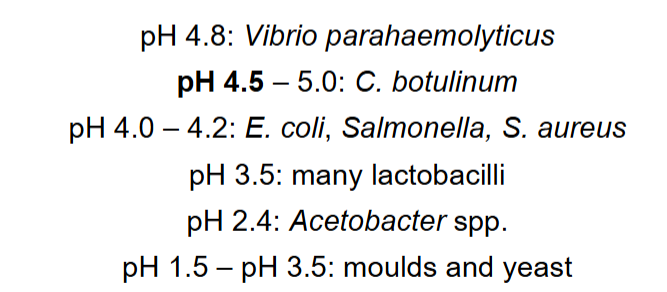
<4.5
******What are 3 PATHOGENS that still grow at <4.5 pH
What are their respective pH min (the lowest pH they can still grow at)
Salmonella (4.0)
E. coli (4.0)
S. aureus (4.2)
*****Most bacterial endospores including C. botulinum DO NOT germinate at what pH?
< 4.5
****What is the 1 exception of “Most bacterial endospores including C. botulinum DO NOT germinate at what pH?”
Alicyclobacillus acidoterrestris
spoilage of fruit juices
****What are the microorganisms that DO GROW at pH <4.5?
LAB
Yeast
Mold
****What is a HIGH vs. LOW acid food?
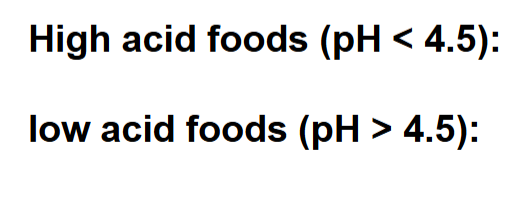
****How should processing differ between a HIGH vs. LOW acid food for preservation?
HIGH acid only needs pasteurization b/c most Endospores do not germinate at such pH. The only microorganisms you need to get rid of are LAB, Yeast + mold which can be eliminated using the pasteurization process

*****The Inhibitory effects of __________ is STRONGER than the inhibitory effects of pH
ORGANIC ACIDS
Lactate + Acetate
Naturally found in plant foods + Fermented foods
What is the Critical pH benchmark for C. botulinum
4.5
Minimum pH value for growth in some microorganisms in food
Note C. botulinum, E.coli Salmonella + S. aureus, LAB + Molds and yeast

*****What are some examples of Acidity change during storage?
Tomatoes + other climacteric fruits: INCREASE in pH by 0.5 during ripening
Souring of dairy
Alkalinization of acid + fermented foods as a result of microbial metabolism
mold growth on fruits, yeast + mold in dairy
Is low pH useful for preservation of ham sandwiches?
NO
the sensory quality of both ham and Bread suffers if pH is too low
****What is the WATER ACTIVITY formula?

Define Water activity
Availability of free water for microbial processes
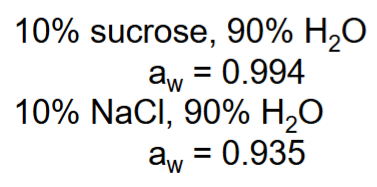
The minimum Aw for growth is dependent on the SOLUTES. How does adding Sucrose vs. NaCl affect water activity???
Both reduce the water activity but SALT does more than sucrose at equal concentrations due to ion dissociation and stronger water binding.
remember aw is measured by amount of available water
at the same aw sugar solutions are less inhibitory than salt
****How does Mold vs. yeast vs. bacterial aw requirements differ for growth?
Bacteria = needs the MOST water available = Higher aw
Yeast = second (around 0.88)
Mold = needs the LEAST water available = lower aw

What is the aw for 2% NaCl vs. 10%

*****What is the minimum aw for LISTERIA MONOVYTOGENES?
0.9 - 0.93
******No toxins are prod from S. aureus below What aw?
0.92
******Below what aw is the growth of most spoilage bacteria inhibited?
0.9

*****Halophiles + halotolerant bacteria vs. Osmotolerant yeast vs. Xerophilic molds
define each term
List the minimum aw for each
Osmotolerant = concentration of ORGANIC compounds eg. sugar

****What are 3 ways aw is decreased?

What is the importance of Oxidation-Reduction potential in food?
DEFINE O/R potential

What is a Oxidizing vs. Reducing AGENT

What is O/R expressed by? What symbol

Is a food with a O/R of +816 mV oxidizing agent or reducing? what about -421 mV?

Which foods typically have high positive redox potentials (oxidizing agents) vs. Med vs. Reducing (agents) potential and what types of microorganisms predominate in these environments?

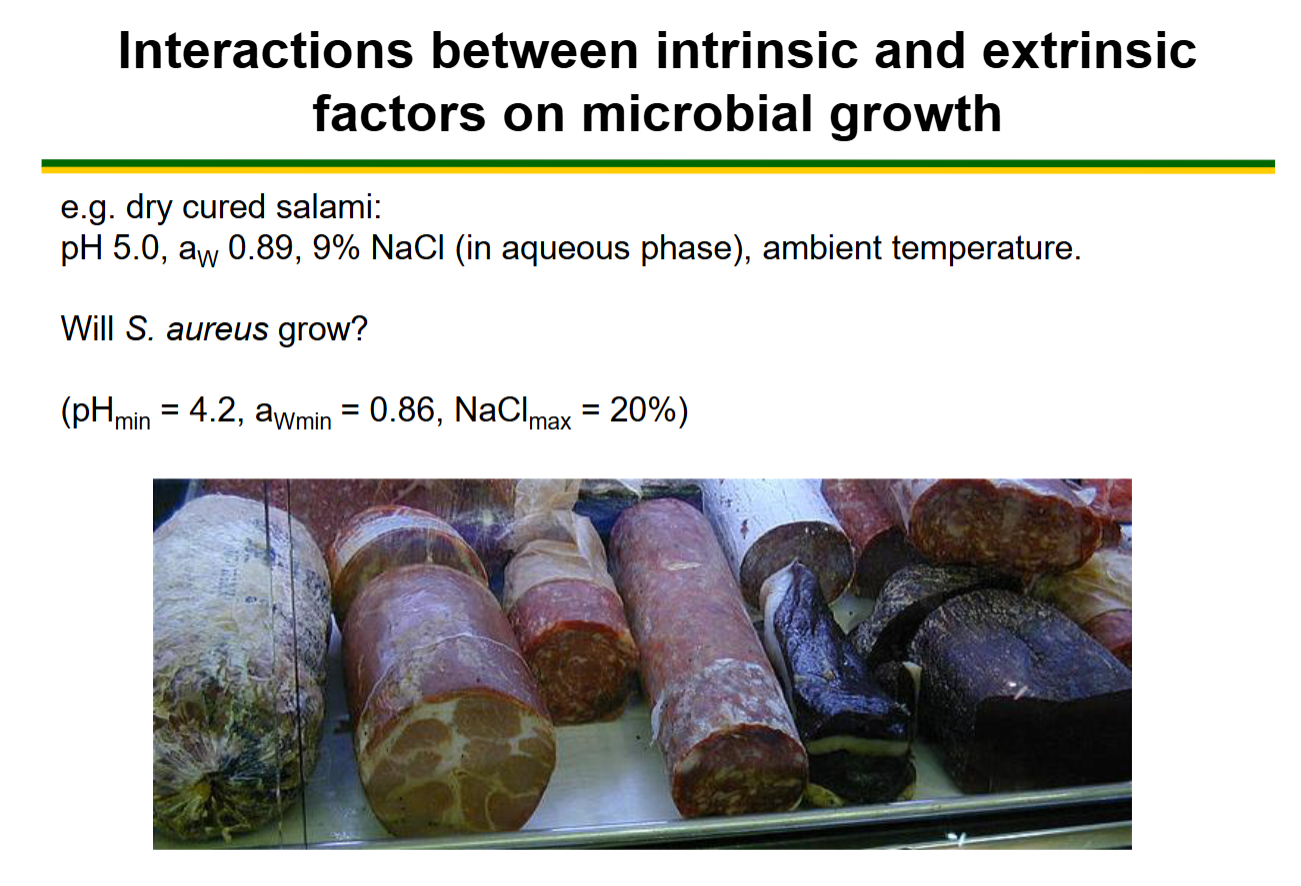
WHY or WHY NOT?
NO it will not grow
Hurdle Concept
under multiple stress factors, a microorganism must be able to tolerate all individual factors simultaneously. While the dry cured salami meets the individual tolerance thresholds for S. aureus, the combined (interacting) effect of these suboptimal conditions inhibits growth.
******Define the HURDLE CONCEPT
Sequence or simultaneous presence of stress → food safety is achieved through their synergistic and cumulative inhibitory effects.
combination of multiple suboptimal environmental factors (hurdles) to preserve food and ensure safety, rather than relying on a single, extreme preservation method.
a)Independent/Sequential Hurdles: Because the hurdles act independently, the organism must be stopped by a single hurdle taller than its tolerance limit, or by the cumulative effect at the final step.
b)Synergistic/Interactive Hurdles: Shows how sub-lethal hurdles act together. As multiple suboptimal parameters are combined, the hurdle height effectively increases, preventing microbial adaptation and inhibiting growth much earlier in the process.

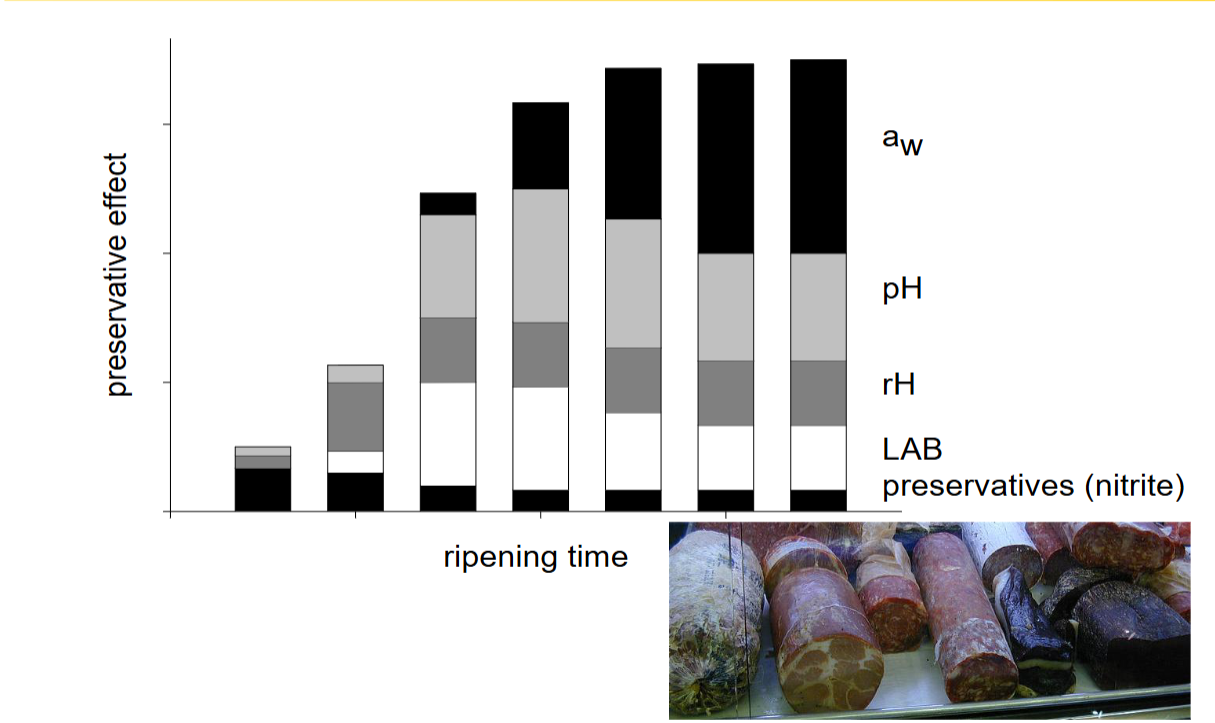
More hurdles = bigger preservative effect
