5.4 Plant Hormones
 Call Kai
 Learn
Learn Practice Test
 Spaced Repetition
 Match
Match Flashcards
 Knowt Play
1/21

Name | Mastery | Learn | Test | Matching | Spaced | Call with Kai | Chat |
|---|
No analytics yet
Send a link to your students to track their progress
22 Terms
Define what is meant by a tropism.
Response of a plant to a stimulus
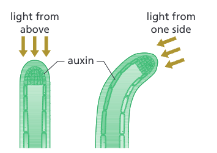
Define phototropism.
Response of a plant to light
Define gravitropism/geotropism.
Response of a plant to gravity
State 3 plant hormones.
Auxin
Gibberellins
Ethene
Describe what unequal distributions of auxin cause.
Unequal growth rates in plant roots and shoots.
Fill in the table below:
Give and describe the tropisms of different parts of a plant.
phototropism | geotropism/gravitropism | |
positive | __________
| __________
|
negative | ______________ | __________
|
+ phototropism — shoots
auxin collects on shaded side of shoot → more growth
shoot bends towards light → more photosynthesis
+ geotropism — roots
auxin collects on lower side → inhibits growth
upper side grows more → grows down
higher levels of water + nutrients
provides stability for plant
- phototropism — roots
- geotropism — shoots
auxin collects on lower side → stimulates growth
plant grows up — light levels likely to be higher
Describe the function of gibberellins.
Initiates seed germination
Describe the function of ethene.
Controls cell division
Controls ripening of fruits
State the independent, dependent, and control variables for investigating the effect of light or gravity on newly germinated seedlings.
Independent — light levels
Dependent — height of seedlings
Control
type of seed
volume of water used to water seedlings
no. of germinated seeds
Describe the sources of error when investigating the effect of light or gravity on newly germinated seedlings.
Temperature — affects growth
Small sample size
Seedlings in same petri dish receive diff. amounts of sunlight
Measuring slanted heights of seedlings
When investigating the effect of light or gravity on newly germinated seedlings, which group of seedlings would you expect to grow the most?
Explain your answer.
Full sunlight
Light needed for photosynthesis
plants don’t have light intensity as limiting factor
Explain why a mean height of the seedlings is used when investigating the effect of light or gravity on newly germinated seedlings.
Seedlings may be diff. heights even if in same dish
Mean = more representative values that can be compared
Explain why you must hold the seedlings straight when you are measuring them.
Seedlings bend → light when growing (phototropism)
Full length can be measured
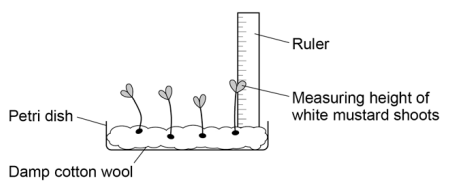
Describe a method to investigate the effect of light or gravity on newly germinated seedlings.
Set up apparatus 1
ensure cotton wool is soaked in equal volumes of water
Let seeds germinate in warm place
Remove excess seeds — each dish has same no.
Measure height of each seedling
Put a dish in each place:
full sunlight
partial sunlight
darkness
Measure height every day for 5 consecutive days
Calculate a mean height for each area.
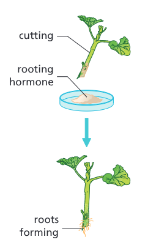
Give three uses of auxins and explain why it is used for this.
Weed killers — causes cells to grow rapidly → cell death
Rooting powder — fast plant growth
Tissue cultures
Give a use of ethene and explain why it is used for this.
Food ripening
Fruit harvested while unripe
Can be ripened just before it is sold
Give three uses of gibberellins.
Ends seed dormancy
Promotes flowering
Increases fruit size
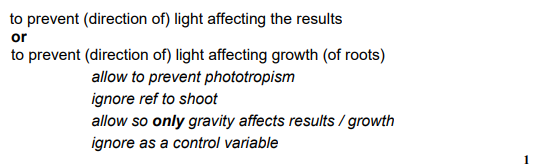
![<ul><li><p>A student investigated the effect of gravity on the growth of bean seedlings.</p></li><li><p>The student set up apparatus A and apparatus B. </p></li><li><p>Figure 2 shows both sets of apparatus</p></li></ul><p>Give the reason why the student placed both sets of apparatus in the dark. [1 mark]</p>](https://assets.knowt.com/user-attachments/6191bd5a-4eb8-43c5-a105-6f03a888b796.png)
A student investigated the effect of gravity on the growth of bean seedlings.
The student set up apparatus A and apparatus B.
Figure 2 shows both sets of apparatus
Give the reason why the student placed both sets of apparatus in the dark. [1 mark]
To prevent the direction of light affecting the results.
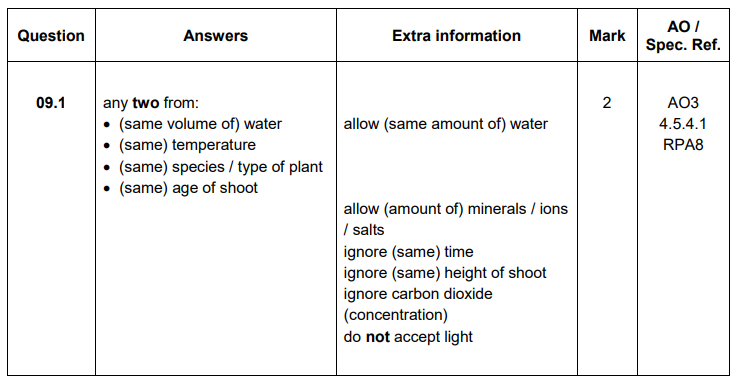
![<ul><li><p>Students investigated the response of plant shoots to one-sided light box.</p></li><li><p>Figure 13 shows how the students set up three experiments.</p></li></ul><p>Suggest two control variables the students should have used in their investigation. [2 marks']</p>](https://assets.knowt.com/user-attachments/86d5598c-50c3-4533-bf65-015979ba5070.png)
Students investigated the response of plant shoots to one-sided light box.
Figure 13 shows how the students set up three experiments.
Suggest two control variables the students should have used in their investigation. [2 marks']
Same volume of water
Same temperature
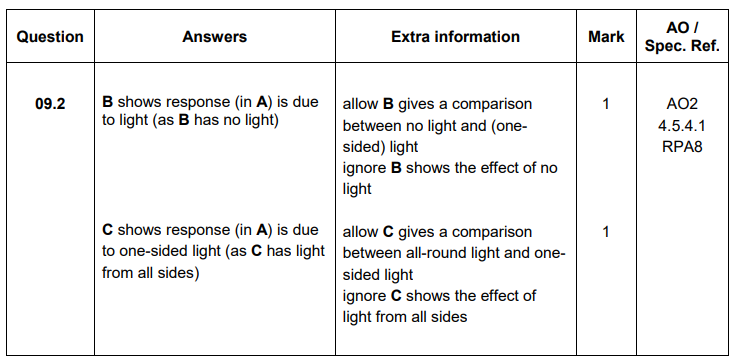
![<ul><li><p>Students investigated the response of plant shoots to one-sided light.</p></li><li><p>Figure 13 shows how the students set up three experiments.</p></li></ul><p>Describe how experiment B and experiment C acted as controls for the investigation. [2 marks]</p>](https://assets.knowt.com/user-attachments/4529b712-367f-40d5-a3d1-6a1c78e1fcf6.png)
Students investigated the response of plant shoots to one-sided light.
Figure 13 shows how the students set up three experiments.
Describe how experiment B and experiment C acted as controls for the investigation. [2 marks]
B shows that the response in A is due to light as B has no light.
C shows that the response in A is due to one-sided light as C has light from all directions.
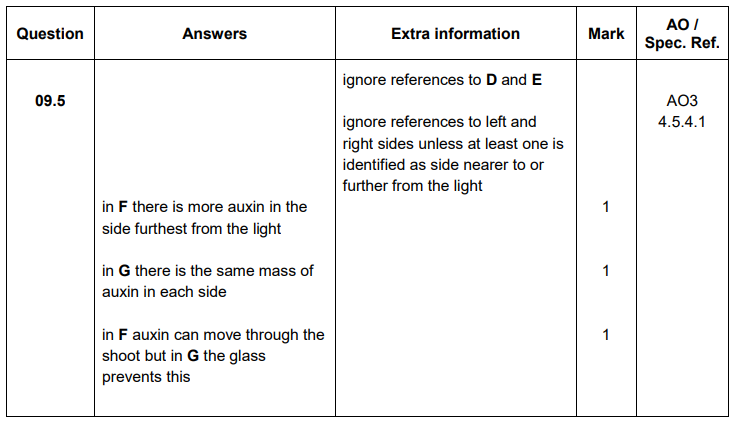
![<ul><li><p>Auxin is a plant hormone. </p></li><li><p>Auxin is made in the shoot tip.</p></li><li><p>Scientists investigated the role of auxin in the response of shoot tips to light. </p></li><li><p>This is the method used:</p><ul><li><p>Grow four seedlings in the dark for a few days.</p></li><li><p>Cut the tip off the shoot of each seedling.</p></li><li><p>Place each shoot tip on a small block of agar jelly.</p></li><li><p>Place the shoot tips and agar in different conditions as shown in Figure 14. </p></li><li><p>After 24 hours, measure the mass of auxin in the agar blocks.</p></li></ul></li><li><p>The numbers under each block show the mass of auxin that diffused into the blocks from the shoot tips. </p></li><li><p>The mass of auxin is given in arbitrary units.</p></li></ul><p><strong>A scientist made a hypothesis: </strong></p><p><strong>‘Light causes auxin to move from the side of the shoot nearest to the light to the side furthest from the light.’ </strong></p><p><strong>Describe the evidence from Figure 14 which supports the hypothesis. </strong>[3 marks]</p><p></p>](https://assets.knowt.com/user-attachments/5176259c-5b3a-462f-809e-9eaa5107fa24.png)
Auxin is a plant hormone.
Auxin is made in the shoot tip.
Scientists investigated the role of auxin in the response of shoot tips to light.
This is the method used:
Grow four seedlings in the dark for a few days.
Cut the tip off the shoot of each seedling.
Place each shoot tip on a small block of agar jelly.
Place the shoot tips and agar in different conditions as shown in Figure 14.
After 24 hours, measure the mass of auxin in the agar blocks.
The numbers under each block show the mass of auxin that diffused into the blocks from the shoot tips.
The mass of auxin is given in arbitrary units.
A scientist made a hypothesis:
‘Light causes auxin to move from the side of the shoot nearest to the light to the side furthest from the light.’
Describe the evidence from Figure 14 which supports the hypothesis. [3 marks]
In F there is more auxin in the side furthest from the light
In G there is the same mass of auxin in each side
In F auxin can move through the shoot but in G the glass prevents this
A farmer sprayed an apple tree with gibberellin.
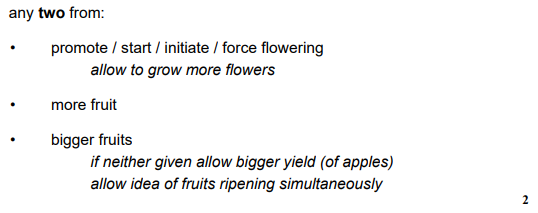
Suggest two reasons why the farmer sprayed the apple tree with gibberellin. [2 marks]
To initiate flowering
To grow bigger fruits