Cancer- Midterm (ALL terms + definitions)
 Call Kai
 Learn
Learn Practice Test
 Spaced Repetition
 Match
Match Flashcards
 Knowt Play
1/100

Earn XP
Description and Tags
All terms + Definitions
Name | Mastery | Learn | Test | Matching | Spaced | Call with Kai | Chat |
|---|
No analytics yet
Send a link to your students to track their progress
101 Terms
Homeotic Genes
a group of genes that control the pattern of body formation during early embryonic development. These encode transcription factors that direct cells to form various parts of the body.
How do homeobox genes relate to homeotic genes?
They are at of one another and are both present in plants/animals.
Homeobox
180 bp long DNA segment present Homeobox genes.
Homeodomain
60 AA protein domain encoded by the homeobox region
How do homeodomains bind DNA
The second and third helices form a helix-turn-helix structure
Hox Genes
These are a type of homeobox genes (which are a type of homeotic gene) and these were discovered in the fruit fly and present in all bilaterian animals.
Purpose: set up the correct positioning of body parts in an organism along the anterior-posterior axis.
Why are hox genes important?
They have spatial and temporal collinearity in expression over AP axis. ex: 3’ genes are expressed more anterior and earlier and 5’ genes are expressed more posterior and later..
What happens if hox genes are not present
No lumbar vertebrate is formed/ribs project from the posterior vertebrae
ex: Synpolydactyly Type II, characterized by distal limb malformations where 2 digits are fused together.
HOXB13 development
Development and maintenance of skin, required for normal differentiation/secretory function of prostate gland.
HoxB13 in cancer
-mediates tamoxifen resistance and invasiveness in human breast cancer
-promotes cell proliferation + tumor growth in ovarian cancer.
Wnt Signaling Pathway
Plays important roles in embryonic development. Stem cell fate determination/adult tissue self renewal. Proliferation of crypt progenitor cells in the intestinal epithelium and terminal differentiation of Paneth cells. Required for hair follicle establishment. Induces osteogenic differentiation.

How is the Wnt pathway altered in cancer
-important role during development
-should be consequently downregulated in differentiated cells
-abnormal activation of the Wnt/b-catenin pathway that has been reported as one of the predisposing factors in many cancers.
What can increase the b-catenin levels?
mutations in that gene
abnormalities in the b-catenin destruction complex
mutations in APC
overexpression of Wnt ligands
Loss of Wnt pathway inhibitors or decreased activity of regulatory pathways
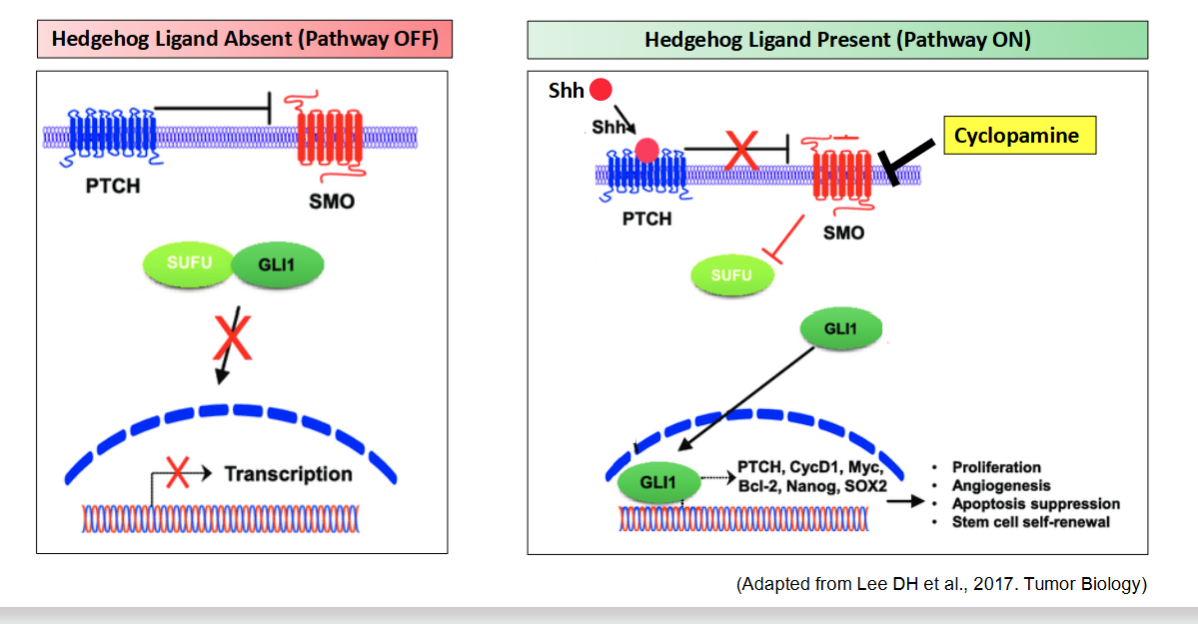
Walk me through the Hedgehog Pathway
This starts with a SHH ligand binding to the receptor and this triggeres Gli proteins to move into the cell nucleus and turns genes off/on to guide cellular growth
What are common themes shared between development and cancer
development requires precise spatail/temporal expression of several genes and activation of signaling pathways. many genes/pathways play an important role in development implicated in cancer. reactivation of developmental pathways in adults can occur as a result of mutations or epigenetic remodeling.
Benign tumors
not cancerous, can be removed (don’t come back) cells in benign tumors do not spread to other parts of the body.
Malignant Tumors
cancerous. these invade nearby tissues and spread to other parts of the body. The spread is metastasis
Hematoxylin
nuclei blue
Eosin
cytoplasm/ECM pink
Histological Features of Cancer Cells
-loss of differentiation
-differences in cell arangmenet (multi-layered epithelium)
-cell shape + nucleus-cytoplasm ratio changes
-morphology of the nucleus and/or chromatin changes
-increase in frequency of mitotic cells
-tumor grade depends on extent of differences from normal
Differences in Structure between a cancer cell and a normal cell

Chemical Carcinogenesis Theory
Chimney sweepers had large exposure to coal and were exposed to polycylic aromatic hydrocarbons in the soot. Chemical carcinogenesis was established from this
Epstein-Barr Virus
First identified human tumor virus. Large DNA virus that causes solid tumors/lymphoid malignancies.
HPV vs. HCV
HPV has a small DNA genoma and HCV is a ss-RNA virus that both infects hepatocytes and causes chronic liver inflammation.
HTLV-1
oncogenic retrovirus that infects T cells and can cause adult T cell lymphoma
Somatic Mutation of Cancer Theory
Cancer is largely the result of acquired genetic + epigenetic changes.
Proto-oncogenes
Genes whose aberrant activation of oncogenes drive tumor progression
Tumor Suppressors
genes who loss of function promotes tumor progression
What is the most important risk factor for cancer?
AGE because mutations and genomic alterations accumulate, DNA repair/genome maintenance is less effective and cells have more stressors, immune surveillenc is less effective and this changes in ways that can promote tumor development.
How many cells does our body have
3.7 × 10^13
Why do normal cells become cancer cells?
they die and are constantly replaced during our lifetime and the genetic material then needs to be copied which increases the potential chance of error.
What is the lifetime risk of cancer correlated with?
Total # of divisions of the normal self-renewing cells, maintaining that tissues homeostasis.
Cancer causing mutations can be:
inherited (small percentage of cancers) or introduced during somatic cell division
What are the two types of cancers?
Epithelia nd non-epithelial
Epithelial Cancer: Carcinoma
most common cancer. these are tumors arising from the epithelial cells (skin/cells that line internal organs and glands)
Epithelial Cancer: Carcinoma: Adenocarcinoma
Refers to cancer that arises in secretary epithelial cells of glands
ex: breast, prostate, ovarian, and colon
Non-Epithelial: Sarcoma
cancer that arises from connective tissues
Non-Epithelial: Hematopoetic Cancer
cancers in blood forming cells/cells of the immune system
-leukemia and lymphoma
Leukemia
cancer of the blood cells that moves freely through the circulation but in rare cases, RBC - they are liquid tumors
Lymphoma
tumors of the lymphoid lineage that aggregates to form solid tumor masses and found in the lymph notes.
Non-epithelial cancer: Neuroectodermal
Arise from cells that form the various components of central and peripheral NS
What are some things that could confer new attributes to cells and contribute to the evolution of a malignant phenotype
UV light exposure, ionizing radiation, chemical exposure, replication errors, cellular metabolism, apoptosis
What is the difference between Hereditary vs. Sporadic cancers
both involve genetic changes, hereditary (risk transmitted through germline) and sporadic cancers are not transmitted to offspring
oncogene
mutations are dominant acting, promotes cancer, usually by cell division stimulation
proto-oncogenes
responsible for basic cellular functions in normal cells; when mutated, becomes oncogenes.
Discovery of cancer-causing rous sarcoma virus
-the carcinogenic agent is a virus that could pass through a fine filter.
-the virus is capable of multiplying within the chicken tissue (more virus can be recovered that way) from the infected tumor tissue than was originally infected)

How did RSV chicken fibroblast cells show traits of cancer?
They became transformed which means that it was converted from a normal cell to a tumor cell.
What are the 8 Properties of transformed cells?
altered morphology rit
loss of contact inhibition
ability to grow without attachment
ability to proliferate indefinitely
high saturation density
reduced requirement of exogenous mitogenic growth factors
increased glucose transport
tumorigenicity in a permissive host
alaah rit
Is RSV required to maintain transformed phenotype or is the initial infection sufficient?
There are temp-sensitive RSV mutants. The viral transforming gene is required to initiate and maintain transformed phenotype.
How does RSV transmit its genome over many generations?
DNA gets integrated into the host cells chromosomes. RSV genome is made of ss-rna that cannot be integrated directly into the host DNA.
Does the RSV Genome have a “cellular transformation element?”
-it has a relatively small genome (9 kB) and should only have a few genes
-has at least 3 genes necessary for virus replication
-potentially contains one gene that is responsible for transformation - src “sarcoma’
src
sarcoma
How did they discover the transforming element in RSV
WT RSV RNA has all sequences
Make radioactive cDNA probes using reverse transcriptase
hybridize probes to transform defective mutant RSV RNA
discarded RNA: DNA hybrids that are formed
isolated probes that did not hybridize
use to follow the fate of src after infecting chicken cells with rsv
Discovery of the “src” oncogene
-it is present in chicken cells that are infected with RSV
-it is present in the DNA of uninfected chicken cells
-src sequences are found in and from all bvertebrate
what is the avian leukosis virus (ALV)
RSV genome is closely related to that of a relatively common infectious agent in a chicken. The src gene is present in RSV and absent in its retroviral ancestral ALV
how does src drive tumor progression
c-src is a non-receptor protein kinase
what are the three types of protein kinases?
Serine-protein kinase
tyrosine protein kinase (RTK and nRTK)
dual specificity protein kinase
how to discover non viral oncogenes?

How do oncogenes become activated in cancer?
Activating mutations
Gene Amplification
Chromosomal Translocation
Describe gene amplification in oncogenic activation
-copy number increase of a restricted region of a chromosome arm, it is prevalent in some tumors and associated with overexpression of the amplified genes, results in increased expression of oncogenes in many cases.
what is myc amplification
this is very frequent in human cancers. a genetic alteration where extra copies of the MYC gene are created, leading to high protein levels that drive aggressive cancer cell growth.
What is chromosomal translocation?
Present with ABL activation in chromic myeloid leukemia and this results in the formation of a new formation gene called BCR-ABL that is constitutively active.
What are 3 other mechanisms by which oncogenes are activated in the cell?
activating mutations
amplifcations of genomic region harboring the oncogene
chromosomal translocation
increase oncorportein stability
increased oncoprotein expression
upregulation of upstream activating pathways
Theory of Oncogene Addiction
a hyperactive oncogene takes over the cellular machinery. Because this driver is so powerful, the cancer cell adapts by shutting down or completely losing alternative, redundant survival pathway to save energy
inhibition of this specific oncogene is suffiicent to halt the neoplastic phenotype
Imatinib
This is a drug that targets the BCR-ABL fusion protein in CML, implying that leukemia cells are addicted to the ABL oncogene. Stronger evidence comes from imatinib’s effectiveness in targeting c-kit oncogene in gastrointestinal stromal tumors.
-unlike CML, gastrointestinal stromal tumors is a cancer with many genetic abnormalities.
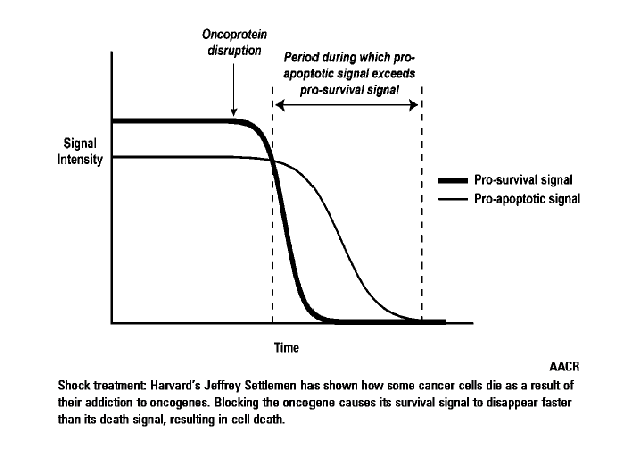
oncogenic shock theory
different rates of decay of proliferative and death signal emanating from the same oncogene
what is the limitation in exploiting oncogenic addiction
clinically - no pt with a metastatic epithelial tumor is cured with just one drug.
the two theories to help explain this is oncogenic escape and tumor heterogeneity
tumor suppressor genes
genes whose normal (WT) products prevent uncontrolled cell proliferation to promote the elimination/repair of damages cells, thereby protecting against cancer.
what is the somatic cell hybdridization experiement
-henry harris and colleagues fused normal and tumor cells
-the resulting hybrids contained chromosomes from both parental cells
-the hybrid cells were not capable of forming tumors
-genes from a normal cell suppressed tumor development.
retinoblastoma
ped cancer. the retinoblasts (which should normally develop into retinal photoreceptors/nerve cells) fail and mato differentiate and continue to divide which forms tumors. this may be hereditary or sporatic and can either be unilateral or bilaterial
what is alfred knudsen’s statistical study of retinoblastoma?
he analyzed 48 retinoblastoma patients and noticed that if it affects both eyes, it is diagnosed earlier as opposed to one eye being diagnosed later. This is more frequent in patients with hereditary disease.
Knudson’s “Two Hit” hypothesis for retinoblastoma
there must be a TSG whose WT function prevents retinal cells from becoming cancerous. Through careful cytogenetic analysis, the gene responsibel for retinoblastoma Rb1
How does the cell lose the second Rb allele?
inactivating mutations
-the probability of inactivating a single gene copy by mutation is 10^-6 per cell generation
the probablility of silencing both copies is 10 ^ -12 per cell generation
how does Rb protects us from cancer?
G1 checkpoint also known as restriction point
-once a cell croses