Applied Behavior Analysis (ABA) Fundamentals
 Call Kai
 Learn
Learn Practice Test
 Spaced Repetition
 Match
Match Flashcards
 Knowt Play
1/26

Earn XP
Description and Tags
Vocabulary practice flashcards covering data analysis, calculations, differential reinforcement strategies, functional assessments, and functions of behavior.
Name | Mastery | Learn | Test | Matching | Spaced | Call with Kai | Chat |
|---|
No analytics yet
Send a link to your students to track their progress
27 Terms
Trend
The overall direction in which graphed data is moving over time, used to determine whether an intervention plan is effective.
Increasing Trend
A pattern in graphed data where the behavior trajectory goes up from left to right.

Decreasing Trend
A pattern in graphed data where the behavior trajectory goes down from left to right.
Stable / Flat Trend
A pattern in graphed data where the behavior remains relatively unchanged over time.
Variability
The degree of fluctuation between data points on a graph.

High Variability
Drastic changes in data points from session to session that appear on a graph like mountain peaks.
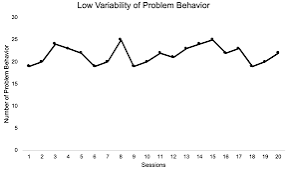
Low Variability
Data points that show no distinct increasing or decreasing trend and remain relatively close together.

X-Axis and Y-Axis
The horizontal axis representing time or date (X-axis) and the vertical axis representing the measure of behavior (Y-axis) on a standard ABA graph.
Rate
A measure of behavior calculated by dividing frequency by time: Rate=frequency×time−1.
Mean Duration
A summary calculation derived from dividing total duration by the number of occurrences: Mean Duration=number of occurrencestotal duration.

Percentage
A summary metric calculated as: Percentage=number of opportunitiesnumber of occurrences×100.
Differential Reinforcement
A intervention strategy that rewards desired or alternative behaviors while withholding reinforcement (extinction) for interfering or challenging behaviors.

Differential Reinforcement of Alternative Behavior (DRA)
Reinforcing an appropriate alternative behavior that is functionally equivalent to the problem behavior while withholding reinforcement for the problem behavior.
Differential Reinforcement of Incompatible Behavior (DRI)
Reinforcing a target behavior that is physically impossible to perform simultaneously with the problem behavior.
Differential Reinforcement of Other Behavior (DRO)
Reinforcing the total absence of the target problem behavior for a specified time interval, resetting the timer if the problem behavior occurs.
Differential Reinforcement of Low Rates of Behavior (DRL)
Reinforcing lower rates of a behavior to systematically reduce its occurrence without needing to eliminate it completely.
Differential Reinforcement of High Rates of Behavior (DRH)
Reinforcing higher rates of an appropriate behavior to increase its frequency or duration.
Indirect Assessment
An assessment method that gathers behavior information without direct observation, utilizing interviews, rating scales, and questionnaires filled out by caregivers or teachers.
Descriptive Assessment (Direct Observation)
Directly observing behavior in real time and recording what occurs immediately before, during, and after the behavior (ABC data collection).
Functional Behavior Assessment (FBA)
A comprehensive process used to gather information to determine why a behavior is occurring, incorporating direct observations, indirect measures, record reviews, and scatterplots.

Scatterplot
A data collection grid used to identify temporal patterns in behavior occurrences across time of day, day of the week, or specific activities.
Functional Analysis (FA)
An experimental assessment procedure that systematically tests behavior hypotheses by manipulating environmental conditions one at a time.
Four Functions of Behavior
The primary underlying reasons for behavior occurrences: Attention, Escape, Tangible, and Automatic (Sensory).

Attention (Function)
A behavioral function maintained by gaining social interaction or notice from others.
Escape (Function)
A behavioral function maintained by avoiding, delaying, or terminating an unwanted task or demand.
Tangible (Function)
A behavioral function maintained by gaining access to a preferred item or activity.
Automatic / Sensory (Function)
A behavioral function maintained by physical sensations or self-stimulation independent of social reinforcement.