Glomerula Filtration Tests
 Call Kai
 Learn
Learn Practice Test
 Spaced Repetition
 Match
Match Flashcards
 Knowt Play
1/50

There's no tags or description
Looks like no tags are added yet.
Name | Mastery | Learn | Test | Matching | Spaced | Call with Kai | Chat |
|---|
No analytics yet
Send a link to your students to track their progress
51 Terms
mL/min
glomerular filtration tests measures rate in ____
glomerular filtration tests
measures the rate (mL/min) at which the kidneys are able to remove (clear) a filterable substance from the blood
substance analyzed must be not reabsorbed or secreted by the tubules
how to measure accurate glomerular filtration
urea
earliest glomerular filtration test
inulin
original reference method of glomerular filtration test
improperly timed collection
greatest source of error in glomerular filtration tests
creatinine
B2-microglobulin
cystatin C
radioisotopes
glomerular filtration: clearance tests
creatinine
single marker that denotes renal disorder
B2-microglobulin
marker of renal tubular injury
inulin
a polymer of fructose, an extremely stable substance that is neither reabsorbed nor secreted by tubules
inulin
not a normal body constituent → must be infused by IV at a constant rate throughout the testing period
cystatin c
a small protein (mw: 13,359) produced at a constant rate by all nucleated cells
cystatin C
filtered readily by the glomerulus
reabsorbed and broken down by the renal tubular cells → no cystatin C secreted
cystatin C
its serum concentration can be directly related to GFR
B2-microglobulin
dissociates from human leukocyte antigens at a constant rate
removed rapidly from the plasma by glomerular filtration
B2-microglobulin
may also be used to distinguish disorders of the kidney as either glomerular or tubular
rise in plasma B2-microglobulin
more sensitive indicator of a decreased GFR than creatine clearance
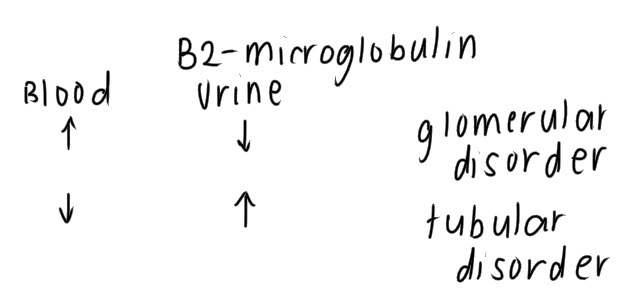
how is B2-microglobulin used to distinguish disorders of the kidney as either glomerular or tubular
acute kidney injury
besides renal tubular injury, B2-microglobulin can be a marker of
B2-microglobulin
its presence denotes proximal tubule damage, as in acute kidney injury—incomplete reabsorption
impaired clearance by the kidneys
protein overproduction
elevated plasma B2-microglobulin is a result of
radioisotopes
determine glomerular filtration through the plasma disappearance of injected radioactive material such as 125I-iothalamate
radioisotopes
enables visualization of filtration in one or both kidneys
radioisotopes
valuable to measure viability of transplanted kidney
120 mL/min
men: 107-139 mL/min
87-107 mL/min
normal creatinine clearance values
other day / day 1 (first morning urine)
in creatinine clearance sample preparation, if the collection starts in the morning, urine formation from ___ is not included
maintained a 4 deg C
sample storage and transport for 24 hr urine
cockgroft and gault — WAGS: weight (kg), age, gender (sex), serum creatinine
modification of diet in renal disease (MDRD) system — GARBAGeS: gender (sex), age, race, BUN, serum albumin, serum creatinine
formulas used for estimated glomerular filtration rate
cockgroft and gault
most frequently used formula for estimated glomerular filtration rate
tubular reabsorption
first function affected in renal disease
SG
osmolarity
tubular reabsorption tests / concentration tests
specific gravity
tubular reabsorption test that depends on number and density of particles present in the solution
urea
contributes to SG than sodium chloride
1.025, 16hr fluid deprived
normal value of SG for tubular reabsorption / concentration test
osmolarity
tubular reabsorption test that depends on number of particles only
osmolarity
sodium = chloride = urea
≥ 800 mOsm, overnight water deprived
normal value of osmolarity for tubular reabsorption / concentration test
Fishberg test
Mosenthal
tests based on specific gravity
Fishberg test
patients were deprived of fluids for 24 hrs prior to measuring SG
Mosenthal
compares the volume and SG of day and night urine samples
osmolality test — osmometers
measurement of freezing-point depression
osmometer
converts freezing point drops → mOsm/kg
1.86ºC
1 mol (1000mOsm) of non-ionizing substance in 1kg water → lower freezing point by
tubular secretion / renal blood flow tests
closely related in that total renal blood flow through the nephron
substance that is secreted rather then filtered through the glomerulus
how to test accurate tubular secretion / renal blood flow
phenolsulfonphthalein test
p-aminohippuric acid test
tubular secretion / renal blood flow tests
urinary ammonia and titratable acidity
used to assess kidney’s ability to excrete acid (H+)
titratable acid
hydrogen phosphate ions
ammonium ions
a typical person excretes approx. 70 mEq/day of acid in the form:
renal tubular acidosis
inability to produce an acid urine in the presence of metabolic acidosis
metabolic acidosis → inability to produce acid urine
proximal convoluted tubule
distal convoluted tubule
renal tubular acidosis may result from:
impaired tubular secretion of hydrogen ions associated with ___
defects in ammonia secretion associated with ___
urine pH
titratable acidity
urinary ammonia
can be used to determine renal tubular acidosis