PMOC: Antibacterial Agents
 Call Kai
 Learn
Learn Practice Test
 Spaced Repetition
 Match
Match Flashcards
 Knowt Play
1/131

There's no tags or description
Looks like no tags are added yet.
Name | Mastery | Learn | Test | Matching | Spaced | Call with Kai | Chat |
|---|
No analytics yet
Send a link to your students to track their progress
132 Terms
The Bacterial Structure
Cell Membrane
Cell Membrane
Protein (30s and 50s ribosomal subunits)
Nucleic Acid and Folates
Antibiosis
Against life (Vuillemin)
Antibiotic
A substance produced by microorganisms, which has the capacity of inhibiting the growth and even of destroying other microorganism
Characteristics of Antibiotics
It is a product of metabolism
It is a synthetic product produced as a structural analog of a naturally occurring antibiotic
It antagonized the growth or survival of one or more species of microorganisms
It is effective in low concentrations
Antibiotics
B-lactams (Penicillins, Cephalosorins, Carbapenems, Monobactams)
Aminoglycosides
Tetracyclines
Macrolides
Lincomycins
Polypeptides
Unclassified Antibiotics
Synthetic
Quinolones
Nitrofurans
Methenamine
Sulfonamides
Trinethoprim
Sulfones
Bactericidal Agents | Cell Wall
Beta-Lactams & Polypeptides
Bactericidal Agents | Cell Membrane
Polymyxins
Bactericidal Agents | DNA Synthesis
Quinolone
Bactericidal Agents | RNA Synthesis
Rifamycin
Bacteriostatic Agents | 30s
Aminoglycosides & Tetracyclines
Bacteriostatic Agents | 50s
Macrolides, Lincomycins, Chloramphenocal
Bacteriostatic Agents | Folate Synthesis
Sulfonamides and Trimethoprim
Beta-Lactam Antibiotics
B-Lactam Ring (Four-Membered Cyclic Amide)
Dominant class antibacterial agents
Broad-spectrum, bactericidal agents
MOA: Inhibition of cell walla synthesis
D-transpeptidase: Cross-linking of peptidoglycan
D-alaninr carboxylpeptidase: Hydrolysis of D-alanine-D-alanine terminal peptide bonds
Beta-Lactam Antibiotics: Penicillins
Discovered by Alexander Fleming
Source: Penicillium notatum/ Penicillium chrysogenum
Introduced by Florey and Chain into therapy (1938)
Process: Freeze-drying
Beta-Lactam Antibiotics | Penicillins
Chemical Instabilities
B-lactam amide bond: Hydrolyzed into carboxylic acid and amine
Most penicillins are acids
Sodium and Potassium Salts: Increased absorption
Benzathine, Procaine, Hydrabamine: Depot forms of Penicillin
Beta-Lactam Antibiotics | Penicillins
Bacterial Resistance
Penicillinases: Beta-lactamases and Acylases
Decreased Permeability
Beta-Lactam Antibiotics | Penicillins
Immine Responses
Penicilloic acid (Hapten) + Proteins = Penicilloyl proteins → Antigenic (Allergic Reactions)
Beta-Lactam Antibiotics | Natural Penicillins
Penicillin G
Chemical Name: Benzylpenicillin
Narrow-spectrum
Poor acid-resistance and oral absoprtion
ROA: Parenteral
Rapidly eliminated from the bloodstream via active tubular secretion
DOC: Syphilis
Beta-Lactam Antibiotics | Natural Penicillins
Penicillin V
Chemical Name: Phenoxymethylpenicillin
The first orallt active penicillin
Beta-Lactam Antibiotics | Antistaphylococcal Penicillins
Resistant to inactivation by the penicillinase found in staphylococci
Structure: Increased steric hindrance in a-carbon of the acyl group
Steric Hindrance: works as a shield
Beta-Lactam Antibiotics | Antistaphylococcal Penicillins
Methicillin
Chemical Name: 2,6-dimethoxyphenulpenicillin
ROA: Parenteral
A/E: Interstitial Nephritis
Beta-Lactam Antibiotics | Antistaphylococcal Penicillins
Nafcillin
Chemical Name: 6-(2-ehoxyl-l-napthyl) penicillin
ROA: Parenteral
Beta-Lactam Antibiotics | Antistaphylococcal Penicillins
Isoxazolul Penicillins
Oxacillin
Cloxacillin
Dicloxacillin
Beta-Lactam Antibiotics | Aminopenicillins
Active against gram-negative bacteria and enterococci
a-amino: Confers an ability to cross cell membrane barriers
Beta-Lactam Antibiotics | Aminopenicillins
Ampicillin
Chemical Name: D-a-aminobenzylpenicillin
Prodrug: Bacampicillin
Not resistant to penicillinase
ROA: Parenteral or Oral
Beta-Lactam Antibiotics | Aminopenicillins
Amoxicillin
Chemical Name: D-a-amino-p-hydroxybenzylpenicillin a
Beta-Lactam Antibiotics | Carboxypenicillins
Carboxyl: Improves penetration of the molecule throught cell wall barriers of gram-negative bacilli
Beta-Lactam Antibiotics | Carboxypenicillins Examples
Carbenicillin
Ticarcillin
Beta-Lactam Antibiotics | Ureidopenicillins
More active against some gram-negative and anaerobic bacteria
Beta-Lactam Antibiotics | Ureidopenicillins Examples
Mezlocillin
Piperacillin
Azlocillin
Beta-Lactam Antibiotics | Carbapenems
Thienamycin
Source: Streptomyces cattleya
Susceptible to renal dehydropeptidase I (DHP-I) Enzyme
Renal dehydropeptidase I: Present in kidney; Metabolize the drug
Beta-Lactam Antibiotics | Carbapenems
Imipenem
Semisynthetic Thienamycin
Claved by dihydropeptidase which products nephrotoxic metabolites
Combined with Cilastatin (Primaxin)
A/E: CNS Effects
Beta-Lactam Antibiotics | Carbapenems
Meropenem
Second-generation carbapenem (greater potency)
Has greater potency against gram-negative and anaerobic bacteria
Slightly less active than most gram-positibe spp.
Resistant to DHP-I and B-lactamades
Beta-Lactam Antibiotics | Cephalosporins
Source: Cephalosporium spp.
Dihydrothiazine ring
Nucleus: 7-aminocephalosphoranic acid (7-ACA)
Cephamycins (Cefoxitin, Cefotetan, Cefmetazole)
Structurally cephalosphorins but from streptomyces spp.
Beta-Lactam Antibiotics | Cephalosporins
Spectrum of Activity
Broad-spectrum
↑ Generation = ↑ Gram-negativr activity (but lower gram-positibr activity)
More resistant to B-lactamases
Permeability of bacterial cells
Intrinsic activity against bacterial enzymes involved in cell wall synthesis and cross-linking
Beta-Lactam Antibiotics | Cephalosporins Adverse Effects
Allergic and hypersentivity reactions
Hypoprothrombinemia (Bleeding)
Dosulfiram-like reactions (Hang-over)
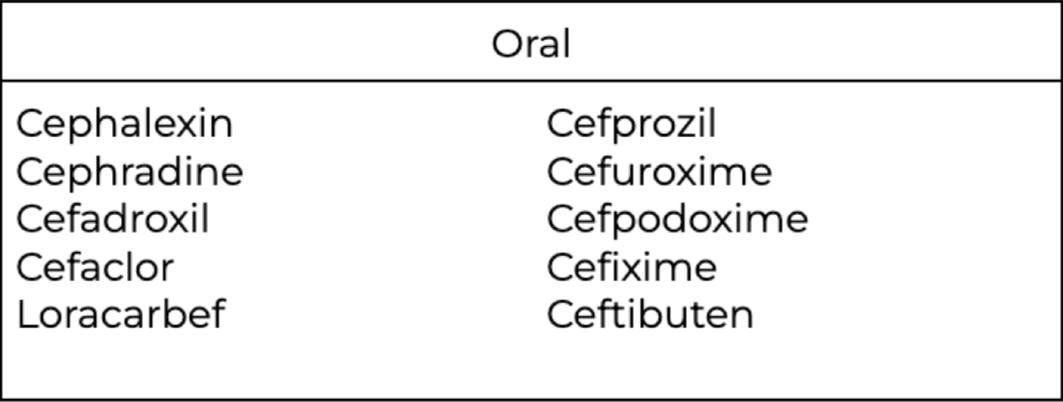
Beta-Lactam Antibiotics | Oral Cephalosphorins
Beta-Lactamd Antibiotics | Monobactams
Aztreonam and Tigemonam
4-methyl group → ↑ Stability to B-lactamase and ↑ Activity against gram-negative bacteria
Polypeptides
Source: Bacillus spp.
A/E: Renal toxicity
Polypeptides Spectrum of Activity
Bacitracin and Vancomycin:
Gram-positive bacteria (cell wall)
Gramicidin:
Bacteria (cell membrane)
Polymyxins:
Gram-negative bacteria (cell membrane)
Polypeptides | Vancomycin
Source: Streptomyces orientalis
A glycopeptide (Glucose ans Vancosamine)
Active against gram-positive cocci
DOC: Pseudomemvrabous colitis and MRSA
ROA: Oral or IV
A/E: Red man syndrome, Impaired auditory acuity, Renal damage, Phlebitis, and Radhes
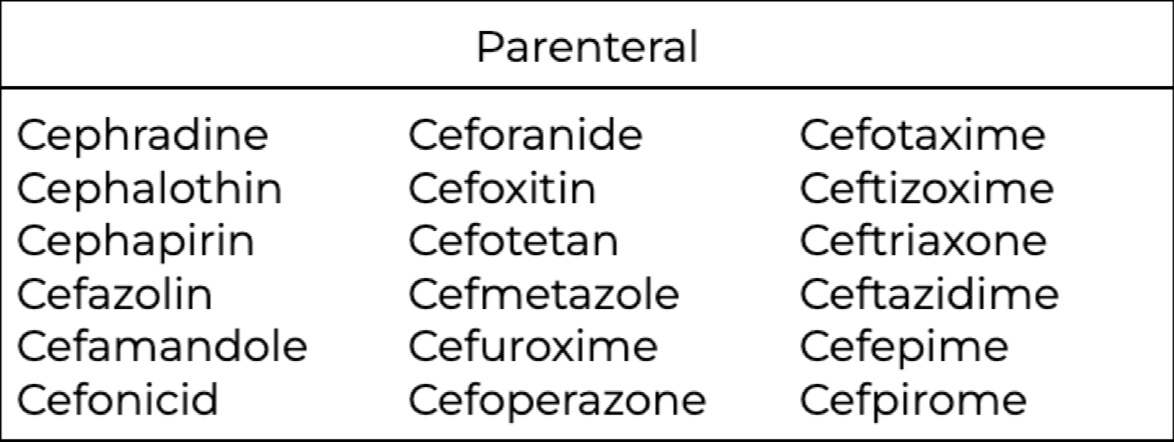
Beta-Lactam Antibiotics | Parenteral Cephalosphorins
Polypeptides | Teicoplanin
Source: Actinoplanes teichomyceticus
Active against gram-positive bacteria
ROA: IM or IV
Polypeptides | Bacitracin
Source: Bacillus subtilis
Zn+2 is required for activity
ROA: Topical
Polypeptides | Polymyxin B
Source: Bacillus polymyxa
Has less kidney damage than other polymyxins
Active against gram-negative organisms
ROA: Topical or Parenteral
Polypeptides | Colistin
a.k.a Polymyxin E
Source: Aerobacillus colistinus
Use: Refractory urinary tract infections
ROA: IV
Polypeptides | Gramicidin
Source: Bacillus brevis
Primarily effective against gram-positive bacteria
Restricted to local applications only
ROA: Topical
Quinolones MOA
MOA: Inhibits the DNA gyrase (topoisomerase II)
Quinolones Synthetic Antibacterial Agents
Quinolones: -floxacin
Napthyridines: Nalidixic acid, Enoxacin
Cinnolines: Cinoxacin
Quinolones Spectrum of Activity
Gram-negative urinary pathogens
Quinolones
CNS Effects
Phototoxicity
Arthropathy: Tendon rapture (C/I → px below 18y/o)
Chelation → Magnesium, Aluminum, Iron, Ca
Quinolones | Nalidixic Acid
Prototype quinolone
Use: UTI (Proteus spp.)
Quinolones | Norfloxacin
Fluorine atom: ↑ Gram-positive potency
Piperazine moiety: Improved antipseudomonal activity
Not effective against obligate anaerobic bacteria
Use: Uncomplicated gonorrhea
Quinolones | Ciprofloxacin
Probenecid: Inhibits active tubular secretion
Widely distributed
Use: Gastroenteritis, Respiratory Infections, Venereal disease, Postexposure inhalational anthrax
D/I: Crystalluria
Quinolones | Ciprofloxacin
Probenecid: Inhibits active tubular secretion
Widely distributed
Use: Gastroenteritis, Respiratory Infections, Venereal disease, Postexposure inhalational anthrax
D/I: Crystalluria
Quinolones | Sparfloxacin
Once-daily dosing
Has a higher potency against geam-positive bacteria
5-amino group: Least phototoxic
Quinolones | Levofloxacin
L-isomer of Ofloxacin
Aminoglycosides
MOA: Inhibits the 30s ribosomal subunit (-cidal)
Effective for anaerobic bacteria
Synergistic with B-lactam antibiotics (in vivo)
ROA: IM
Mycin: from Streptomyces spp.
Micin: macromonospara spp.
Aminoglycosides Spectrum of Activity
Aerobic gram-negative bacilli
Aerobic gram-negative cocci
Aerobic gram-positive cocci
Resistant: Anaerobic bacteria
Adverse Effects:
Ototoxicity
Nephrotoxicity
Aminoglycosides | Streptomycin
Source: Streptomyces griseus
The most effective glycosides for TBZ
Use: Tularemia/ Rabbit Fever
Aminoglycosides | Neomycin
Source: Streptomyces fradiae
The most nephrotoxic aminoglycosides
Aminoglycosides | Paromomycin
Source: Streptomyces rimosus
Use: Intestinal amoebiasis
Aminoglycosides | Kanamycin
Source: Streptomyces kanamyceticus
Use: Intestinal tract infections
Aminoglycosides | Amikacin
Semisynthetic aminoglycoside (from Kanamycin)
Aminoglycosides | Gentamicin
Source: Micromonospora purpurea
Active against Pseudomonas aeruginosa and Gram-negative enteric bacilli.
Use: Skin infections and Nosocomial infections (Hospital acquired infections)
Aminoglycosides | Tombramycin
Source: Streptomyces tenebrarius
Use: Inhaled aminogkycosides for the treatment of Pseudomona infections in patients with cystic fibrosis
Aminoglycosides | Netilmicin
Semisynthetic aminoglycoside
Aminoglycosides | Sisomicin
Source: Micromonospora inyoensis
Aminoglycosides | Spectinomycin
Source: Stretpmycrs spectabilis
Use: Veterinary medicine
Bacteriostatic agent
Tetracyclines
Broadest Spectrum
Gram-negative
Gram-positive
Atypical Bacteria
MOA: Inhibits the 30s Ribosomal Subunit
Chemically octahydronaphthacenr → 4 annated 6-membered ring
Tetracycline Adversr Effects
Photosensitivity
Chelation
Fanconi Syndrome
Affect the Kidney Organ
May induce superinfections caused by the pathogenic yeast
C/I: Pediatrics
Short-Acting Tetracyclines
Chlortetracycline and Oxytetracycline
Intermediate-Acting Tetracyclines
Demeclocycline and Methacycline
Long-Acting Tetracyclines
Doxycycline and Minocycline
Very Long-Acting Tetracycline
Tigecycline
Tetracyclines | Tetracyclines
For Acne vulgaris
Tetracycline | Chlortetracycline
Source: Streptomyces aureofaciens
Brand Name: Aureomycin
Use: Vererinary medicine
The first tetracycline discovered
Tetracycline | Oxytetracycline
Source: Streptomyces rimosus
Tetracycline | Demeclocycline
Source: Streptomyces aureofaciens
Tetracyclines | Melocycline
Semisynthetic oxytetracycline
Tetracyclines | Doxycycline
PK: Long half-life, Well-absorbed, and Does not accumulate in patients with impaired renal function.
Use: Leptospirosis (DOC) and Prophylaxis for Malaria
Tetracyclines | Minocycline
The most potent tetracycline
Use: Chronic bronchitis and other URTIs
Tetracyclines | Tigecycline
A glycycycline
Use: Skin and intra-abdominal infections
ROA: IV
A/E: Photosensitivity, Pancreatitis, and Pseudotumor Cerebri
Macrolides
Source: Actinomycetes
First: Picromycin
MOA: Inhibits the 50s Ribosomal Subunit
Macrolides Structure
Macrocyclic Lactone Ring (12, 14, or 16 atoms)
Ketone (R-COOH)
Glycosidically linked amino sugars
Macrolides Spectrum of Activity
Resembles penicillin
Mycoplasma
Chlamydia
Campylobacter
Legionella
Macrolides Adverse Effects
GI Effects
Liver Effects
QT Prolongation
Macrolides | Erythromycin
Alternative for patients allergic to penicillin
Source: Streptomyces erythraeus (From IloIlo)
Use: Mycoplasma pneumoniae, Chlamydia, Campylobacter jejuni, Legionnaires disease
Formulated as enteric-coated and
delayed-release
Estolate Salt: Choleststic Hepatitis
D/I: Enzyme Inhibitir
DOC: Diptheria pertussis & Legionnaires Disease
Macrolides | Clarithromycin
Methylated Erythromycin
Use: Helicobacter pylori, Pneumonia, and Cellulitis
Macrolides | Azithromycin
Semisynthetic erythromycin
An azalide (contains nitrogen)
Long-half life → 3-5 days treatment
More active against gram-negative bacteria
Macrolides | Dirithromycin
Alternative to Erythromycin
Once-daily dosing
Macrolides | Troleandomycin
Most potent enzyme inhibitor
Lincomycins
MOA: Inhibits the 50s ribosomal subunit
Source: Streptomyces lincolnensis
Sulfur-containing
Lincomycins Spectrum Activity
Resembles the macrolides
Lincomycins Adverse Effect
Pseudomembranous Colitis → TX: Vancomycin
Rashes
Lincomycins | Lincomycins
Most active and medially useful
Active against gram-positive microorganisms
Lincomycins | Clindamycin
Semisynthetic Lincomycin
Chemical Name: 7-chloro-7-deoxylincomycin
Use: Cellulitis, Osteomyelitis, and CNS Infections
Sulfonamides
Discovered by Gerhard Domagk
MOA: Inhibits Dihydropteroate Synthase or Compete with PABA
Prontosil → Sulfanilamide
Sulfonamides Spectrum of Activity
Gramp-positive and Gram-negative bacteria
Nocardia
Chlamydia trachomatis
Some protozoa