Community Health Nursing
 Call Kai
 Learn
Learn Practice Test
 Spaced Repetition
 Match
Match Flashcards
 Knowt Play
1/183

Earn XP
Description and Tags
Integrated Management of Childhood Illness (IMCI) / Philippine Health Care Delivery System / Epidemiology / Disaster Nursing
Name | Mastery | Learn | Test | Matching | Spaced | Call with Kai | Chat |
|---|
No analytics yet
Send a link to your students to track their progress
184 Terms
Integrated Management of Childhood Illness (IMCI)
It is a strategy developed by the World Health Organization (WHO) and UNICEF to reduce illness and deaths among children below 5 years old through an integrated approach. It does not focus on one disease only; it evaluates the child as a whole and manages multiple childhood conditions simultaneously.
Reduce childhood mortality
Reduce illness and disability
Improve growth and development
Improve quality of care for children under 5 years old
The main goals of IMCI are?
Children aged 2 months to 5 years
Young infants: birth to 2 months
Primary targets of IMCI
Integrated Approach
Syndromic Approach
Family Involvement
Principles of IMCI
Syndromic Approach
Diagnosis is based on:
Signs and symptoms
Classification system
Not solely on laboratory tests.
Improve Case Management Skills of Health Workers
Improve Health System Support
Improve Family and Community Practices
Three Major Components of IMCI
1. Unable to Drink or Breastfeed
2. Vomits Everything
3. Convulsions
4. Lethargic or Unconscious
5. Chest Indrawing
6. Stridor in Calm Child
Game Changer:
What are the 6 general danger signs of a child?
Severe illness
Game Changer:
A child with general danger signs is classified as ___ and needs immediate referral.
Red (Severe Disease)
Yellow (Moderate Disease)
Green (Mild Disease)
IMCI Classification System
GREEN CATEGORY (Mild Disease)
Meaning:
Home management possible
Action:
Provide home care advice
Counsel caregiver
YELLOW CATEGORY (Moderate Disease)
Meaning:
Requires specific treatment
Action:
Treat at health facility
Provide medications
Counsel caregiver
RED CATEGORY (Severe Disease)
Meaning:
Emergency condition
Requires urgent referral
Examples:
Severe pneumonia
Severe dehydration
Severe malnutrition
Very sick child
Action: Refer urgently
5 years old
Game Changer:
IMCI focuses on children below ___.
Assess → Classify → Treat
Game Changer:
Main strategy for IMCI (Management Principles)
Pneumonia
Diarrhea
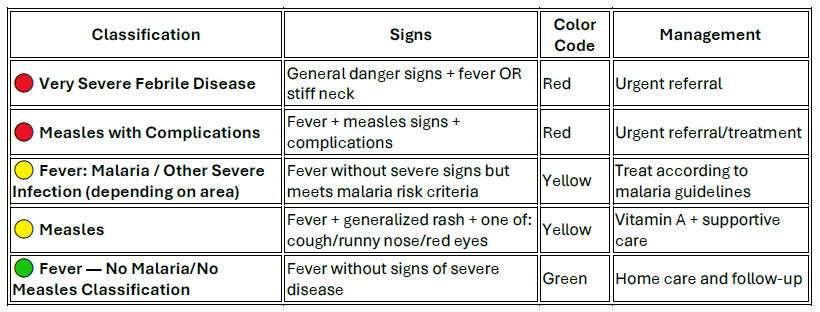
Fever
Ear problems
Malnutrition
Anemia
6 IMCI Major Conditions Assessed
Pneumonia Assessment
We assess about the child’s:
Cough
Difficulty breathing
Fast breathing
Chest indrawing
Severe Pneumonia (Red)
Signs:
General danger signs
Chest indrawing
Stridor
Treatment:
Urgent referral
Pneumonia (Yellow)
Signs:
• Fast breathing
Treatment:
• Antibiotics
• Follow-up
No Pneumonia (Green)
Signs:
• No fast breathing
Treatment:
• Supportive care
Diarrhea
We assess about the child’s:
Duration of elimination
Blood in stool
Signs of dehydration
Severe Dehydration (Red)
Some Dehydration (Yellow)
No Dehydration (Green)
Classifications of Diarrhea
Severe Dehydration (Red)
Signs:
• Lethargy
• Sunken eyes
• Unable to drink
• Poor skin turgor
Management:
• IV fluids
• Urgent referral
Some Dehydration (Yellow)
Signs:
• Restlessness
• Thirst
• Sunken eyes
Management:
• Oral rehydration solution (ORS)
No Dehydration (Green)
Management:
• Continue feeding
• Increase fluids
Persistent Diarrhea
Diarrhea lasting 14 days or more
Dysentery
Blood in stool
Possible cause is invasive intestinal infection
Fever
We ask about the child’s:
Temperature Duration
Malaria risk (where applicable)
Measles signs
Other infections

Classifications of fever
Ear Problems
We assess the child’s:
Ear pain
Ear discharge
Duration
Classifications of Ear Problems
Malnutrition
Assess:
Weight
Height/length
Edema
Feeding practices
Severe Acute Signs
Visible severe wasting
Bilateral pitting edema
Weight-for-height very low
Anemia
We assess the child’s:
Palmar pallor

Classifications of Anemia
Feeding
Continue breastfeeding
Provide appropriate complementary feeding
Encourage adequate nutrition
Medication
Correct dose
Correct timing
Complete treatment course
• Child becomes sicker
• Unable to drink
• Develops fever
• Difficulty breathing
• Persistent vomiting
• Convulsions
Caregiver should return immediately if:
Exclusive Breastfeeding
Immunization
Vitamin A Supplementation
Growth Monitoring
Hand Hygiene and Sanitation
Prevention Strategies Under IMCI
Exclusive Breastfeeding
Game Changer:
Recommended for the first 6 months of life
Benefits are Nutrition and Immunity protection
ORS
Game Changer:
___ is the priority treatment for dehydration due to diarrhea
Caregiver
___ education is an essential component of IMCI.
IMCI
The goal is reduction of childhood mortality and morbidity.
Infants
(0–12 months)
Health Priorities:
• Growth and development monitoring
• Immunization
• Nutrition (breastfeeding)
• Infection prevention
Infant care
Game Changer:
___ focuses on Nutrition, Immunization, Growth monitoring, and Safety
Children
(1–9 years or preschool/school-age)
Health Priorities:
• Nutrition
• Immunization completion
• School readiness
• Injury prevention
Children Care
Game Changer:
___ are managed using IMCI Guidelines/Approach.
Adolescent care
Game Changer:
___ (10-19 years old) require counseling, education, and risk prevention.
Pregnant women
(Maternal Care)
Health Priorities:
• Safe pregnancy
• Fetal monitoring
• Prevention of complications
Maternal care
Game Changer:
___ focuses on safe pregnancy and early detection of complications
Elderly care
Game Changer:
___ focuses on maintaining independence and quality of life.
Clinic visit
A ___ is a structured interaction between nurse and client in a health facility to provide care and health services.
Clinic visit focuses on structured assessment and health service delivery.
Reception of Patient
Assessment
Nursing Intervention
Documentation
Follow-up Planning
Steps in Clinic Visit
Home visit
A ___ is a planned nursing visit to the client’s home to provide care, assess environment, and deliver health teaching.
Objectives:
• Assess home environment
• Provide nursing care
• Strengthen family relationships
• Promote health education
Preparation Phase
Entry Phase
In-Home Phase
Termination Phase
Documentation
Phases of Home Visit
Home visit
Game Changer:
___ evaluates real living conditions and family dynamics.
Bag Technique
Itis a systematic procedure used by public health nurses during home visits to prevent infection and maintain efficiency using a specially prepared nursing bag.
• Clean hand towel
• Soap
• Thermometer
• Alcohol/spirit lamp
• Sterile supplies
• Cotton balls
• Medicines
• Record book
Contents of Nursing Bag
1. Prepare materials
2. Place bag on clean surface
3. Perform hand hygiene
4. Remove only needed items
5. Perform nursing care
6. Dispose waste properly
7. Return items properly
8. Close and secure bag
Game Changer:
Bag technique is about asepsis, organization, and infection control.
What are the steps in bag technique?
Infection Control (Prevent contamination)
Clean to Dirty Principle (Clean items first, Dirty items last)
Hand Hygiene (Before and after procedures)
Proper Bag Placement (Keep on surface, not floor or bed)
Avoid Contamination (Don’t touch inside if unnecessary)
Principles of bag technique
Philippine Health Care Delivery System
The ___ is the organized network of health services, facilities, professionals, and programs that provide healthcare to the Filipino population.
Local Government Units (LGUs)
Game Changer:
The Philippine health system follows a decentralized structure, where local health services are mainly managed by ___.
Department of Health (DOH)
Local Government Units (LGUs)
Health Facilities (Private health sector)
Public Health Care System (Structure)
Local Government Code of 1991
Under the ___, health services were devolved to LGUs.
LGUs manage:
Provincial hospitals
City health offices
Rural Health Units
Barangay Health Stations
Primary Health Care (PHC)
Secondary Health Care
Tertiary Health Care
Levels of Health Care Delivery
Primary health care
Game Changer:
___ = first contact and prevention.
Services:
• Immunization
• Maternal and child health
• Nutrition programs
• Health education
• Family planning
• Basic treatment
Rural Health Unit (RHU)
Barangay Health Station (BHS)
Facilities under primary care
Secondary health care
Specialized care provided by physicians and specialists.
Facilities:
District hospitals
Provincial hospitals
Services:
Emergency care
Specialist consultation
Diagnostic procedures
Example: Patient referred from RHU to hospital.
Tertiary health care
Highly specialized and advanced medical care.
Facilities:
• Medical centers
• Specialty hospitals
Services:
• Complex surgeries
• Intensive care
• Advanced diagnostics
Referral system
A system where patients are transferred from one healthcare level to another for appropriate care.
Barangay Health Station
⬇
Rural Health Unit
⬇
District/Provincial Hospital
⬇
Tertiary Hospital
Referral Flow
Department of Health
The ___ is the national government agency responsible for leading the health sector and ensuring access to quality healthcare.
Vision: A leader in health development toward a healthier Filipino society.
Mission: To guarantee equitable, sustainable, and quality health services for all Filipinos.
Vision and Mission of DOH
National Immunization Program (NIP)
Maternal and Child Health Program
Family Planning Program
National Tuberculosis Control Program (NTP)
HIV/AIDS Prevention Program
National Dengue Prevention Program
Universal Health Care (UHC)
Major DOH Programs
National Immunization Program (NIP)
Program Goal: Prevent vaccine-preventable diseases.
Provides:
BCG
Hepatitis B
Pentavalent vaccine
OPV/IPV
Measles-containing vaccine
Maternal and Child Health Program
Program Focus:
• Safe pregnancy
• Skilled birth attendance
• Newborn care
Family Planning Program
Program focus:
• Counseling
• Contraceptive services
• Reproductive health education
National Tuberculosis Control Program (NTP)
Program focus: DOTS (Directly Observed Treatment Short-course)
Components:
• Early detection
• Standard treatment
• Treatment adherence
HIV/AIDS Prevention Program
Program Focus:
• Prevention
• Testing
• Treatment access
• Education
National Dengue Prevention Program
Program Focus:
• Mosquito control
• Community participation
• Early detection
Universal Health Care (UHC)
Under Universal Health Care Act
Program Goal: Provide all Filipinos access to:
Quality healthcare
Financial protection
Integrated health services
Primary Health Care (PHC)
Essential healthcare made universally accessible to individuals and families through community participation.
Equitable Distribution
Community Participation
Appropriate Technology
Intersectoral Coordination
Game Changer:
Principles of Primary Health Care
Health Care Provider
Health Educator
Community Organizer
Coordinator
Disease Surveillance Worker
Roles of Public Health Nurse (PHN)
DOH
Game Changer:
___ = national authority for health policies and programs.
RHU
Game Changer:
___ serves municipalities; BHS serves barangays
Universal Health Care (UHC)
All Filipinos have access to quality and affordable health services without causing financial hardship. It ensures that everyone receives the healthcare they need when and where they need it without suffering financial burden.
Universal Health Care Act of 2019
Established the Philippine UHC program.
Purpose:
• Reform the Philippine healthcare system
• Expand access to healthcare
• Strengthen primary care
• Provide financial protection
Better Health Outcomes
Financial Protection
Responsive Health System
Goals of Universal Health Care
Population Coverage
Service Coverage
Financial Protection
Key Components of UHC
Primary Care Strengthening
Integrated Health Care Provider Networks
Automatic PhilHealth Membership
Health Information Systems
Major Strategies of UHC
Health Promotion
Disease Prevention
Primary Health Care
Patient Advocacy
Game Changer:
Public health nurses contribute to UHC through?
Sustainable Development Goals (SDGs)
The __ are a set of 17 global goals adopted by the United Nations in 2015 to achieve a better and more sustainable future by 2030.
Health
Game Changer:
___ is directly connected to many SDGs, especially SDG 3: Good Health and Well-being.
SDG 3
Game Changer:
Most important health-related SDG for nurses
SDG 1 – No Poverty
SDG 2 – Zero Hunger
SDG 3 – Good Health and Well-being
SDG 4 – Quality Education
SDG 5 – Gender Equality
SDG 6 – Clean Water and Sanitation
SDG 7 – Affordable and Clean Energy
SDG 8 – Decent Work and Economic Growth
SDG 9 – Industry, Innovation, and Infrastructure
SDG 10 – Reduced Inequalities
SDG 11 – Sustainable Cities and Communities
SDG 12 – Responsible Consumption and Production
SDG 13 – Climate Action
SDG 14 – Life Below Water
SDG 15 – Life on Land
SDG 16 – Peace, Justice, and Strong Institutions
SDG 17 – Partnerships for the Goals
The 17 Sustainable Development Goals
SDG 2 (Zero Hunger), SDG 3 (Health), and SDG 6 (Water and Sanitation)
SDGs that are highly relevant to community nursing.
Good Health and Well-being
Universal Health Care
Improves access to health services - Reduces health inequalities - Improves population health
It supports SDG 3
What is SDG 3?
Primary Health Care (PHC)
It is an approach to healthcare that makes essential health services universally accessible to individuals and families in the community through their full participation and at a cost the community can afford.
PHC
It focuses on health promotion, disease prevention, community participation, and addressing the basic health needs of the population. (acronym)
Alma-Ata Declaration (1978)
The International Conference on Primary Health Care held in Alma-Ata, Kazakhstan emphasized that:
Health is a fundamental human right. It promoted Health for all, Community participation, and Accessible healthcare
PHC
It was adopted as the foundation of community health nursing.