Flashcards from Quizzes
 Call Kai
 Learn
Learn Practice Test
 Spaced Repetition
 Match
Match Flashcards
 Knowt Play
1/36

There's no tags or description
Looks like no tags are added yet.
Name | Mastery | Learn | Test | Matching | Spaced | Call with Kai | Chat |
|---|
No analytics yet
Send a link to your students to track their progress
37 Terms
How did Licklider and his team in the early 1960s experiment with a precursor to the Internet?
Connecting two computers over a dial-up telephone line
What is the Domain Name System (DNS) designed to do primarily?
Translate domain names into IP addresses
What is the architectural design of the Internet protocol stack based on?
Layers
Both the data link and transports layer protocols may provide error correction.
True
What allows for communication between the application layer and transport layer?
Sockets
Which of the following protocols belong to the application layer?
DNS (Domain Name Service)
Which two protocols belong to the transport layer?
TCP, UDP
When an application sends a packet of information across the network, this packet travels down the IP stack and undergoes what process?
Encapsulation
According to the end-to-end principle, where should most of the Internet’s functionality/intelligence be implemented?
At the edges of a network
What is the difference between hubs, bridges, and routers?
They operate on different layers of the IP stack
A packet is __________ when it is moved from a router’s input link to the appropriate link.
Forwarded
Determine which action is network-wide (i.e. involves multiple routers).
Routing
Intradomain routing must involves multiple administrative domains.
False
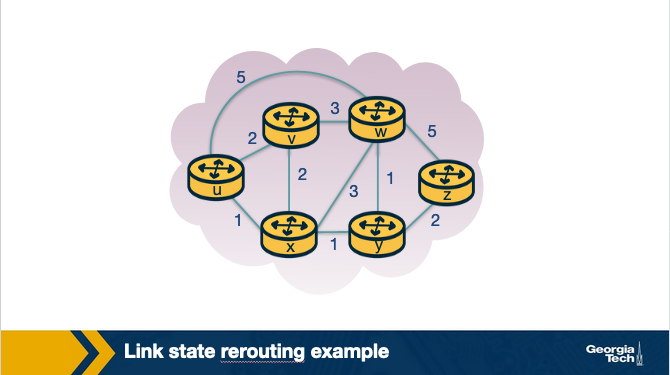
In the previous example, node u was the source node, and distances were calculated from u to each other node. Consider the same example, but let x be the source node. Notice that node x has more direct neighbors than u does. Suppose x is executing the linkstate algorithm as discussed, and has just finished the initialization step. Which of the following statements are true?
Node x will execute the same number of iterations that node u did, as the number of immediate neighbors has no impact on the number of iterations the algorithm requires.
In Dijkstra's algorithm, all nodes in a network are aware of the entire network topology only after the algorithm's termination.
False
Determine which of the following can cause the count-to-infinity problem for the distance vector algorithm.
Routing Loops
The Bellman Ford equation is used by the ______________ algorithm.
distance vector
There may be multiple egress points from an administrative domain to an external destination.
True
Hot potato routing always selects the egress point that is geographically closest to the ingress point.
False
Each router along a packet's path independently decides that packet's next hop.
True
Intradomain routing refers to routing that takes place among routers that belong to the same administrative domain. In contrast when routers belong to different administrative domains, we refer to routing as interdomain routing.
True
In link-state routing, each node broadcasts the cost of only its own attached links, yet every node ends up with a complete map of the network.
True
In link-state routing, a node learns the topology by exchanging distance vectors with its immediate neighbors.
False
Consider the link-state routing protocol and a node u as our source node. The goal of the algorithm is to compute the least-cost paths from the source node u to every other node in the network.
True
Consider the link-state routing protocol with a node u as our source node. Consider the initialization of the algorithm. We initialize the least-cost path from node u to directly attached neighbors to be the cost of the direct links, and for non-directly attached neighbors we initialize the least-cost path to be infinity.
True
The distance vector (DV) routing algorithm continues iterating as long as neighbors send new updates to each other.
True
The distance vector (DV) routing algorithm is an example of a ______________ algorithm.
False
In the distance vector algorithm, each node eventually holds a complete map of the network topology.
False
Consider the distance vector (DV) routing algorithm. Which is used by each node to update the node's distance vector?
The Bellman Ford equation
In distance vector routing, an increase in a link cost can take many more iterations to propagate through the network than a decrease does.
True
The poison reverse technique solves the count-to-infinity problem for all network topologies.
False
The Routing Information Protocol (RIP) is based on the Distance Vector protocol.
True
Open Shortest Path First (OSPF) is based on the link state routing algorithm.
True
Hot potato routing reduces a network's resource consumption by moving traffic off its own network as quickly as possible.
True
Because hot potato routing is an internal decision, a change to an IGP link weight cannot affect the routes advertised to neighboring networks.
False
When BGP cannot otherwise distinguish between two routes to an external destination, a router selects the egress point with the lowest IGP path cost.
True
Two routers in different administrative domains must run the same routing protocol in order to forward packets along a path between them.
False