GREGMAT Quant Mountain
 Call Kai
 Learn
Learn Practice Test
 Spaced Repetition
 Match
Match Flashcards
 Knowt Play
1/139

There's no tags or description
Looks like no tags are added yet.
Name | Mastery | Learn | Test | Matching | Spaced | Call with Kai | Chat |
|---|
No analytics yet
Send a link to your students to track their progress
140 Terms
Integers
Natural Numbers - 1,2,3,4
Whole Numbers - 0,1,2,3,4
Integers - -3,-2,-1,-,1,2,3
Consecutive Integers
Difference between two integers is 1. (e.g., 6 and 7 are consecutive integers)
The Number Line
Humans invented to more easily see the relationship between numbers.
4 Arithmetic Operations
Addition, Subtraction, Multiplication, Division
Exponents
Shorthand for multiplication (e.g., 5^6)
Roots
The reverse of exponents.
1. "even" roots cannot have a negative only positive values or zero
2. "odd" roots can take either positive or negative values
3. n^2 = 64, then n equals both 8 and -8
4. Square Root of 64 though is only 8
Factorials
Multiply every integer together down to 1 (e.g., 4! = 4 x 3 x 2 x 1)
Operations with Negatives
1. Negative added to another negative is always negative
2. Negative subtracted from a negative can result in either a negative number, zero, or positive number
3. Negative times a positive is a negative. Two negatives equal a positive
4. Division is the same as multiplication
PEMDAS
Parenthesis, Exponents, Multiplication, Division, Addition, Subtraction
PEMDAS Trickiness
It's easy to conclude that additional is before subtraction and multiplication is before division. However, it is better to consider them on the same level. You work from left to right.
# of Integers in an Interval
Last Number - First Number + 1
Sum of Integers in an interval
1. (from 1 to N) - (n(n+1)/2) (e.g., sum of integers from 1 to 80 = (80 x 81)/2
2. (from m to n, where n is not equal to 1) (e.g., find sum of integers from 30 to 101) -
find the number of integers in the interval: 101 - 30 + 1 = 72.
calculate the sum of the first and last number: 30 + 101 = 131
(72 x 131)/2 = 4716
Factors / Divisors
If an integer is divisible by a certain number, then that certain number is a factor of that integer
Greatest Common Factor (GCF)
Largest factor common to both numbers
Even and Odd Integers
1. Even integers are integers with 2 as a factor
2. Odd numbers are integers that are not even
Consecutive Even/Odd Integers
1. Consecutive Even - 2,4,6,8
2. Consecutive Odd - 1,3,5,7
Multiples
If n is an integer, the numbers 0n, 1n, 2n, 3n, 4n and so on are multiples of n
Three Consecutive Integers
1. A multiple of 3 is always included amongst the three integers
2. The product of the three integers is always a multiple of 3
3. The sum of the three integers is also a multiple of 3
Least Common Multiple (LCM)
Smallest positive multiple they share in common.
# of Multiples in an Interval
1. (From 1 to n) - How many multiples of 31 from 1 to 1,000. (1000/31 = 32.26)
2. (From n to m, where n is not 1) - ((last multiple - first multiple)/multiple in question) + 1
Sum of Multiples in an Interval
1. What is the sum of all multiples of 3 from 1 to 500.
Step 1 - Find the number of multiples of 3 from 1 to 500 (e.g., (500/3) = 166)
Step 2 - List out the first three multiples and last three multiples (3,6,9..492,495, 498)
Step 3 - Notice that every "pair" adds up to 501. (e.g., 3+498, 6 +495, etc.)
Step 4 - There are 83 pairs (166/2). The final equation is as follows: (166/2) x 501 = 41,583
Divisibility Rules (1,2,3,4)
1. All integers are divisible by 1
2. An integer is divisible by 2 if its even
3. An integer is divisible by 3 if the sum of digits is divisible by 3 (e.g., 816 --> 8+1+6 = 15, a # divisible by 3)
4. An integer is divisible by 4 if the last two digits in that integer are also divisible by 4. (e.g., 56,234,332 is divisible by 4 because 32 / 4 = 8)
Divisibility Rules (5,6,8,9,10)
5. Divisible by 5 if it ends in 5 or 0
6. Divisible by 6 if also divisible by 2 and 3
7. calculator
8. Divisible by 8 if the last three digits of the number are divisible by 8.
9. Divisible by 9 if the sum of digits is divisible by 9. (e.g., 5985 -> 5+9+8+5 = 27 / 9 = 3)
10. Divisible by 10 if last digits in the number is 0
Divisibility Rule (11)
11. Alternating signs of positive and negative on a number (e.g., 638 --> +6 - 3 + 8 = 11 / 11 = 1, so this works)
Prime Numbers
Numbers with exactly two factors - 1 and itself
Primes up to 50
2,3,5,7,9,11,13,17,19,23,29,31,37,41,43,47
Prime Factorization
Every positive integer can be written as the product of primes (e.g., 24 can be written as 2^3 x 3)
Every Prime Factorization is Unique
No two distinct integers share the same prime factorization
Determine whether a number is Prime
To determine whether the integer n is prime, take the square root of n and see if it is divisible by any prime number lower than the square root value. Sqrt(107) = 10.34. So see if 2,3,5,7 divide evenly into 107. They do not so prime
Factors of Factorials
8! has the following factors: 8,7,6,5,4,3,2,1 but also 56 is a factor 7 x 8 or 30 is a factor 6 x 5.
Non Factors of Factorials
How to find factors that not factors of 20!
1. Simply find the prime numbers greater than 20 (e.g., 23, 29,31,37,41)
2. How do we find non prime numbers? Just find the multiples (23: 46,69,92 or 29:58,87,116)
# of Numbers in Factorials Part 1
Add Floors: (n/p) + (n/p^2) + (n/p^3) etc... until the square root of number is bigger than the numerator (e.g., 100!/3^x)
1. 3^1 1 to 100 = 33
2. 3^2 1 to 100 = 11
3. 3^3 1 to 100 = 3
4. 3^4 1 to 100 = 1
5. 3^5 1 to 100 = 0 (243 is greater than 100)
# of Numbers in Factorials Part 2
Example: find the powers of 15 in 200!
1. Prime Factorize (3x5)^x
2. 5 is limiting factor in this example
3. 5^1 (5) 1 to 200 = 40
4. 5^2 (25) 1 to 200 = 8
5. 5^3 (125) 1 to 200 = 1
6. Sum the numbers up to get 49
Example: find the powers of 4 in 200!
Hint - Don't forget to convert 4 to (2)^2X
# of Numbers in Factorials Part 3
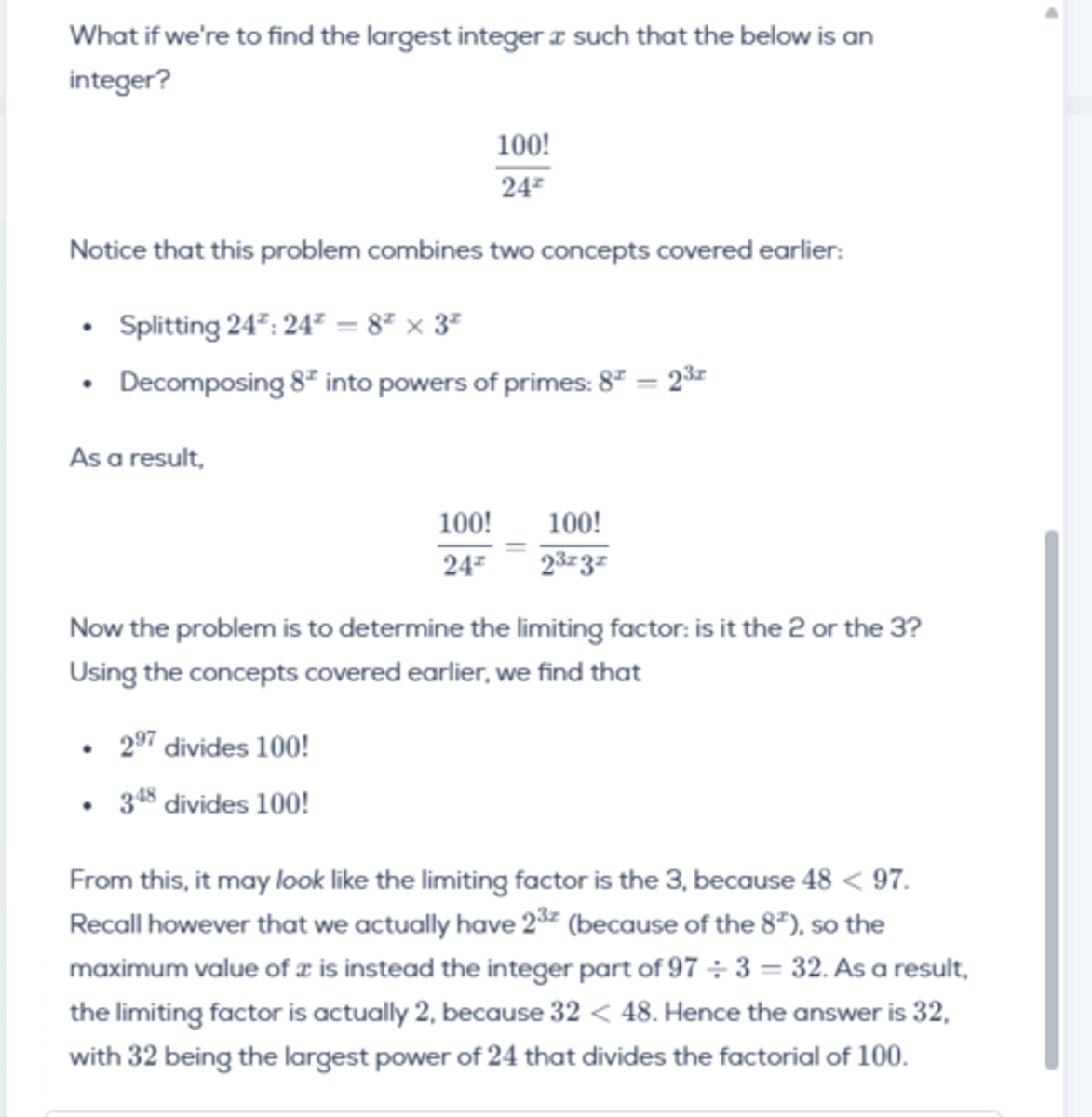
Trailing Zeros
Example: (270!/10^x)
Step 1. Breakdown 10 into primes 2 x 5, 5 is less common so that is limiting factor.
Step 2. 5^1 in 270 = 54
Step 3. 5^2 in 270 = 10
Step 4. 5^3 in 270 = 2
Sum it up= 66 trailing zeros
Zero is Weird (Part 1)
1. it is neither positive nor negative
2. It is even (divisible by 2)
3. It is a multiple of EVERY integer
4. It's a factor only of itself
Zero is Weird (Part 2)
5. Cannot divide by 0
6. Anything raised to 0 power equals 1
7. 0! = 1
Primes are Infinite
Primes within a fixed interval tend to decrease as the numbers get larger. (e.g., 1 to 100: 25, 101 to 200: 21, 201 to 300: 16)
Positive Factors with PF
1. First prime factorize the integer (e.g., 3000 = 2^3 x 3^1 x 5^3)
2. Add 1 to each exponent in the prime factorization ( 4 x 2 x 4 = 32)
Odd Factors w/PF
1. First prime factorize the integer
2. Focus only on the odd prime divisors
3. Add one to the exponents and mutliply
Even Factors with PF
# of positive factor - # of odd factors = # of even factors
GCF with PF
1. Prime factorize the two numbers and identify the numbers / exponents they share in common
LCM with PF
1. Prime factorize the two numbers.
2. Write down all the prime divisors
3. Take the largest exponent present for each prime divisor.
4. Exp:
110 = (2^1)(5^1)(11^)
200 = (2^3)(5^2)
Answer: (2^3)(5^2)(11^1) = 2200
Exponent Unit Digit Patterns
0^n: always 0
1^n: always 1
2^n: 2,4,8,6,2,4,8,6 (repeats in blocks of 4)
3^n: 3,9,7,1,3,9,7,1 (repeats in blocks of 4)
4^n: 4,6,4,6 (repeats in blocks of 2)
5^n: always 5
6^n: always 6
7^n: 7,9,3,1 (repeats in blocks of 4)
8^n: 8,4,2,6 (repeats in blocks of 4)
9^n: 9,1,9,1 (repeats in blocks of 2)
Roots as Exponents
Square Root(5) = 5^1/2
Cubed Root (5) = 5^1/3
Fourth Root(5) = 5^1/4
Operations on Roots 1
Square Root (a^2) = |a|
(Square Root(a))^2 = a, if a > 0
Square Root(a) x Square Root(b) = Square Root(ab)
Operations on Roots 2
(Square Root(a)/Square Root(b) = Square Root(a/b), if a,b>0
N root(a^n) = |a|, if n is a positive even integer
N root(a^n) = a, if n is an odd positive integer
"Pulling Out" Perfect Squares
Roots can be simpliefied by taking out all the perfect squares (or cubes, or the nth power, depending on the question), under the root after prime factorizing what's inside.
Square Root(360) = Square Root((2^2 x 3^2) x (2 x 5)
= 6 Square Root(10)
Rationalizing Denominators
If there is a single radical in the denominator of a fraction, multiply both the numerator and denominator by that radical. This will have the effect of removing the radical from the denominator
Rationalizing Denominators 2
(a)/(b + Sqrt(c)) can be simplified by multiplying both sides by (b - Sqrt(c))
Answer becomes - a(b - sqrt(c))/ b^2-c
The Number Line Revisited
The real numbers comprises all real numbers, even irrational ones. Even though we cannot nail down Sqrt(2) decimals exactly, it does have a position on the real number line. All irrational (and rational) numbers do
Real Number Properties 1
Property 1: Adding number a to number is is the same thing as adding number b to number a
Property 2: Brackets have no impact when we are just multiplying or adding 3 + (4+5) = (3+4) + 5
Property 3: The distributive law: a(b+c) = a x b + a x c
Property 4: 0 added to a number returns the number itself, and 0 multiplied by a number returns 0
Real Number Properties 2
Property 5: If the product of two n umber is 0, either (or both) of the numbers must be 0
Property 6: Dividing any number by 0 is not defined
Property 7: The sum and product of two positive numbers is positive
Property 8: The sum and product of two negative number is negative and positive respectively
Real Number Properties 3
Property 9: If the product of two numbers is negative, exactly one of the two numbers is negative
Property 10: The absolute value of the sum of two integers is always less than or equal to the sum of the absolute values of the two integers. that is |a+b| less than or equal to |a| + |b|
Property 11: The absolute value of the product of two integers is equal to the product of the absolute values of the two integers. That is, |ab| = |a|x|b|
Property 12:
- a = a^2 = Sqrt(a), if a = 1
- a^2 > a > sqrt(a),if a > 1
- sqrt(a) > a > a^2, if 0 < a < 1
Real Number Properties 4
-|a+b| less than or equal to |a| + |b, if a > 0 and b < 0, ab < 0
-|a| x |b| = |ab|
- If a > 1 , a^2 > a
- If 0 < a < 1, a^2 < a
Absolute Value
Casual Definition: The absolute value is a machine that "makes whatever is inside its positive
Correct Definition: The absolute value of something is its distance from 0 on the number line
FYI - The absolute value of something can equal zero but never a negative value
Representing Ratios
All represent the same thing - the ratio of a to b
- a:b
- (a/b)
- a to b
Proportions
A proportion is an equation involving two fractions, or two ratios. Basically, its just two fractions equal to each other
-(a/b) = (c/d)
- 3/5 = 21 / 35
Cross Multiplication
Can use cross multiplication to prove that two fractions equal each other or solve for some unknown value.
Percent
A percent is simply a fraction, or ratio, meaning "parts per 100". 37% is simply 37 parts per 100, or 0.37.
Percent Increase
|difference|/small number
Percent increase can never be negative. That's why there is an absolute value in the numerator.
Percent Decrease
|difference|/larger number
Quick Perfect Calculations
30% more than a = 1.3a
30% less than a = 0.7a
% greater than 100
(larger number) / (smaller number)
For example, 30 is 200% of 15
% of vs % More
b is 200% of a means that b = 2a
However, b is 200% more than a means that b = 3a
Fraction / Decimal / Ratio / Percent
- 1/2 = 0.5 = 50% = 1:2
-12/5 = 2.4 = 240% = 12:5
Algebraic Expressions
Equations but without the = sign.
1. 4x
2. 2x+3
3. 7y + 2y
Polynomials
Sum of infinite number of terms in which each term is either a constant or a product of a coefficient and one or more variables with non-negative integer exponents. (e.g., 4x^2 + 7x + 1)
Polynomial Degree
The degree of a polynomial is the highest power of the variable in the polynomial.
- Degree of a Term: The sum of the exponents of the variables in that term: 6x^2y^3 has a degree of 2 + 3 = 5
-Degree of a Polynomial (Expression): The highest degree of any term in the polynomial: 5x^4+2x^2y has a degree of 4 bc the first term has a degree of 4
-Constant has a degree of zero
-Sum up the exponents, even if they come from different variables
Linear and Quadratic Polynomials
Polynomial with degree 1 = linear
Polynomial with degree 2 = quadratic
Simplifying Expressions 1
= 6x^3 + 2xy + 2x^3 - xy
= (6x^3 + 2x^3) + (2xy - xy)
= 8x^3 + xy
Simplifying Expressions 2 (FOIL)
FOIL - Front, Outside, Inside, Last
E.g., (x+4)(2x-5) = 2x^2-5x+8x-20
Simplifying Expressions 3
=6x^3 + 9x
=3x x 2x^2 + 3x x 3
= 3x(2x^2 + 3)
Simplifying Expressions 4
Factoring and Cancelling:
=(7x^2+14x)/(2x+4)
=7x(x+2)/2(x+2)
=7x/2
Algebraic Identities
Identity 1: ax + bx = x(a+b)
Identity 2: ax - bx = x(a-b)
Identity 3: (a+b)^2 = a^2 + 2ab + b^2
Identity 4: (a-b)^2 = a^2 - 2ab + b^2
Identity 5: (a+b)(a-b) = a^2 - b^2
Linear Equations
x = 5
y = 3x + 7
x + y + 8z = 732
Solving Linear Equations
Find the value of the variable that make the equation true. Often isolating the variable.
- 8x + 13x = 42
- 21x = 42
- x = 2
Solving Absolute Value Equations
Set up two equations, one for when the expression inside the absolute value is positive, and one when it is not.
- 3x + 6 = 21, when 3x+6 great than or equal to 0
- -(3x+6) = 21, when 3x+6 is less than or equal to 0
System of Equations
Example 1: A set of two equations, each with two variable
Example 2: Set of three equations, each with three variables
Systems of equations are solvable if the number of variables in each equation equals the number of equations in the set. And the equations cannot be equivalent or inconsistent (e.g., x+y = 2 and 2x + 2y = 4 are the same thing, while 2x + 2y = 5 would be inconsistent as its impossible for the two statements to be true at same time)
Elimination Method
You manipulate one or both of the equations so that, when you add one equation to the other or subtract one equation from the other, one of the variables is eliminated, allowing you to solve the system of equations
Example 1 - Adding the equations to eliminate a variable
Example 2 - Subtract the second equation from the first to eliminate a variable
Substitution Method
Isolate one variable in one equation and plug it in the other equation to solve
System of Equations Possibilities
- The system has one solution (e.g., only one pair of variables satisfy the equations)
-The system has infinite solutions (e.g., there are infinite pairs of the variables that would satisfy the equations)
-The system has no solution (e..g, there are no pairs of variables that would satisfy the equations)
The Quadratic Formula
The solutions of ax^2+bx+c=0 are the quadratic formula
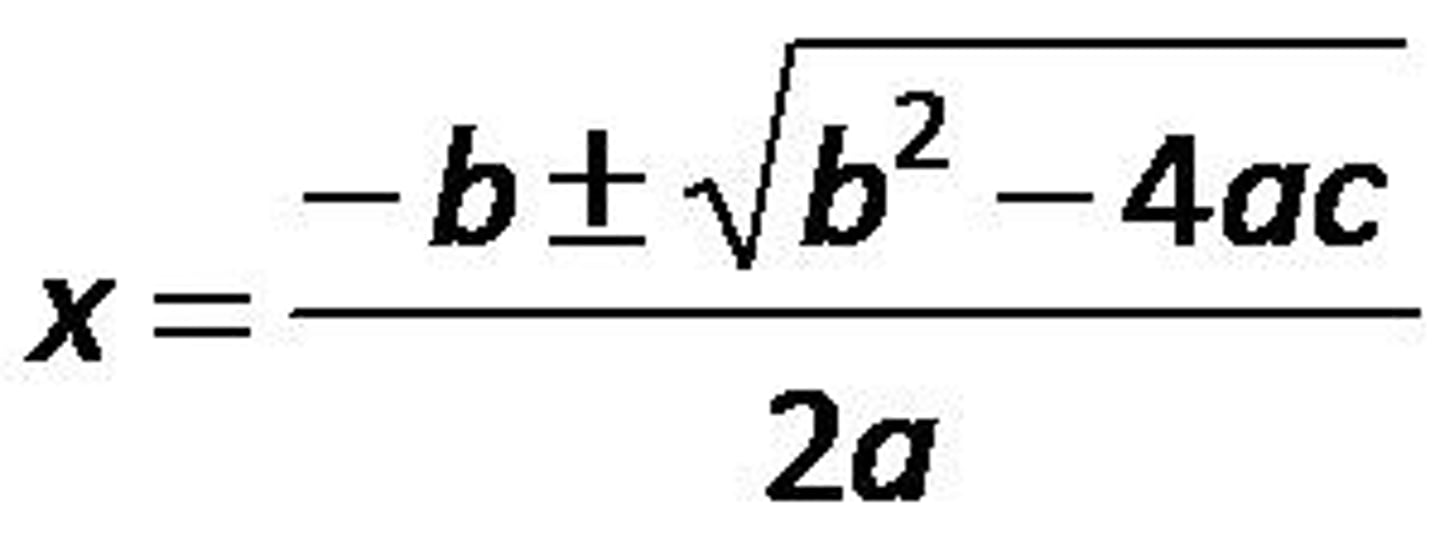
The Discriminant 1
The discriminant D is D = b^2 - 4ac
Notice that it's what is inside of the square root in the quadratic formula
The Discriminant 2
-If D > 0, the quadratic has two solutions
-If D = 0, the quadratic has one solution (e.g., a repeating root)
-If D < 0, the quadratic has no solutions
Factoring Quadratics
For a quadratic of the form (x^2 + bx + c)
- Find two integers m and n, whose sum is b and product c
- Write it in the form (x+m)(x+n)
Completing the Square
Technique we can apply to a quadratic equation in order to get into a more useful form.
Example: y = x^2 + 6x + 10
Step 1: Halve and then square the x term's coefficient (6/2 = 3, 3^2 = 9)
Step 2: Add 9 to both sides of the equation and group the three terms together, leaving the 10 on the outside. (y + 9 = (x^2 + 6x + 9) + 10
Step 3: Move the 9 back over: y = (x+3)^2 + 1
This formula let's us see the minimum possible y value. Zero out the (x+3)^2 term with x = -3 and we can see that the smallest possible y value is 1.
Minimizing / Maximizing Quadratics
Notice that the square term cannot be negative. Hence, the minimum value of the quadratic is b.
Similarly, you can show that the maximum value of the below quadratic is b:
b - (x+a)^2
Absolute Value Quadratics
The same principle applies as in a linear equation: set up two equations (one positive and one negative)
15 = |x^2 + 7x|
- 15 = x^2 + 7x
- -15 = x^2 + 7x
Set both equation to zero to get the more familiar quadratic form:
- 0 = x^2 + 7x - 15
- 0 = x^2 + 7x + 15
Inequalities
- x > p includes all values strictly greater than p
- x < p includes all values strictly less than p
- x >/= includes all values greater than or equal to p
- x
Solving Inequalities 1
Simplest condition of solving an inequality.
-We can add or subtract anything we'd like to both sides
-We can multiply or divide ONLY positive numbers
With these conditions, solving an inequality is easy. It's no different than solving an algebraic equation.
Example:
- 3x - 7 > 8
- Add 7 to both sides
- 3x > 15
- Divide each side by 3
- x > 5
Solving Inequalities 2
Multiplying or dividing by a negative value, then the inequality sign FLIPS.
Example 1:
-5x < 10
- x > -2
Example 2:
(-7/18)x>14. Multiply both sides by 18
-7x > 252
x < -36
Solving Inequalities 3
When completing inequalities with absolute values, two inequalities are created. For the first, just remove the absolute value sign and change nothing else. For the second, make it negative and FLIP the sign.
|x| > 10
results in x > 10 and x < -10
Solving Inequalities 4
Squares and square roots can also introduce extra inequalities. For examples,
x^2 > 9
implies x > 3
and
-x > 3 --> x < -3
Functions
Functions are represented using the notation f(x). Let's examine what each piece of this represents:
1. The bit inside the brackets, in this case x represents the *input* of the function
2. The letter f represents the name of the function
3. The whole thing f(x) represents the *output* produced by the function (with an input of x)
Functions are sometimes shown like this:
f(x) - x^2 + 7x + 10
What this means exactly is that the *output produced when giving an input* of x to the function f is always equivalent to performing the operation x^2+7x+10
Domain of a function
possible input values
Range of a function
Possible output values
Even function
f(-x) = f(x)
In a polynomial, all terms must have even exponents. For example, f(x) = x^8 + x^4 + x^0
Odd function
f(-x) = -f(x)
In a polynomial, all terms must have odd exponents. For example, f(x) = x^7 + x^3 + x^1
Words to Algebra 1
- + = addition, plus, sum, more, added to
- - = minus, difference, decrease, less than, under, remaining
- x = times, product, of, twice, quadruple, into, increase by a factor
- (division) = divided by, over, ratio, slices, halve, quarter, decrease by a factor