Infection and Exposure Control PPT
 Call Kai
 Learn
Learn Practice Test
 Spaced Repetition
 Match
Match Flashcards
 Knowt Play
1/53

Earn XP
Description and Tags
ch 5,6,7
Name | Mastery | Learn | Test | Matching | Spaced | Call with Kai | Chat |
|---|
No analytics yet
Send a link to your students to track their progress
54 Terms
Whats a communicable disease?
(contagious) any disease transmitted from one person or animal to another. Direct: from excreta or other bodily discharges. Indirect: from substances or inanimate objects (contaminated drinking glasses, water, insects, or toys).
whats an infection?
a state caused by the invasion, development, or multiplication of an infectious agent into the body
what kind of disease is caries?
communicable
what bancteria causes caries?
streptococcus mutans
what is cross contamination?
Spread of microorganisms from one source to another: person to person, or person to an inanimate object and then to another person
What in the oral cavity provides some protection against infection?
Intact mucous membrane of the oral cavity provides some protection against infection
High counts of total microorganisms are found in dentalbiofilm, periodontal pockets, and carious lesions
True or false?
True
what is proactive to do to prevent cross contamination?
Recognition of possible transfer of transmissible diseases provides the basis for planning a system of disinfection, sterilization, and management of instruments, equipment, and environment.
direct transmission
Saliva and microorganisms directly passed from one person to another ex. kissing
indirect transmission
microorganisms passed through a secondary object ex. sharing drinks
what is standard precautions
Represent a standard of care whereby universal application of precautions in the treatment of all clients apply, regardless of the individual or the client's infectious disease status
what are standard precautions applied to?
all patients and apply to contact with blood, saliva, all body fluids, secretions, and excretions (except sweat), regardless of whether they contain blood.
Nonintact (broken) skin.
Mucous membranes.
when are transmission based precautions meant to be used?
are to be used in addition to standard precautions when a patient has or is suspected of having a disease that can spread through contact, droplet, or airborne routes (includes these transmissions)
droplet precautions (transmissible)
Respiratory or mucous membrane contact transmitted through airborne droplets (sneezing,coughing)
contact precautions (transmissible)
Reduce risk of transmission of organisms and specific diseases by direct skin or indirect contact.
Examples: Vancomycin-resistant enterococci
airborne precautions (transmissible)
Reduce risk of airborne transmission of infectious agents by droplet nuclei
sharps precautions (transmissible)
Reduce risk of bloodborne pathogen transmission and infection by percutaneous sharps injury.
Examples: Hepatitis B virus (HBV) and hepatitis C virus (HCV), human immunodeficiencyvirus (HIV)
what is the order of intervention break chain of disease transmission (reviews breaks in chains with picture)
infectious agent, reservoir, port of exit, transmission, port of entry, and susceptible host
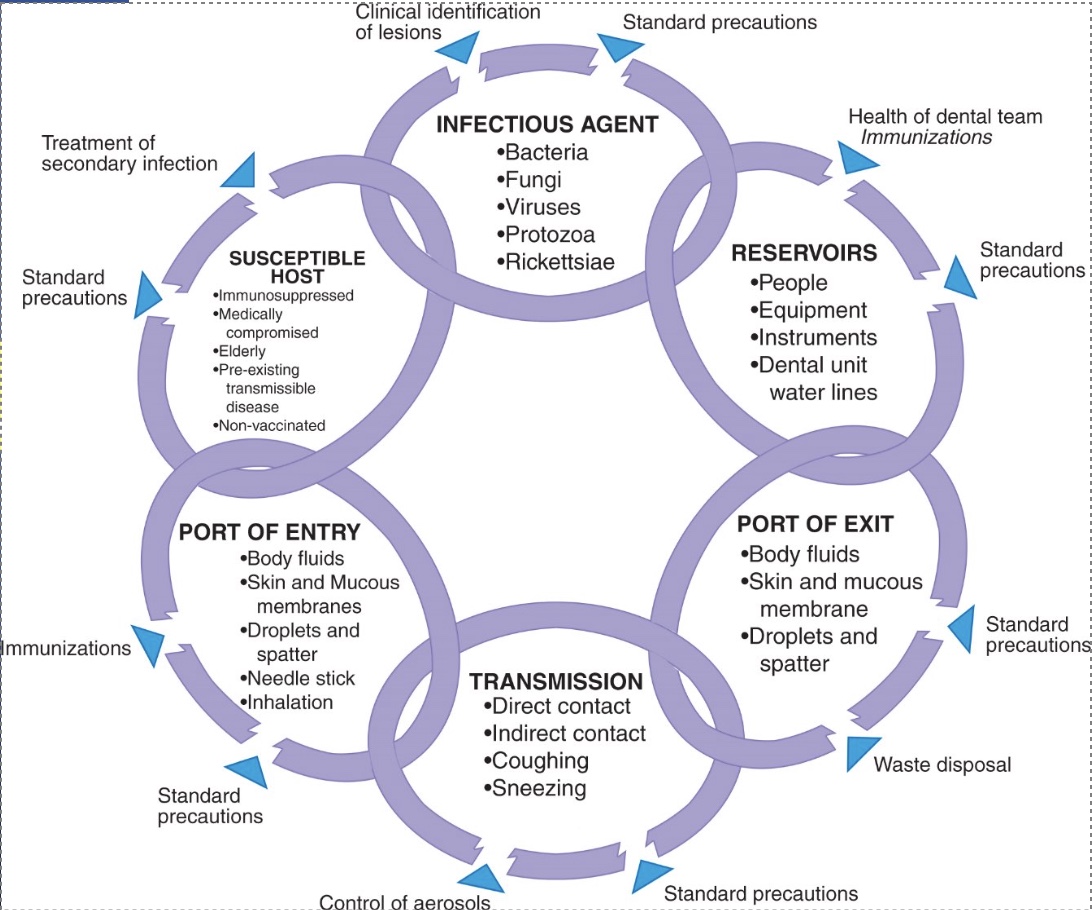
prevention of transmission
-airborne infection can be controlled
-pre-procedural oral hygiene measures (antiseptic/microbial mouthwash)
-interruption of transmission
-clean water
-protection of the clinician
-protection of the patient
-maintain infection control protocols
why cant hygienists treat active infection of tuberculosis
because its an airborne infection and can be a danger to clinician and others in the dental setting
why are droplet nuclei dangerous?
are small enough to pass through over 95% bacterial filtration efficiency required of standard surgical masks, and may remain suspended in the air for hours. Standard precautions may be insufficient to protect the DHCP from transmission of TB in the healthcare setting
Patients with symptoms or history suggestive of active TB are NOT Treated, and are referred immediately for medical evaluation
True or False?
True
why do clinicians not treat patients with active herpes?
because it could be transmissible to the clinician and other patients
how would you teach the patient in a clinic setting why you cannot treat them if they have active herpes and what to do when they have active lesions?
-postpone appointment
-explain the contagious nature/stage of disease (prodromal stage)
-dont share saliva, utensils, food, drink, or lip products
-stress meticulous hygiene, limit touching lesion to prevent spread to other areas
-autoinfection can reoccur from products used during infections ex. ointments, chapstick
What is herpetic whitlow?
virus invades finger where percutaneous membrane is not intact
Primary herpetic gingivostomatitis?
typically has a prodrome of 2-4 days, and consists of fever, malaise, headaches ,mouth ulcers, dry mouth and red, swollen or painful gums
Latent herpetic gingivostomatitis?
virus's lifelong, dormant state after the primary infection, where it remains inactive in nerve cells (sensory ganglia) but can periodically reactivate and cause recurrent, milder outbreaks of blisters
_____ is the most likely oncogenic HPV to progress to cancer and is attributed to 95% of head and neck cancers, sexually transmitted, causes cells to mutate.
HPV-16
What is HPV-16
a type of virus that can infect the genital area. It is one of the most common types of high-risk HPV, which means it has a higher likelihood of causing cancer
seroconversion
development of specific antibodies in the blood as a result of an infection or immunization
Herpes virus 8
aka Kaposi’s Sarcoma and often present with HIV, purple palatal lesion present clinically, considered to be sexually transmitted oral mucosa and saliva are the primary sites of viral shedding and infection transmission
why do we use masks?
because particles 1–5 μm can remain suspended for hours and can be inhaled directly
whats the most effective defense for eye protection?
protective eyewear
whats an ultrasonic processor do?
removes debris from instruments using acoustic energy waves transmitted in liquid disrupting the attachment of debris from an object
how is chemical indicator tape used?
change of color on the indicator confirms the autoclave reached a designated temperature required for penetration. This is not a conformation of sterilization but an indication the device has been processed.
how are instrument packages stored?
Packages are kept completely sealed until unwrapped in front of the patient.
how should the instrument processing area be divided?
1-receiving, cleaning, and decontamination
2-preparation and packaging
3-sterilization
4-storage
Chemical indicators (no matter what class or type) do not verify sterility and do not replace the need for weekly spore testing
True or false?
True
Mechanical and chemical indicators do not guarantee sterilization; however, they help detect procedural errors (e.g., overloaded sterilizer, incorrect packaging) and equipment malfunctions. Mechanical and chemical monitoring should be done for every sterilizer load
True or false?
True
biological indicator
or spore tests, are the most accepted means of monitoring sterilization because they assess the sterilization process directly by killing known highly resistant microorganisms
mechanical indicator
a system within a sterilizer that tracks and displays the critical parameters of a sterilization cycle, including time, temperature, and pressure (and steam is using that sterilizer)
Chemical indicators (no matter what class or type) do not verify sterility and do not replace the need for weekly spore testing.
True or false?
True
chemical indicator
sed inside every package to verify that the sterilizing agent has penetrated the package and reached the instruments inside. If the internal chemical indicator is not visible from the outside of the package, an external indicator should also be used.
mechanical monitoring involves?
checking the sterilizer gauges, computer displays, or printouts, and documenting in your sterilization records that pressure, temperature, and exposure time have reached the levels recommended by the sterilizer manufacture
______________ inactivate spores and all forms of bacteria, fungi, and viruses. Applied atdifferent time schedules, the high-level chemical is either a disinfectant or a sterilant
high level disinfectants
____________ inactivate all forms of microorganisms but do not destroy spores tuberculocidal.
intermediate level disinfectants
____________ inactivate vegetative bacteria and certain lipid-type viruses but do not destroy spores, tubercle bacilli, or nonlipid viruses.
low level disinfection
disinfection is achieved by
Coagulation, precipitation, or oxidation of protein of microbial cells, Denaturation of the enzymes of the cells.
An SDS (safety data sheet) provides facts about the safety and effectiveness ofthe product including
-shelf life
-use life (life expectancy once activated)
-resuse life (amt of time solution can be used/reused)
-directions for activation
-type of container for use/storage
-storage directions
-directions for use (precleaning/drying of items, time/temp ratio)
-instructions for disposal
-warnings (toxic effects, emergency care)
how long is the water/airline flushed in clinic set up and in between patients?
Flush water 2 min at the beginning of every day, and 20-30 sec between patients.
Critical (scalers) and semi-critical (mouth mirrors, items are sterilized or are disposable
True of false?
true
define disinfection
the chemical or physical process of killing most pathogenic microorganisms, but not necessarily all microbial forms like bacterial spores, on inanimate objects and surfaces to prevent the spread of infection
define sterilization
the complete elimination of all forms of microbial life, including bacteria, viruses, and spores, from dental instruments and equipment to prevent cross-contamination and infectio