Section 1
 Call Kai
 Learn
Learn Practice Test
 Spaced Repetition
 Match
Match Flashcards
 Knowt Play
1/15

There's no tags or description
Looks like no tags are added yet.
Name | Mastery | Learn | Test | Matching | Spaced | Call with Kai | Chat |
|---|
No analytics yet
Send a link to your students to track their progress
16 Terms
List the factors that affect the three frequency measures during a power disturbance in a transmission line
RoCoF, Frequency Nadir, steady-state frequency division
RoCoF: Disturbance size, system inertia
Frequency nadir: Disturbance size, system inertia, FCR, D (local frequency disturbance)
SS frequency division: Disturbance size, FCR, D
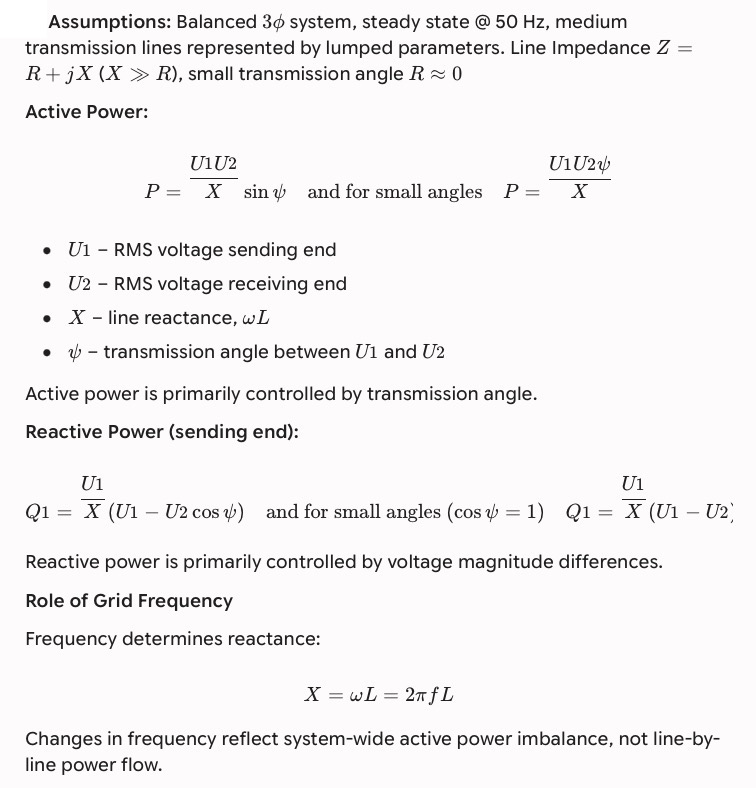
What is the relationship between active power, reactive power, transmission angle, voltage magnitude, and grid frequency in a high voltage ac transmission system? State assumptions
Explain why voltage variation is a concern in power systems?
Overvoltage: Corona losses increase, damage/ increasing aging to equipment, potential risk to people
Undervoltage: Higher transmission losses, reduced transfer capacity, higher risk of voltage instability
Explain the factors that affect the voltage variation in a ac transmission system
Line loading level, load power factor, transmission line length/ impedance, generator short circuit capacity, control capability of different voltage regulating devices
Explain the impact on the grid voltage regulation of decommissioning nuclear and fossil-fuel powered thermal generators and installing wind farms in the power system?
When nuclear and fossil fuel thermal generators are closed, voltage control and reactive power support are reduced. This can lead to an increased risk of voltage collapse and reduce power transfer capability if no V control or Q support devices are put in place.
Wind farms rely on variable wind speeds which causes power variation and voltage variation. Wind farms are also installed further away from demand and have difficulty to provide Q support through long distance AC transmission.
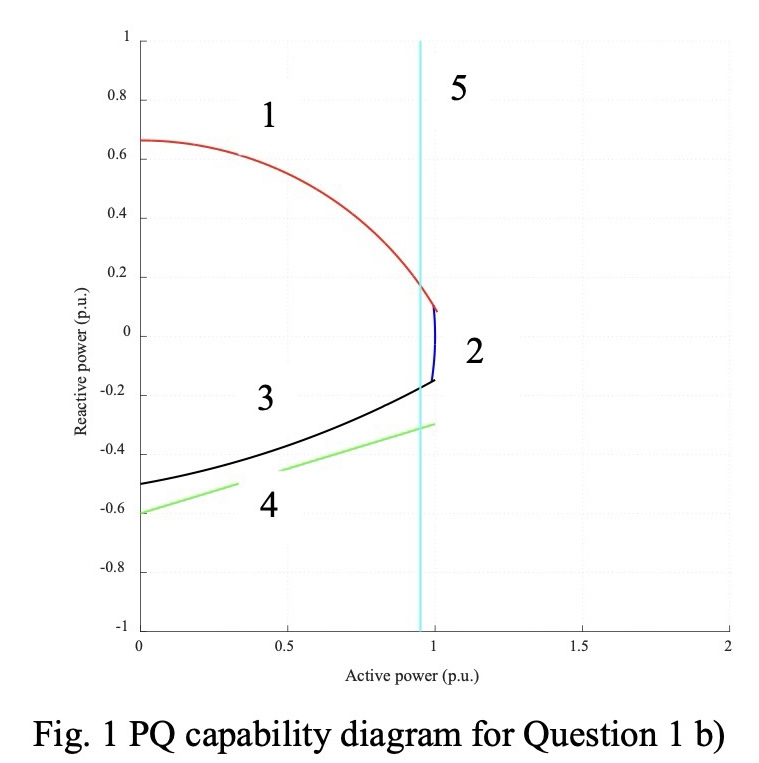
Figure 1 shows the steady-state PQ capability diagram of a synchronous generator. Explain which electrical limitation is imposed for each of the five curves in the figure.
Red: Rotor field current thermal limit
Blue: Stator current thermal limit
Black: Rotor angle stability limit including grid and transformer impedence
Green: Stator end region heating limit
Cyan: Power Factor Requirement
When the grid is subject to an active power disturbance, what are the steps/stages to bring the frequency back to 50 Hz? Describe the names of the process and the corresponding purposes.
Inertia Response (FFR): Determines system initial RoCoF
Frequency Containment Process (FCR): Stabilize frequency under power imbalance and limit frequency nadir
Frequency restoration process (FRR): Restore FCR reserve, bring frequency back up to 50 Hz
Reserve replacement process: re-dispatch to achieve cost minimization or economic benefits
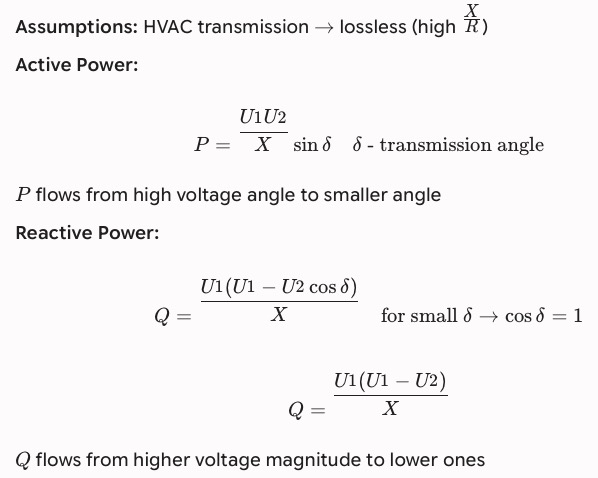
Explain how the direction of active and reactive power flow between two busses is related to the voltage at the two busses in a high voltage ac transmission system. State the assumptions and motivate your answers.
Explain why frequency variation is a concern in power systems?
Over frequency: Accelerated aging of mechanical components, torsional resonance above 100 Hz
Under frequency: Accelerated aging, thermal constraints due to reduced ventilation, torsional resonance below 50 Hz, over-excitation
Explain the physical meaning of reactive power
Reactive power is the power that oscillates back and forth between source and reactive components. It does not do net work, but it is necessary to maintain magnetic and electrical fields in devices.
Explain the role of inertia in an ac power system
reduced inertia → increased initial RoCoF
reduced inertia → lower frequency nadir
reduced inertia → damping increases, but to a lesser extent
Explain the cause-effect relationship between frequency, transmission angle, and active power.

Sometimes we hear the following statements about reactive power:
It is not real power, it is imaginary power
Reactive power is the oscillating power
Are these statements correct? Motivate your answers
The first statement is incorrect: Reactive power is the imaginary part of complex power S = P + jQ, however it is physically real. It is the energy stored in the electric and magnetic field.
The second statement is correct: Reactive power oscillates between source and reactive components
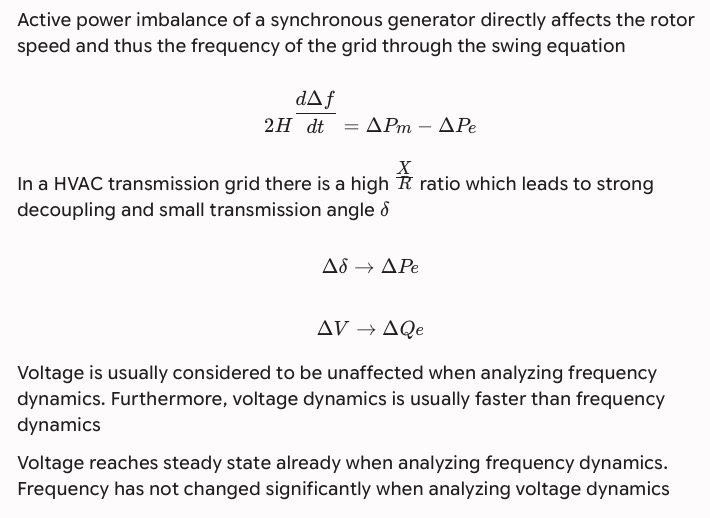
When analyzing active power imbalance and frequency variation of an ac transmission system, the grid voltage is normally assumed to be constant (1 p.u.) and its dynamic variation is ignored. On the other hand, when analyzing voltage control using tap changers or generator excitation control, grid frequency is typically assumed to be constant (50 Hz) and its dynamic variation is ignored.
Explain why such assumptions are often used in ac transmission system analysis, and what are the limitations of such assumptions in both cases.
Explain what the key measures of frequency quality and stability are.
Explain what factors affect these key performance measures and what the corresponding remedial actions are to improve the frequency quality and stability.
Key measures of frequency quality
Minutes of a year which frequency of the grid goes outside [49.9, 50.1] Hz
Factors that affect it: System inertia, stochastic load variation, grid/solar PV variation, generator regulating speed for FCR-N provision, aFRR regulation speed and volume
Remedial actions: faster but stable regulation of FCR-N, faster and longer volume of aFRR
Key measures of frequency stability
RoCoF factors affected by disturbance size and system inertia
Remedial actions: synthetic inertia, reduced disturbance size if possible
Factors that affect frequency nadir: disturbance size, system inertia, frequency containment process, load-frequency dependence
Remedial actions: synthetic inertia, FFR, faster FCR-D from BESS, flexible load
Explain the factors that affect frequency nadir and RoCoF in an AC synchronous power system
Initial RoCoF: Inertial (H) and disturbance size (ΔP)
Frequency nadir: H, ΔP, active power support (FCR, FRR) local frequency dependence (D)