BIOL 371 Homeostasis to Thrive and Survive
 Call Kai
 Learn
Learn Practice Test
 Spaced Repetition
 Match
Match Flashcards
 Knowt Play
1/142

There's no tags or description
Looks like no tags are added yet.
Name | Mastery | Learn | Test | Matching | Spaced | Call with Kai | Chat |
|---|
No analytics yet
Send a link to your students to track their progress
143 Terms
What is homeostasis?
the maintenance of a stable state or a balanced position suitable for metabolic processes through responses to deviations from this stable state
What does homeostasis do?
biochemical reactions that organisms must regulate in response to many internal variables
What type of internal variables does homeostasis respond to?
nutrients, gasses, pH, waste products, [water], [solutes], volume, pressure, temperature
How does the negative feedback loop of homeostasis work?
Change → Receptor (sensor) → Integrator (sensory information received and determine whether action is required) → Effector → Back to baseline
What is a positive feedback loop in comparison to a negative feedback loop?
Negative feedback loop: Reverses a change to return a physiological variable back to its baseline (set point), maintaining homeostasis. The response stops once normal conditions are restored.
Positive feedback loop: Amplifies or increases the original change, moving the variable further from the baseline until a specific event is completed.
What is the relationship between homeostasis and cell location?
A cell's location determines its environment and function, so different cells require different conditions to maintain homeostasis.
How do external cells maintain homeostasis?
they must face the environment
Traits of external cells
sometimes they’re dead (superficial layers of skin)
sometimes protected by an acellular cuticle
What do cells of exchange surfaces do? Why must they be alive?
Found inside the body, they control access to the internal environment while dealing with aspects of the external environment to regulate exchange
They need energy (ATP) to:
Control what enters and leaves the body.
Actively transport substances.
Repair damage.
Produce protective secretions.
How do cells of exchange surfaces deal with wear and tear?
Rapid turnover
They divide and replace damaged cells quickly.
Produce secretions lethal to microbes
They release substances like enzymes, acids, and antimicrobial peptides that kill bacteria and other pathogens.
Covered by mucus
Mucus forms a protective layer.
It traps microbes and dust.
It prevents direct contact between the environment and the cells.
Why do cells of exchange surfaces experience wear and tear?
They experience wear and tear because they are constantly exposed to the external environment and are used continuously.
What is the difference between intracellular fluid and extracellular fluid?
Intracellular fluid (ICF): Fluid inside cells (cytoplasm); ~60% of total body water.
Extracellular fluid (40%) composed of:
Interstitial fluid: Fluid surrounding cells; the immediate environment for cells where exchange occurs.
Plasma: Fluid portion of blood inside blood vessels; transports nutrients, oxygen, hormones, and wastes throughout the body.
What do internal cells do for homeostasis?
homeostasis by organism regulates the internal environment
Blood vs Hemolymph
Hemolymph and blood are both body fluids, but blood is found in vertebrates inside a closed system, while hemolymph is found in many invertebrates inside an open system
Where does interstitial fluid come from?
Blood plasma
Why does regulating the extracellular fluid help maintain homeostasis?
By keeping the ECF stable and isoosmotic, the organism creates a predictable environment for all cells. This reduces the amount of work individual cells need to do to maintain their own internal conditions, allowing them to specialize instead of focusing on basic survival tasks like osmotic regulation.
What is osmoregulation?
regulation of the internal osmotic (water/salt/waste) environment
What is circulation in homeostasis?
bulk flow of fluid within the body (water, solutes, nutrients, gasses)
What is gas exchange?
exchanging gasses with the environment
What is pH regulation?
controlling the proton [proton H+] of body fluids
3 ways the body uses homeostasis to osmoregulate
diffusion
osmosis/water potential
bulk flow
What is diffusion?
Movement of dissolved solutes from high concentration → low concentration.
Effective only over short distances.
What is Fick’s law?
Diffusion rate across a membrane = D x A x dC/dX
D = diffusion constant
A = surface are of the membrane
C = concentration
X = distance
What does Fick’s law tell us?
Diffusion is faster with:
Larger surface area
Steeper concentration gradient
Higher diffusion constant
Diffusion is slower over longer distances.
What is osmosis?
The tendency of water to diffuse across a selectively permeable membrane towards the side of greater osmolality (hyperosmotic) when the membrane is impermeable to the solute
What is water potential?
overall potential determining where water moves
In what direction does water move?
Water moves from higher water potential → lower water potential.
What is water potential influenced by?
Water potential is influenced by:
Osmotic (solute) potential
Pressure (hydrostatic) potential
gravity
humidity
What is hydrostatic pressure?
the pressure exerted by a standing or resting fluid due to gravity
What is bulk flow?
mass movement over long distances due to hydrostatic pressure
modifying a pressure mechanism to ‘flush’
What is a concentration gradient?
a spatial difference in the relative abundance of one type of molecule or atom
Why does diffusion happen and what does it result in?
Diffusion occurs because particles are in constant random motion, causing a net movement from areas of high concentration to areas of low concentration.
It results in the diminution of the concentration gradient and the establishment of an equilibrium
What is the diffusion coefficient dependent on?
depends upon characteristics of solute and solvent, temperature etc.
What is dC/dX?
dC - concentration difference across membrane
dX - thickness of membrane
dC/dX - force driving diffusion
Active vs Passive transport
active - up concentration gradient (low to high)
passive - down concentration gradient (high to low)
What will change the rate of particles if all other variables are equal?
the surface area of the membrane
What is molality?
the total number of dissolved particles of solute per kg of solute
What is osmolality?
osmotic concentration of a solution (osmotically active particles), measured in osmoles
What are osmotically active particles?
any solute particles that cannot freely cross a semipermeable membrane, meaning they pull water toward themselves and create osmotic pressure
What are osmoles?
a unit of measurement that describes the number of active particles in a liquid, charged particles that impact diffusion rate
ex. 1 mole NaCl dissolved in 1 L of water yields
2 moles of particles in solution– 1 mol Na+, 1 mol Cl-
= 2 osmoles
Hypoosmotic
of a solution, having a lower osmolality than the reference solution
Is water hypoosmotic, hyperosmotic or isosmotic to the red blood cell placed in it? What happens to it?
hypoosmotic, it blots
Hyperosmotic
of a solution, having a higher osmolality than the reference solution
Is a strong saline solution hypoosmotic, hyperosmotic or isosmotic to the red blood cell placed within it? What happens to it?
hyperosmotic, it shrivels
Isoosmotic
of a solution, having the same osmolality as the reference solution
Is a bath if physiological saline hypoosmotic, hyperosmotic or isosmotic to the red blood cell placed within it? What happens to it?
isoosmotic, it stays the same
What is the osmotic potential of pure water and how is osmotic potential determined?
pure water has an osmotic potential of zero, which is the highest it could be
the more solute, the more negative the osmotic potential
What direction does water move in relation to water potential, and osmotic potential?
Water moves from high potential to low potential volumes for both osmotic potential as well as water potential as a whole
What is the key difference between osmotic and water potential?
Osmotic potential → only considers dissolved solutes.
Water potential → considers the overall conditions affecting water movement, including osmotic potential + pressure.
What is osmotic pressure?
force exerted on water generated by differences in solute concentration across a semi-permeable membrane
What is hydrostatic pressure?
the physical pressure that water exerts because it is pushing against something.
affecting how water crosses membrane from volume of high osmotic potential to volume of low osmotic potential
What happens in a cell that has high pressure potential and low osmotic potential?
the cell is turgid - flow of water across the membrane is decreased, reversed or stopped
Low osmotic potential → pulls water IN
High pressure potential → pushes water OUT
What is the relationship between osmotic pressure and hydrostatic pressure?
Osmotic force pulls water toward the solute, while hydrostatic pressure can push water away from the solute.
What happens in a cell that has low pressure potential and low osmotic potential?
flow of water across membrane increased
What is water potential made up of?
sum of osmotic potential, pressure potential, gravity etc. across a membrane
What is the significance of osmosis to animals?
Cells will shrink or swell not in an isoosmotic environment (without work on the cell’s part)
What is the significance of osmosis to plants?
Cells will develop turgor pressure (hydrostatic) as water enters, which limits further influx of water
What is bulk flow and what exchange occurs because of it?
Bulk flow uses mechanical pressure to move fluid through the body, and this pressure also helps control the exchange of water and dissolved substances between blood and the extracellular fluid.
What determines whether fluid leaves or enters a capillary?
Hydrostatic pressure (CHP) = pushes fluid OUT of capillary
Blood osmotic pressure (BOP) = pulls fluid INTO capillary
Upstream (arteriole):
CHP > BOP → Filtration → fluid leaves capillary
Middle:
CHP = BOP → No net movement
Downstream (venule):
BOP > CHP → Reabsorption → fluid enters capillary
Osmoconformer strategies
Adjust osmotic potential of cells and extracellular fluid to match environment
Osmoregulator strategies
Adjust osmotic potential of extracellular fluid to match cells and regulate or protect against the external
generally requires thick outer layer
Terrestrial and aquatic animals responses to environment
Terrestrial environments are dry:
– lose water to the environment
consume/produce/conserve water
limit salt intake
Marine environments are hyperosmotic (dry):
– lose water to the environment and gain ions from the environment
eliminate salt and consume/produce/conserve water
limit salt intake
Freshwater environments are hyposmotic:
– gain water from the environment and lose ions to the environment
eliminate water and consume/conserve salt
Is osmolality of body fluids the same among aquatic organisms?
Body fluid osmolality varies among aquatic organisms
Some marine groups are isoosmotic with seawater – osmotically stable environment
What type of tonicity do elasmobranchs have?
isosmotic to seawater, but concentrations of Na+, K+, Cl- all less than seawater in which the difference is made up by urea
What diffuses through elasmobranchs? How is this regulated?
Still must deal with inward diffusion of Na⁺, K⁺, Cl⁻ through gills (since salts inside body are less than seawater)
Rectal gland secretes a highly concentrated salt solution removing excess salt
What type of tonicity do marine bony fish have? What direction does water move?
hypoosmotic to environment
lose water and gain ions, especially through the gills
How do marine bony fish account for their loss of water and gain of salt?
they drink seawater to offset water loss
chloride cells in gills eliminate Na+, K+ and Cl- from blood
Produce small amounts of urine, conserving water, eliminating excess solute in faeces
What type of tonicity do freshwater bony fish have? What direction does water move?
hyperosmotic to environment, lose ions and gain water, especially through the gills
How do freshwater bony fish account for gain of water and loss of salt?
Do not drink
Produce large amounts of dilute urine
Must replace ions from food or from transport across gill membrane
Do land dwellers lose or gain water?
A dry environment - constant water loss through evaporation:
Across wet respiratory membrane
Across surface of skin
Water loss in urine and faeces
How do land dwellers account for their loss of water?
waterproofing of outer layer of body to prevent evaporataion
minimal exposure of gas- exchange and digestive surfaces to air (must stay moist)
Minimizing salt intake - The more salt you take in, the more water you need to remove it.
What is osmoregulation in animals?
Controlling water loss and gain
What is excretion?
elimination of waste/toxins
aids in controlling content of extracellular fluid (salt/water/pH)
What are the actions of the excretory tubule?
filtration (non selective)
reabsorption (selective
secretion (selective)
Ion pump (Primary active transport)
Uses ATP directly to move ions against their concentration gradient, creating an ion gradient across the membrane.
Co-transporter (Secondary active transport)
Uses the energy stored in an ion gradient to move another substance across the membrane, often transporting both substances in the same direction.
Ion exchanger (Antiporter)
Uses the movement of one ion down its concentration gradient to transport a different ion in the opposite direction without directly using ATP.
What is secretion?
active transport of ions from extracellular fluid to filtrate
Summarize the processes of urine formation
Filtration forms an isosmotic filtrate by filtering water and small solutes from the blood into the nephron. Reabsorption returns useful substances to the blood, while secretion adds unwanted ions and wastes to the filtrate. Water is reabsorbed only in water-permeable regions, so the remaining filtrate becomes hyperosmotic, producing concentrated urine.
How do most aquatic life get rid of ammonia?
diffusion into the environment (across body / gills)
excretion in filtrate/urine
Ammonium (NH+4) / sodium exchangers
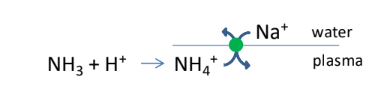
How do terrestrial (and some aquatic) life get rid of urea?
Terrestrial cannot use diffusion or ion exchange with air
• only excretion in filtrate
Who produces urea?
mammals, amphibians, sharks
Who produces uric acid?
• Key for animals that develop in terrestrial eggs
land snails, insects, reptiles/birds
Summarize nitrogen waste excretion in animals.
Proteins and nucleic acids are broken down into amino acids and nitrogenous bases, releasing amino groups (NH₃). Depending on the animal, nitrogen is excreted as ammonia (aquatic animals; very toxic, requires lots of water), urea (mammals; less toxic, moderate water), or uric acid (birds and reptiles; least toxic, conserves the most water).
What is a protonephridium?
A protonephridium is an excretory organ mostly found in acoelomates that filters body fluid and removes nitrogenous wastes using ciliated flame cells, with the filtrate draining through a series of ducts to the outside.
What is a metanephridium?
A metanephridium is an excretory organ in coelomates that filters coelomic fluid, reabsorbs useful substances into the blood, and excretes the remaining waste. It is associated with closed circulatory systems.
What is hemolymph?
transport fluid in open circulatory systems, comes into contact with interstitial fluid - extracellular fluid pool
How do Malpighian tubules excrete nitrogenous waste in insects?
Malpighian tubules have a large absorptive surface area in contact with the hemolymph (blood). They actively secrete uric acid ions into the tubule lumen, water follows by osmosis, and the filtrate enters the gut. Na⁺ and K⁺ are reabsorbed, causing water to follow, leaving solid uric acid to be released with feces, conserving water.
Key idea: Insects excrete uric acid as a solid to minimize water loss.
How does the nephron excrete wastes?
Found in vertebrates
• Filters water and solutes from blood, reabsorbs water and solutes to produce concentrated urine
Why do fluids circulate?
processing
transortation/communication
Why do larger animals need a circulatory system?
because diffusion is only adequate in small, simple organisms
Plants vs animal circulation
both use a series of tubes, but differ in:
• Nutrient, energy and water sources
• Metabolic rates
• Cell structure
• Presence or absence of muscle
What are the different types of circulation in aniamls?
circulation of external fluid through an open body cavity
circulation of internal fluid through an open body cavity
circulation of internal fluid though a closed circulatory system
circulation of internal fluid though a closed circulatory system with a double circuit
Why do animals need efficient circulatory systems?
Animals are heterotrophs with extracellular digestion and have high metabolic rates, requiring rapid transport of oxygen and sugars to tissues and removal of CO₂ and wastes. Because animals move, their circulatory structures must be elastic and flexible to withstand changes in pressure and movement.
How does circulation work in animals?
a cardiovascular system (pump for cardio and vessels for vasculature)
circulatory fluid and vessel network for circulation
fluid must be directed through the vessels
What kind of organisms have are open circulatory systems?
suitable for taxa with slow metabolic rates, like arthropods and molluscs
What can open circulatory system be supported with?
May be supplemented with faster specialized transport systems, ie. tracheae in insects
How does an open circulatory system work?
The heart(s) are located in hemolymph-filled sinuses. When the heart contracts, hemolymph is pumped through arteries into body spaces; when it relaxes, hemolymph returns from the hemocoel (the main body cavity). Valves maintain one-way flow. Body movements help distribute hemolymph, but flow cannot be directed precisely to active tissues; accessory hearts may help supply limbs.
Key idea: Open circulatory systems circulate hemolymph through body spaces instead of closed blood vessels.
What is a closed circulatory system and why is it efficient?
A closed circulatory system keeps blood contained within the heart and blood vessels, so it does not directly contact body tissues. Blood plasma circulates through capillary beds that connect arteries and veins, allowing efficient filtration, oxygen delivery, waste removal, and directed blood flow under pressure.
Key idea: Blood stays in vessels → higher pressure → faster, more controlled delivery to active tissues.
What does the heart do in circulatory systems?
Closed circulatory system: The heart creates pressure and directs blood flow through vessels. Also maintains bulk flow of fluids in the face of resistance
Open circulatory system: The heart creates flow of hemolymph through body spaces.