microbe hunt microbiology
 Call Kai
 Learn
Learn Practice Test
 Spaced Repetition
 Match
Match Flashcards
 Knowt Play
1/36

There's no tags or description
Looks like no tags are added yet.
Name | Mastery | Learn | Test | Matching | Spaced | Call with Kai | Chat |
|---|
No analytics yet
Send a link to your students to track their progress
37 Terms
What is an artificial situation in which only one species of bacteria has been isolated from all other species.
pure culture
in nature, bacteria do not live in pure culture, but in symbiosis—in communities.
What kind of medium:
contain chemical substances that inhibit growth of one group or species of bacteria while encouraging another group or species of bacteria to grow
selective medium
Some selective media are also differential.
What kind of medium:
contains chemical indicators that allow the microbiologist to distinguish between two or more groups or species of bacteria.
differential medium
What kind of media:
contain chemical nutrients to support the growth of fastidious heterotrophs (organisms with complex nutritional requirements).
This laboratory exercise will demonstrate how selective, differential, and enriched media can be used to isolate and differentiate between bacterial species.
enriched media
complex mixture of bacteria can be separated and differences between the various organisms can be ascertained by growing the mixture on , what kind of media?
selective and differential media
Mannitol salt argar (MSA) is what kind of medium
selective and differential
MSA inhibits most bacterial species because it contains 7.5% sodium chloride (NaCl), which makes it?
inhospitable for salt-intolerant species.
MSA does not inhibit halophilic (salt-loving), _____ species
Staphylococcus
MSA is also a differential medium in that it can distinguish, what?
mannitol fermenters from non-fermenters
MSA contains the carbohydrate mannitol along with an indicator dye called phenol red
If a bacterium can ferment mannitol, it produces acids that lower the pH of the medium, causing the phenol red to turn, what color?
yellow
Colonies grown on MSA that are surrounded by a yellow zone are mannitol fermenters, and those that remain red are?
non-fermeters
The MSA medium is used to diffentiate , what?
Staphylococcus aureus, which is a mannitol fermenter, from other nonfermenting, salt-tolerant staph species. I
Nutrient agar (NA)
commonly used to culture bacteria that have already been identified for use in further tests such as oxidase, catalase, or coagulase.
Since NA contains no dyes or chemicals, there will be no interference with further tests.
What is any inanimate object that is capable of carrying infectious organisms, and possibly transferring them from one person to another
fomite
Procedure for collection of microbes from Fomites
1.Each pair of students will inoculate two plates.
2. Once you have located a surface to test, dip your sterile swab in the sterile water, press the swab against the side of the test tube to remove excess saline (if the swab is soaked and dripping, your samples will run together).
3. Rub the swab across your chosen surface while rotating the swab between your fingertips, and then place it in the empty sterile tube. Repeat the procedure with the second swab next to the original area on the same fomite.
4. Return to the lab with your fomite samples.
5. Obtain a nutrient agar (NA) and mannitol salt agar (MSA) plate.
6. Label your agar plates on the bottom with the date, lab section, group, and fomite around the edge of the plate.
7. Swab the surface of each plate with one of the swabs used to sample the fomite. While swabbing the surface of the plate, roll the swab between your thumb and fingers to ensure all bacteria on the swab are transferred to the surface of the agar.
8. Tape the lid of each plate to the base with two short pieces of masking tape. Stack both plates on top of each other with the bottom sides facing up and tape them together with masking tape.
9. Incubate the plates as instructed until returning to the lab to observe your results
0 colonies, is what level of contamination
no contamination
1 to 10 colonies, is what level of contamination
low contamination
11-50 colonies, is what level of contamination
moderate contamination
over 50 colonies is what level of contamination
heavy contamination
what are some shapes of colonies
Look at the whole colony. Describe the shape using the terms
circular, filamentous, irrefular, rhizoid, spindle
what are some margin (edge of colonies viewed from above) of colonies
Describe the outer edge of the colony as
entire, undulate, lobate, filamentous, serrate, scalloped
what are some elevation (colonies viewed from side) of colonies
Hold the plate to the side and note if the colonies are
flat, raised, convex, pulvinate, umbonate
size: whenever possible, measure the colony diameter and express it in millimeters (mm). If the bacterial colony is too small to be measure (less than 1 mm), you may describe it as
punctiform
PIGMENTATION or COLOR:
Describe the color of the colony as precisely as possible (using colors you would expect to find in a 24 pack of crayons).
SURFACE: Select one from each of the following lists:
smooth, wrinkled, rough, or concentric rings
dull (matte) or shiny (glistening)
TRANSMITTED LIGHT: Hold plate up to the light with something (e.g. text) behind it. If light passes through the colony and you can see through it, the colony is _______.
If light does not pass through the colony and you can't see through it, the colony is ____
traslucent;opaque
Which type of medium allows a microbiologist to distinguish between two of more groups of bacteria by visual observation?
differential medium
Which type of medium inhibits the growth of one group of species of bacteria while encourage another group or species of bacteria to grow?
selective medium
Which type of medium is Mannitol Salt Agar used in the Microbe Hunt lab exercise?
selective and differential medium
After incubating your nutrient agar plate swabbed with a sample from a fomite overnight, you count 27 colonies growing on the petri plate.
Based on this observation, what is the contamination level of the sampled fomite considered to be?
moderate contamination
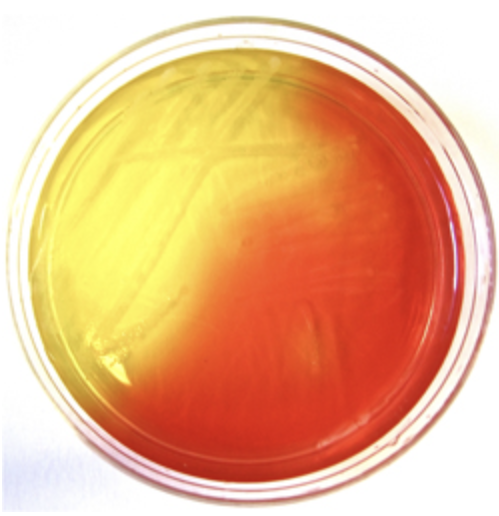
An unknown specimen was grown on Mannitol Salt agar (MSA). Observe the pictured result and answer the following question
select all appropriate statements regarding the pictured Mannitol Salt agar (MSA) test result.
The organism tested is able to grow in the presence of high salt. |
The organism tested is most likely Escherichia coli (E. coli). |
The organism tested is possibly a type of Staphylococci. |
The organism tested does not ferment mannitol. |
The organism tested ferments mannitol. |
The organism tested is able to grow in the presence of high salt.
the organism tested possibly a type of Staphylococci.
the organism tested ferments mannitol

An unknown specimen was grown on Mannitol Salt agar (MSA). Observe the pictured result and answer the following question.
Select ALL appropriate statements regarding the pictured Mannitol Salt agar (MSA) test result.
The tested organism is likely to be coagulase positive.
The media used in this test is good for growing Staphylococci
The media used in this test is differential.
The media used in this test is selective.
differentiates between members of the Staphylococcus genus based on their ability to ferment mannitol to produce acids
mannitol
pH indicator that is red under neutral pH and turns yellow under acidic pH
allows differentiation between mannitol fermenters (acid producers) and mannitol non-fermenters
phenol red
7.5% NaCl - selects for…
halophilic species of bacteria such as those in the Staphylococcus genus
Identify this:
does not ferment mannitol
punctiform, white, opaque colony
Staphylococcus epidermidis
Identify this:
Mannitol fermenter
Yellow “halo” in agar around colony from acid production
White/yellow opaque colony (larger than S. epidermidis)
Staphylococcus aureus