structure and function of large biological molecules | Ch 5
 Call Kai
 Learn
Learn Practice Test
 Spaced Repetition
 Match
Match Flashcards
 Knowt Play
1/32

There's no tags or description
Looks like no tags are added yet.
Name | Mastery | Learn | Test | Matching | Spaced | Call with Kai | Chat |
|---|
No analytics yet
Send a link to your students to track their progress
33 Terms
Polymers
One long molecule constructed by linking many smaller monomers
4 main class of macromolecules
Carbs, proteins, nucleic, lipids
Dehydration reaction
Cells synthesize (build) polymers from monomers
monomers release water as byproducts (H and OH combined when bonded)
Known as condensation
Hydrolysis
Cells breakdown polymers into monomers
H2O added to help break that bond
Carbohydrates
Macromolecule 1:
Classified as Saccharides and has 3 types of how many sugars/glucose there are
monosaccharides
Disaccharides
Polysaccharides
Monosaccharides
Base (single unit) of carbs, monomer of carbs
one sugar
5-6 carbons
One carbonyl group
2/more hydroxyl groups
Ring structures
Disaccharides
2 sugars
Dimer
Joined by covalent bond
Sucrose, lactose, maltose
Polysaccharides
More than 2 sugars
polymer!
Complex carbs, linear or branched
Glycosidic linkage
The bond that two or more monosaccharides have between eachother
dehydration: produces water! (Condensation)
Sucrose
glucose and fructose
Lactose
Glucose and galactose
Maltose
Glucose and glucose
3 main types of carbs
Starch, cellulose, and glycogen
Starch
Made by plants, a ten by humans
Cellulose
Made by plants consumed by plants (cellular building material)
glycogen
Made by animals, a ten by animals (energy storage)
Starch(explained)
Polymer of alpha glucose monomers(all same pattern)
same direction monomer(all top/or bottom)
Coiled molecule, almost all branching (easily hydrolyzed)
Cellulose
Component of plant cell walls
polymer of beta glucose monomers(upside down pattern)
Upside down pattern= structure better hold in plants
Parallel rows via hydrogen bonds
Glycogen
Polymer of alpha glucose monomers
extensively branched
Chitin
Made by animals and fungi
provides structural support (exoskeleton and fungal cells)
Polymer with amine groups!!!!!
Proteins
Macromolecule 2:
Monomer: amino acids
All constructed from a set of 20 amino acids
Proteins structure
4 components attached to alpha carbon
amino acid
A carboxyl group
A hydrogen atom
An R group
R groups
Some non polar/polar
each acid has a different R group! (20 different ones)
Non polar groups: hydrophobic
Polar: hydrophilic
Electrically charged: hydrophilic
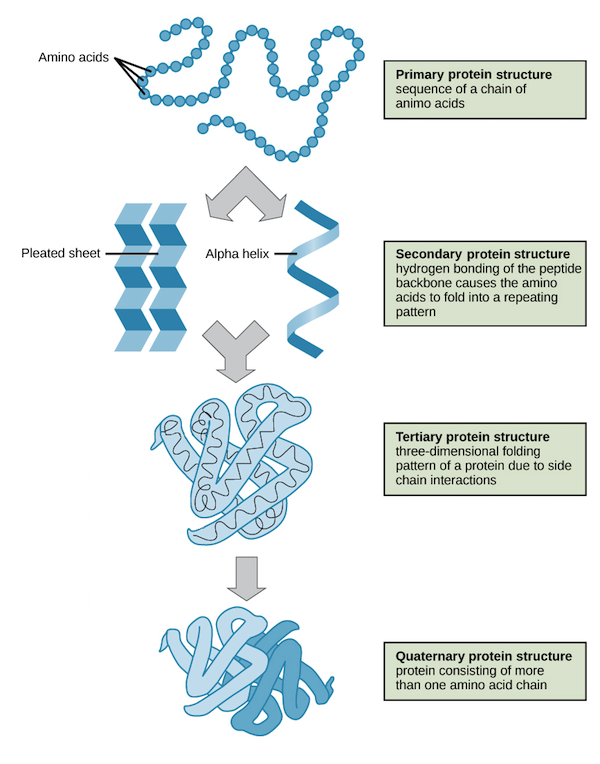
Primary structure
Amino acids(monomers) linked to eachother by a peptide bond
Not yet a protein
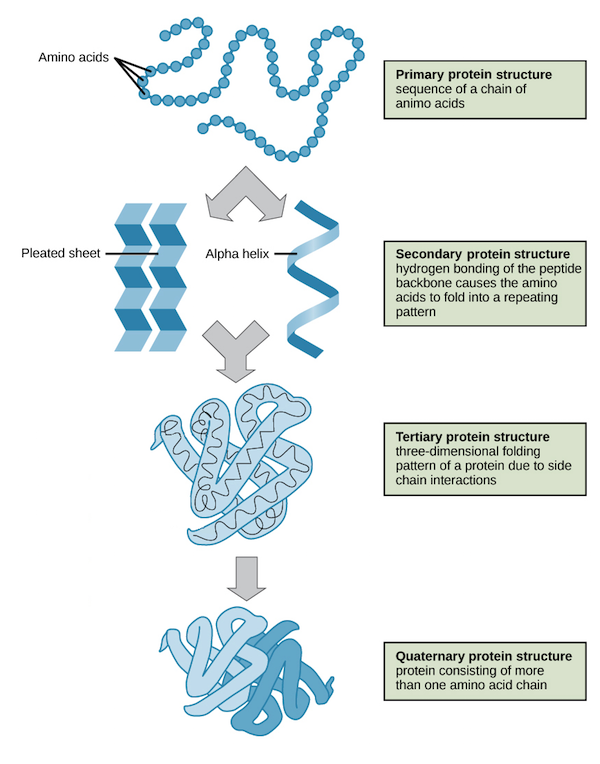
Secondary structure
hydrogen bonding between segments of the peptide create 2 unique 3D shapes!
officially a protein
Alpha helix
Beta pleats
Tertiary structure
Bonds between R groups
creates globular protein shapes- complete 3D shape
Quaternary structure
Bonding of 2 or more proteins to form a large complex protein
hemoglobin has 4 subunits
Functionality of a protein
Unique shape determines functionality
denature: loss of 3D shape (unreaveling) due to extreme environmental conditions
Example: pH, salt concentration, temperature
Ex: cooked eggs
Nucleic acids
Monomer: nucleotide
Function: gene expression
2 types of nucleic acids: DNA and RNA
Deoxyribonucleic Acid (DNA)
codes for traits
Without oxygen
DNA makes RNA
2 strands (runs opposite direction)
5’-3’
Ribonucleic Acid (RNA)
template for making proteins
Single strand
Base paring still occurs within single strand (3D structure)
No Thymine!
Nucleotide
The monomer of Nucleic Acids
composed of three parts: pentose sugar, phosphate group, nitrogenous base
Pyramidines
Single ring nitrogenous base- bonded hy hydrogen bonds
Purines
Double ring nitrogenous base- bonded ny hydrogen bonds