Fat Metabolism
 Call Kai
 Learn
Learn Practice Test
 Spaced Repetition
 Match
Match Flashcards
 Knowt Play
1/36

There's no tags or description
Looks like no tags are added yet.
Name | Mastery | Learn | Test | Matching | Spaced | Call with Kai | Chat |
|---|
No analytics yet
Send a link to your students to track their progress
37 Terms
What is the basic structure of a triacyclglycerols
A glycerol backbone esterified to three fatty acids.

functions of lipids in the human body
1. Major source of energy,
2. Component of cells and tissues (membranes),
3. Required to absorb fat-soluble vitamins,
4. Precursors converted into other molecules (e.g., prostaglandins)
The two most common saturated fatty acids in the diet and their carbon counts.
Palmitic acid (C16:0) and Stearic acid (C18:0)
Identify the major monounsaturated fatty acid in our diet.
Oleic acid (C18:1)
What is the "Rule of 3" for double bond positioning in polyunsaturated fatty acids?
Double bonds are typically positioned 3 carbons apart (e.g., in 20:4, the bonds are at Δ5,8,11,14
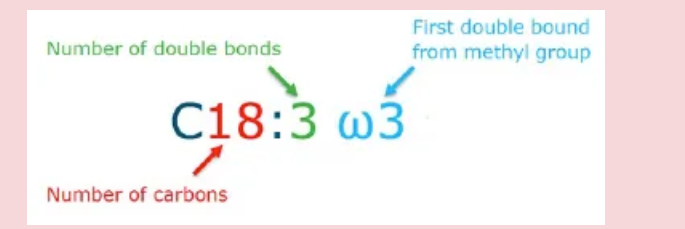
How to write the shorthand for fatty acid chains?
In the short notation (Cx: y ωz):
the first number (x, red) corresponds to the chain length,
the second number (y, green) corresponds to the number of double bonds,
the third number (z, blue) corresponds to the position of the first double bond counted from the methyl end.
Whats unsaturated fatty acids?
With one or more double bonds
Monounsaturated fatty acid: A fatty acid with one double bond.
Polyunsaturated fatty acid: A fatty acid with two or more double bonds.
Where does fat digestion mainly occur?
Small intestine
What is the role of bile acids?
Emulsify fat droplets to increase surface area for enzymes
What does pancreatic lipase do?
Hydrolyzes triglycerides into monoglycerides and free fatty acids
What are micelles?
Small aggregates that transport digested lipids to the intestinal surface
What happens inside enterocytes?
Fatty acids are re-esterified into triglycerides and packed into chylomicrons
What are chylomicrons?
A chylomicron consists of a core of triacylglycerols and some cholesterol. The outer layer mainly consists of phospholipids, which ensures solubility of the chylomicron in the blood.
They enter blood via the lymphatic system (thoracic duct)
how are chylomicrons processed in the body?
When the chylomicrons enter the blood/lymph system it encounters the enzyme protein lipase which breaks down triacylglycerols into fatty acids.
fatty acids can be used as storage in fat cells
energy in muscle cells
fatty acid signaling in the heart
What are lipoproteins?
a group of soluble proteins that combine with and transport fat or other lipids in the blood plasma.
Lipoproteins contain both triacylglycerols and cholesterol.
Main function of VLDL
Transports triglycerides from liver to tissues
Main function of LDL
Transports cholesterol to peripheral tissues
Main function of HDL
Transports cholesterol back to the liver (reverse cholesterol transport)
what are the 4 different lipoproteins and order them in size?
largest to smallest
1 . Chylomicrons
2. VLDL (Very Low-Density Lipoproteins)
3. LDL (Low-Density Lipoproteins)
4. HDL (High-Density Lipoproteins)
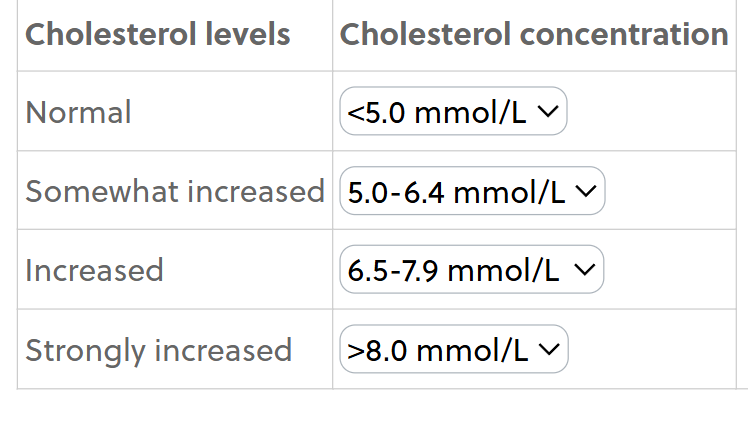
What is regular vs unhealthy cholesterol concentration in the blood?
Why are trans fatty acid unhealthy?
Trans fatty acids are unhealthy because they decrease the HDL levels and increase the LDL levels in your blood.
HDL transports the cholesterol to the liver, where the cholesterol LDL is removed from the body.
While LDL transports the cholesterol to the cells for e.g. building up new tissues, while too much might lead to arthrosclerosis.
Plant Sterol functions
Similar chemical structure as cholesterol.
Cholesterol replacers.
Preventing absorption of cholesterol.
Decreasing cholesterol levels in the blood.
Where are fat (triglycerides) present and how much energy is available in the,?
Adipose tissues; 100000+
Where are carbohydrate (glycogen) present and how much energy is available in them?
Muscle and liver; 2500
Where are protien present and how much energy is available in them?
Muscle; 15000
Characteristics of Adipose tissue in fed state
During or right after food consumption
Fatty acids are a form of energy
Fatty acids are transported to the adipose tissue
Lipoprotein lipase breaks down lipoproteins
Insulin stimulates lipogenesis
Glucagon and adrenaline stimulate lipolysis
Adipose tissue in fasted state
Lipase breaks down triacylglycerols from adipose tissue
Moment in between food consumptions, e.g. late at night
Fatty acids are a form of energy
Fatty acids are transported to the blood stream
Insulin stimulates lipogenesis
Glucagon and adrenaline stimulate lipolysis
Is cholesterol a nutrient? Explain why based on its origin in the body.
No, cholesterol is not a nutrient because the body can synthesize approximately 2/3 of what it needs; only 1/3 typically comes from the die
Describe "Enterohepatic Circulation" in the context of fat digestion.
The process where ~95% of bile acids are reabsorbed in the ileum, returned to the liver via the portal vein, and reused for further emulsification
Order the four lipoproteins by size (Largest to Smallest).
1. Chylomicrons 2. VLDL 3. LDL 4. HDL
Characteristic and scientific name of bile
Taurocholate with an amphipathic nature as it has a hydrophobic side (which interacts with the fat droplet) and a hydrophilic side (which interacts with the surrounding water), allowing it to act as an emulsifier
What components make up the Surface Coat of a chylomicron?
Unesterified cholesterol, phospholipids, and apolipoproteins
What components make up the Lipid Core of a chylomicron?
Triglycerides and cholesteryl esters
What is Olestra chemically, and why does it provide zero calories?
It is a sucrose polyester; its structure is too large/complex for human lipases to digest, so it is not absorbed
What are the medical side effects and absorption risks of Olestra?
Side effects include steatorrhea (fatty stools) and it inhibits the absorption of fat-soluble vitamins (A, D, E, and K)
What is the legal status of Olestra in the EU vs. the US?
It is approved for use in snacks in the US but is not approved in the EU
Aside from energy storage, what are the two other functions of adipose tissue?
Heat insulation and endocrine function (releasing hormones)