Microbiology Ch 6. Microbial Genetics
 Call Kai
 Learn
Learn Practice Test
 Spaced Repetition
 Match
Match Flashcards
 Knowt Play
1/83

There's no tags or description
Looks like no tags are added yet.
Name | Mastery | Learn | Test | Matching | Spaced | Call with Kai | Chat |
|---|
No analytics yet
Send a link to your students to track their progress
84 Terms
Genetics
the study of inheritance or heredity:
transmission of biological properties (traits) from parents to offspring
How those traits are expressed
Structure and function of genetic material
how material changes
Chromosomes in Eurkaryotes and Prokaryotes are different
Eukaryotic chromosomes consist of DNA tightly wound around histone proteins located; nucleus
Prokaryotic chromosomes are condensed and jammed into a packet form by histone-like proteins;located; cytoplasm
Accurate statement regards to genotype or phenotype of an organism
The alleles contained within the cells of an organism comprise its genotype
Genome
Sum total of the genetic material of an organism
** Most genomes exist in the form of chromosomes
*Some of an organisms genome may appear in non chromosomal forms:
-plasmids tiny extra pieces of DNA separate from bacterial chromosome
DNA double stranded characteristics;
2 nanometers in width
10 base pairs per turn
34 nanometers per basepair
DNA sequence is complemtary to 5’TAGAC3’?
3’ATCTG5’
Helicase
The enzyme that unwinds a segment of DNA molecule| unzipping DNA Helix
Primase
Synthesizing an RNA primer
DNA polymerase I
Responsible for removing the primer, closing gaps in the DNA and repairing mismatched bases
Ligase
Responsible for the final binding of nicks in DNA during replication
Topoisomerases I and II
Responsible for supercoiling and untangling of DNA
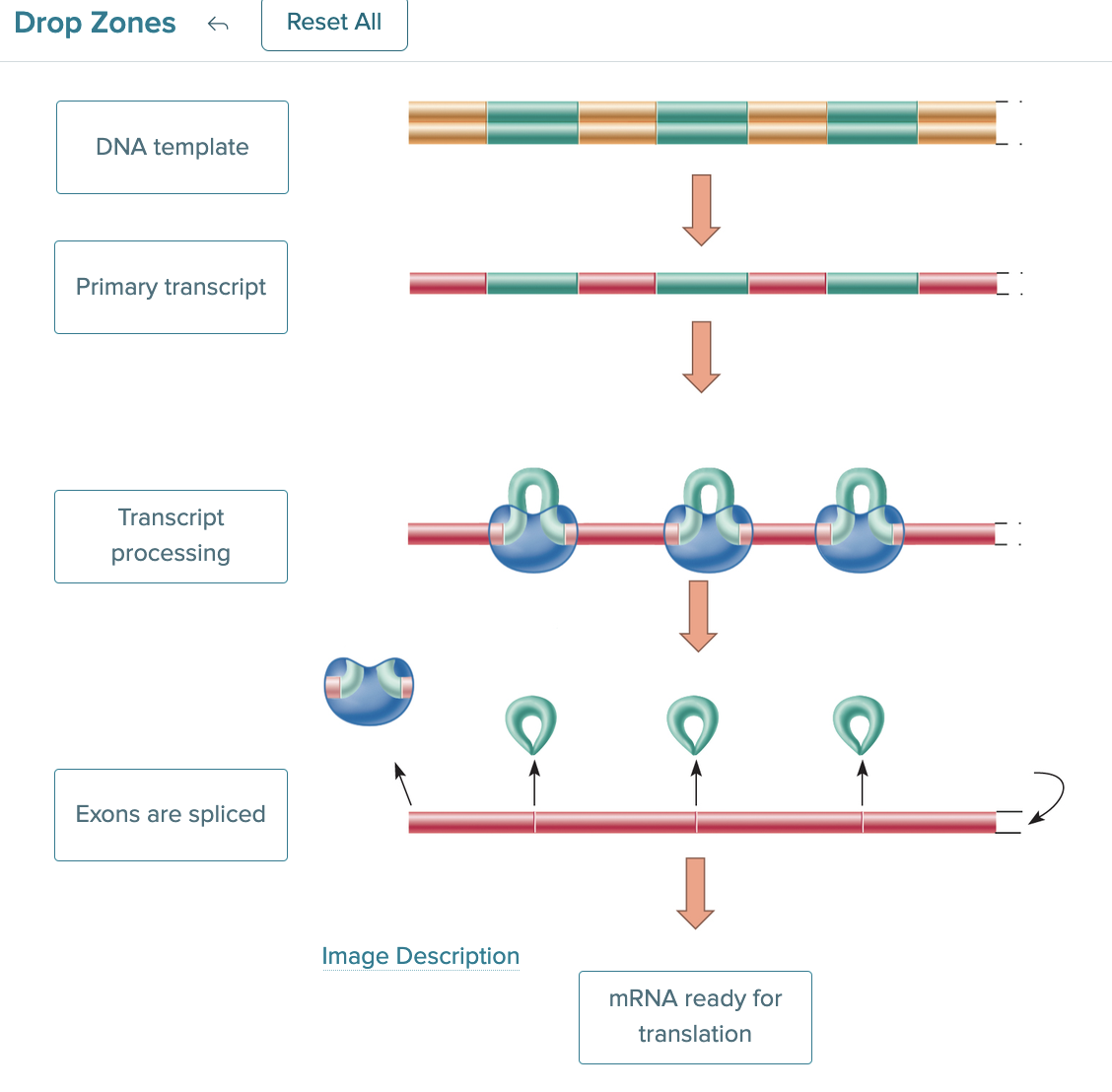
MRNA processing in Eukaryotes
Transposons
Transposable DNA elements
Which does not directly involve DNA?
Translation
In a protozoal or fungal cell, chromosomes are located in the (blank)
nucleus
DNA segments that code for proteins are referred to s (blank) genes
structural
Genomics
study of complete sets of genes
Genotype
Sum of all genes that constitute an organism’s distinctive genetic makeup
**ALL organisms contain more genes in their genotype than are manifested as a phenotype at any given time. phenotype can change depending on what genes are activated and being expressed
Phenotype
Expression of the genotype;certain structures or functions are created
Sizes; Ecoli has single chromosome with 4000-5000 genes
Chromosome 1mm long if unwound and stretched but it is still 1000 times longer than the cell.
** A human cell has 23,000 genes on 46 chromosomes and about 6 feet long.
Nucleotide
Basic unit or building block
-phosphate group
-Deoxyribose sugar
Purines and pyrmidines
*Adenine always pairs with Thymine
*Guanine always pairs with Cytosine )
^ always called complementary base pairing
DNA;
has an antiparrallel arrangement
**SIgnificance of DNA structure- genetic code is maintained during reproduction
*this is assures by the constancy of base pairing in a DNA molecule
Semiconservative replication:
DNA molecule unzips the hydrogen bonds between complementary nitrogenous bases are broken
*the original DNA strands are called parental strands in the new daughter strand
-Each strand is made up of one conservative and one new one.
DNA Polymerase III
*Synthesizes a new daughter strand of DNA using the parental strand as a template
*DNA molecule must be unwound and separated before DNA polymerase III can function
Replication Fork;
A place in the helix where two DNA strands are unwound and replication is taking place
-In bacteria each circular DNA molecule will have two replication forks from a single origin,
Eukaryotes have multiple replication forks from multiple origins
*Leading strand: strand of new DNA that is synthesized continously in a 5’ to 3’ direction-heading towards the opening replication fork
*Lagging strand: strand of new DNA that must be synthesized non-continously heading away from the opening replication fork
Primer
*A length of RNA that is inserted initially during replication by DNA primase for DNA polymerase III to start making a new DNA strand
Concept Check: A gene is:
a. A fundamental unit of heredity
b. a specific portion of DNA along on a chromosome
c. A segment of DNA that codes for a protein or RNA molecule
d. comfortable pants
a,b, and c
Central Dogma
states genetic information in a cell flows from DNA to RNA to a protein
What is the connection between DNA and an organisms trait?
proteins primary structure determines its characteristics shape and function
*Proteins ultimately determine phenotype
Proteomics: study of organisms complete set of expressed proteins.
DNA vs RNA
DNA- double stranded while RNA is single stranded
DNA sugar is deocyribose while RNA is ribose
Structural Genes
DNA segments that code for proteins
Characteristics resulting from interaction of that particular genetic makeup of an organism and the environment is the (blank) of that organism
phenotype
Different type of nucleotides in DNA contain
Same sugar and phosphate but different nitrogenous bases
Adenine and Guanine
both are purines
Antiparallel orientation of strands in DNA
One strand is 5’to 3’ and the other is 3’to5’
Match number of genes with its genome:
Virus- few dozen
Bacterium- few thousand
Human- ten thousand
Ensuring that the DNA code will be maintained during cell growth and cell (blank) is one of the two essential effects of the structure of DNA
replication
In DNA replication (blank) unwinds (unzips) the double helix, primase synthesize the short RNA primer and DNA (blank) adds nucleotides to the new chain
helicase, polyermase
what is true regarding DNA replication?
Each new DNA helix contains one parent strand and one newly synthesized strand
What is the main enzyme in elongation of a DNA strand during replication?
DNA polymerase
During DNA replication the newly made double helices are composed of one parent template and one newly synthesized strand and therefore the replication is considered (blank)
semiconservative
During DNA replication, the lagging strand is replicated in a discontinous manner forming (blank) fragments
okazaki
Enzymes that function in DNA replication
-Helicase
-ligase
-DNA polymerase
The Y-shaped point on a replicating DNA molecule where the DNA polymerase is synthesizing new strands of DNA is (blank) fork
replication
DNA polymerase synthesize new strands of DNA in
the 5’ to 3’ direction only
Ligase
final sealing of nicks in a newly synthesized DNA strand
How many replication forks are formed from opening a section of a circular DNA molecule during replication
2
During DNA replication why are primer sequences necessary?
Primers provide DNA polymerase with the 3’end needed for synthesis
In central dogma;
DNA is copied to RNA in a process called transcription and RNA is used to direct the synthesis of a protein in a process called translation
What is the function of mRNA
it carries a copy of DNA sequence to the ribosome
rRNA
RNA comprises ribosomal subunits
Length of typical tRNA molecule
75-95 bases
What occurs during Transcription termination?
RNA polymerase reaches a terminator region
The process of transcription (blank) results in release of a completed RNA transcript
termination
Translation Elongation
-formation of peptide bond between amino acids in A and P sites
-tRNA delivers amino acid to empty A site
How many stop codon are contained within the genetic code
3
Which 3 events in protein synthesis occur post translationally?
Removal of formyl methiononine
Protein folding
Addition of cofactor
Stop Codon-
UAA,UAG, UGA
The genes of which microorganism are arranged as operons
bacteria
Finishing touches on proteins are (blank) modification
posttranslational
The (blank) of the lac operon is comprised of three genes, each encoding a different enzyme needed to catabolize lactose
structural locus
The lactose operon has 3 important components;
the regulator, a gene that codes for a protein (a repressor) capable of repressing the operon
Phase variation
process of bacteria turning on or off a group of genes that chages their phenotype in a heritable manner
The lactose repressor protein binds to the (blank) of the lac operon
operator
which process in bacteria do abx in group erythromycin inhibit?
Protein synthesis
they also prevent translation
Three methods of gene transfer:
Conjugation, transformation and generalized transduction
Plasmid
A small circular piece of DNA that replicates its nonessential genes independently of the chromosome
During which method of gene transfer are bacterial cells in direct contact?
Conjugation
Transformation
Acceptance by a bacterial cell of small fragments of DNA from the surrounding environmnent; uptake of free DNA by competent bacterial cells
Transduction
Method of DNA recombination in bacteria that involves transfer of DNA via bacteriophages
Transposons also called “jumping genes”
Insertion sequences that can lead to changes in genotype within a cell or between cells
*Involved in; changes in traits such as
1.) colony morphology, pigmentation, and antigenic characteristics
2.) replacement of damaged DNA
3.)transfer drug resistance between bacteria
Pathogenicity Islands
Areas of genome contain multiple genes which contribute to a new trait for the organism that increases its ability to cause disease
Transposons;
Replacement of damagede DNA
Inter-microbial transfer of drug resistance
Phenotypic changes in colonies
Missense mutation
Any changes in the code that leads to placement of a different amino acid;
functions’
*1.) create faulty nonfunctional protein
2.) produce a protein that functions in a different manner
3.)cause no significant in protein function
Which of the following is repsonisble for spontaneous mutations?
Errors in DNA replication
A mutation that affects only a single base pair in DNA is termed (blank)
point
When a mutation changes a base, but does not change amino acids sequence of the encoded protein
silent mutation
Nonsense mutation
Early termination of a protein
A mutation that changes a base but does not change amino acid sequence of endoded protein
Silent mutation
Photoactivation
process repairs DNA that has been damaged by UV radiation using visible light
Frameshift mutation
Most harmful mutations to cells
Which test is a method of detecting mutagenic and potentially carcinogenic agents based upon genetic alteration of nutritionally defective bacteria
Ames