9/10 ch.3 required reading quiz 2
 Call Kai
 Learn
Learn Practice Test
 Spaced Repetition
 Match
Match Flashcards
 Knowt Play
1/43

There's no tags or description
Looks like no tags are added yet.
Name | Mastery | Learn | Test | Matching | Spaced | Call with Kai | Chat |
|---|
No analytics yet
Send a link to your students to track their progress
44 Terms
two basic pharmacokinetic parameters
Volume of distribution and Clearance
volume of distribution
the measure of the apparent space in the body that a drug seems to distribute into
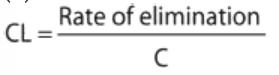
clearance (CL)
measure of the ability of the body to eliminate the drug
clearance (CL) predicts
rate of elimination in relation to the drug concentration (C)
CLb
clearance of blood
CLp
clearance of plasma
CLu
unbound in water
Elimination of drug from the body may involve processes
in the kidney, the lung, the liver, and other organs
rate of elimination =
CL x C
First-order elimination
body eliminates a constant percentage of the drug per unit of time
area under the curve (AUC)
represents the body's total exposure to the drug over time
first order elimination clearance
dose/AUC
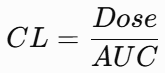
Large AUC
lots of drug remains in the blood over time → low clearance
Small AUC
drug disappears from the blood quickly → high clearance
Capacity-limited elimination
the enzymes or transporters responsible for eliminating a drug have a maximum capacity
Capacity-limited elimination is also known
mixed-order, saturable, nonlinear, and Michaelis-Menten elimination
Vmax (maximum elimination capacity)
maximum elimination capacity

Km
drug concentration at which the rate of elimination is 50% of Vmax

concentrations that are high relative to the Km
the elimination rate is almost independent of concentration—a state of “pseudo-zero order” elimination
flow-dependent elimination
the organ is so good at removing the drug that the limiting factor is how quickly blood can bring the drug to the organ
two aspects to the pharmacokinetics of proteins (large molecules)
long half life and target-mediated drug disposition (TMDD)
long half life
Large molecules tend to stay in the body for a long time, like a couple of weeks
target-mediated drug disposition (TMDD)
for large molecules the drug binds its target, and that interaction helps remove the drug from the body
Half-life (t1/2)
time required to change the amount of drug in the body by one-half during elimination (or during a constant infusion)
Half-life (t1/2) equation
0.7xV/CL
drug accumulation
give the next dose before the previous dose has been completely eliminated, some of the old drug is still present., the new dose adds on top of it
Accumulation is inversely proportional
to the fraction of the dose lost in each dosing interval
accumulation factor (AF)
how much higher the drug level becomes with repeated dosing compared with a single dose

Bioavailability (F)
fraction of the administered drug dose that reaches the systemic circulation unchanged
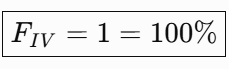
Why is IV bioavailability 100%
When you give a drug intravenously (IV), you're putting it directly into the bloodstream
orally administered drugs
don't get fully absorbed from the GI tract bc drugs need right balance of water and lipid solubility and P-glycoprotein can pump drugs back in intestine
-decreases bioavailability
first-pass elimination
when a drug is metabolized before entering systemic circulation, can be metabolized in blood or in liver (can excrete drug in bile)
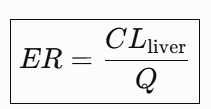
extraction ratio (ER)
fraction of the drug the liver removes during one passage through the liver

extraction ratio (ER) formula
CLliver = hepatic clearance
QQ = blood flow through the liver
systemic bioavailability of the drug (F)
can be predicted from the extent of absorption (f) and the extraction ratio (ER)
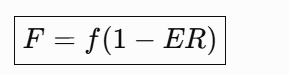
rate of absorption
determined by the site of administration and the drug formulation
Zero-order absorption
constant amount of drug is absorbed per unit time
first-order rate of absorption
constant fraction (percentage) of the remaining drug is absorbed per unit time
after four absorption half-lives
almost all of the dose will have been absorbed
choose a route other than oral
avoid first-pass metabolism by the liver
topical, patch, sublingual, rectal, inhalation
Sublingual
under the tongue and largely avoids first pass
Transdermal
patch on skin and largely avoids first pass
Rectal
only partially avoids first pass , 50% pass
inhalation
bypass the hepatic first-pass effect but lung may also serve as a site of first-pass loss