8 - Alteration of Product Strength
 Call Kai
 Learn
Learn Practice Test
 Spaced Repetition
 Match
Match Flashcards
 Knowt Play
1/18

Earn XP
Description and Tags
Important terms only
Name | Mastery | Learn | Test | Matching | Spaced | Call with Kai | Chat |
|---|
No analytics yet
Send a link to your students to track their progress
19 Terms
c. Dilution and concentration
Pharmaceutical calculation that describes the relationship between strength and total quantity.
a. Percentage
b. Osmolarity
c. Dilution and concentration
d. Alligation
d. 120 mL of 6% H₂O₂ and 120 mL of sterile water
[DIlution and Concentration]
PRACTICE PROBLEM:
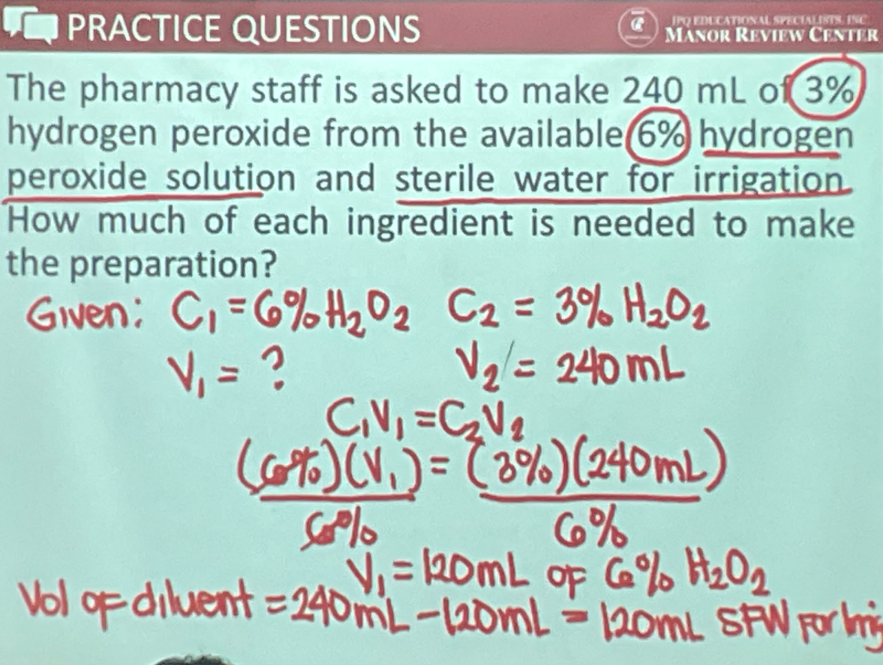
The pharmacy staff is asked to make 240 mL of 3% hydrogen peroxide from the available 6% hydrogen peroxide solution and sterile water for irrigation. How much of each ingredient is needed to make the preparation?
a. 60 mL of 6% H₂O₂ and 180 mL of sterile water
b. 80 mL of 6% H₂O₂ and 160 mL of sterile water
c. 100 mL of 6% H₂O₂ and 140 mL of sterile water
d. 120 mL of 6% H₂O₂ and 120 mL of sterile water
c. %v/v
[DIlution and Concentration]
BEQ: In the USP, concentrated acids are expressed as
a. %w/w
b. %w/v
c. %v/v
d. %v/w
a. %w/v
[DIlution and Concentration]
BEQ: In the USP, dilute acids are expressed as
a. %w/v
b. %w/w
c. %v/v
d. %v/w
a. Dilute Acetic Acid USP = 6% w/v
[DIlution and Concentration]
BEQ: The exception to the official dilute acid concentration
a. Dilute Acetic Acid USP = 6% w/v
b. Dilute Hydrochloric Acid USP = 10% w/v
c. Dilute Sulfuric Acid USP = 10% w/v
d. Dilute Nitric Acid USP = 10% w/v
a. 6% w/v
[DIlution and Concentration]
BEQ: Dilute Acetic Acid USP is expressed as
a. 6% w/v
b. 10% w/v
c. 5% w/v
d. 8% w/v
c. Alligation
Arithmetical method of solving problems that involves mixing of solutions possessing different strengths.
a. Dilution
b. Percentage
c. Alligation
d. Osmolarity
c. Alligation medial

[Alligation Medial]
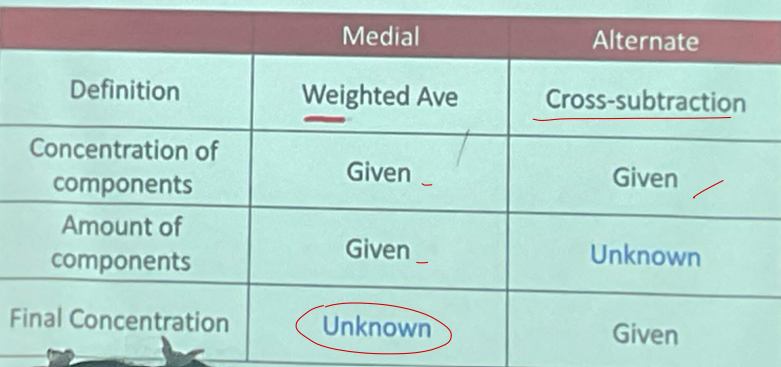
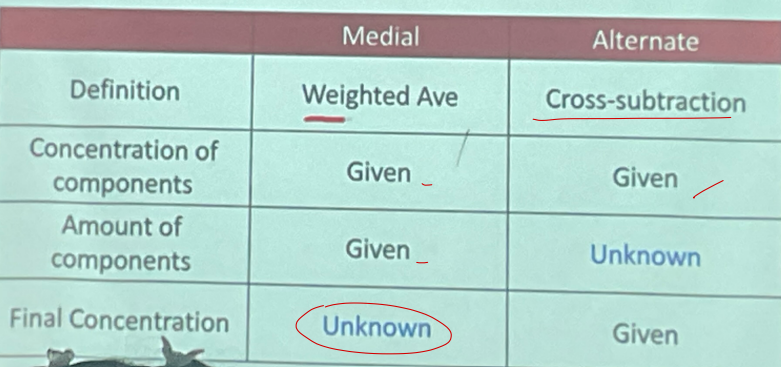
Type of alligation defined as weighted average.
a. Alligation alternate
b. Alligation simple
c. Alligation medial
d. Alligation complex
d. Alligation alternate

[Alligation Medial]
Type of alligation defined as cross-subtraction.
a. Alligation medial
b. Alligation simple
c. Alligation complex
d. Alligation alternate
c. Final concentration
[Alligation Medial]
In alligation medial, the unknown value is:
a. Concentration of components
b. Amount of components
c. Final concentration
d. Number of components
d. Amount of components

[Alligation Medial]
In alligation alternate, the unknown value is:
a. Concentration of components
b. Final concentration
c. Number of components
d. Amount of components
c. Given

[Alligation Medial]
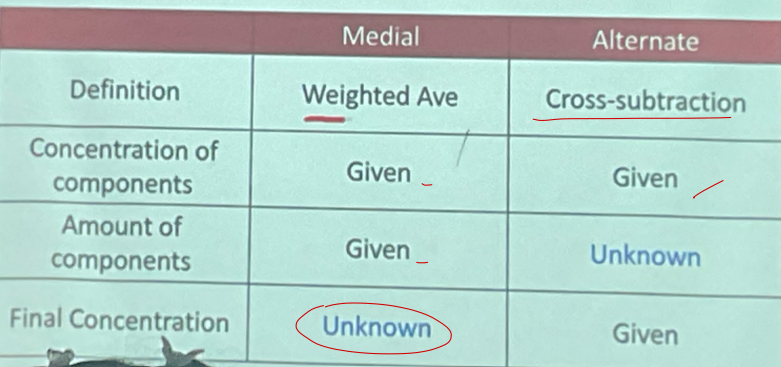
In alligation medial, concentration of components is:
a. Unknown
b. Calculated
c. Given
d. Estimated
d. Given
[Alligation Medial]
In alligation medial, amount of components is:
a. Unknown
b. Calculated
c. Estimated
d. Given
c. Given
[Alligation Medial]
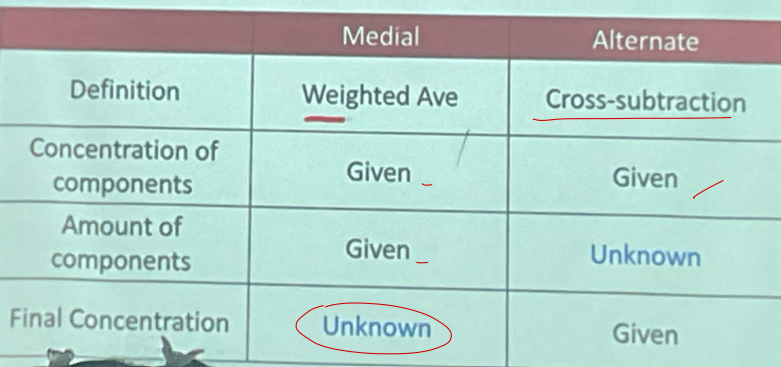
In alligation alternate, concentration of components is:
a. Unknown
b. Calculated
c. Given
d. Estimated
d. Given
[Alligation Medial]
In alligation alternate, final concentration is:
a. Unknown
b. Calculated
c. Estimated
d. Given
c. General Weighted Average (GWA)
[Alligation Medial]
Alligation medial is analogous to computation of:
a. Median
b. Mode
c. General Weighted Average (GWA)
d. Standard deviation
c. 10% ZnO
[Alligation Medial]
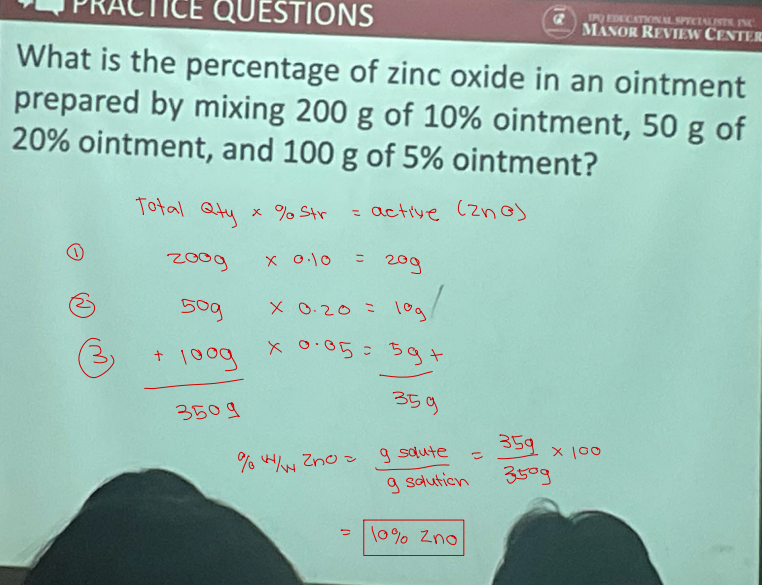
What is the percentage of zinc oxide in an ointment prepared by mixing 200 g of 10% ointment, 50 g of 20% ointment, and 100 g of 5% ointment?
a. 8% ZnO
b. 9% ZnO
c. 10% ZnO
d. 11% ZnO

[Alligation Alternate]
Steps in Alligation Alternate:
c. 4:5

[Alligation Alternate]
PRACTICE PROBLEM:
In what proportion should alcohols of 95% and 50% strengths be mixed to make 70% alcohol?
a. 2:3
b. 3:4
c. 4:5
d. 5:6