2210 Microbiology Stephanie Miller Exam 1
 Call Kai
 Learn
Learn Practice Test
 Spaced Repetition
 Match
Match Flashcards
 Knowt Play
1/84

There's no tags or description
Looks like no tags are added yet.
Name | Mastery | Learn | Test | Matching | Spaced | Call with Kai | Chat |
|---|
No analytics yet
Send a link to your students to track their progress
85 Terms
three domians of life
Bacteria, Archaea, Eukarya
What are the four biomolecules and their subunits?
oxygen: 70%
Carbon:15%
Hydrogen:10%
Nitrogen:3%
16S rRNA sequencing (Woese and Fox)
classification & quantitation of microbes & bacteria in complex mixtures. Identification & Classification of Microbes.
Typical size of bacteria? What is a micrometer?
1μm-5μm
Typical size of virus?
20nm-450nm (nanometers)
What was discovered in 1940s that changed the practice of medicine? Who was well known for this discovery?
penicillin,
Alexander Fleming
What molecular structure was discovered in the 1950s and who was involved?
DNA double helix; found by James Watson and Francis Crick
Two cell types
eukaryotic and prokaryotic
What was discovered in the mid 16oos that gave "birth" to microbiology?
The microscope
How high can compound light microscopes magnify?
40x-1000x
What is the field of study called molecular biology?
studies the molecular basis of biological activity
endosymbiotic theory
Eukaryotic cells may have evolved when multiple cells joined together into one. They began to live in what we call symbiotic relationships.
Germ Theory
the theory that certain diseases are caused by the invasion of the body by microorganisms, organisms too small to be seen except through a microscope.
microbes
a microorganism, especially a bacterium causing disease or fermentation.
cellular microbe
these microbes include bacteria, the archaea, the fungi, and the protists ( algae, protozoa, slime molds, and water molds). Cellular microbes can be either unicellular or multicellular.
acellular microbes
Viruses, viroids and prions are included in acellular microorganisms. These organisms when present outside the living host cell are considered non-living, as they behave as inert particles, but inside the host cell they can replicate and behave like living organisms.
eukaryotic microbe
organisms whose cells contain a nucleus and other membrane-bound organelles. There is a wide range of eukaryotic organisms, including all animals, plants, fungi, and protists, as well as most algae. Eukaryotes may be either single-celled or multicellular.
prokaryotic microbe
Prokaryotes are organisms whose cells lack a nucleus and other organelles. Prokaryotes are divided into two distinct groups: the bacteria and the archaea, which scientists believe have unique evolutionary lineages. Most prokaryotes are small, single-celled organisms that have a relatively simple structure
Taxanomy
Taxonomy is the science of naming, describing and classifying organisms and includes all plants, animals and microorganisms of the world
phylogeny
the relationship between all the organisms on Earth that have descended from a common ancestor, whether they are extinct or extant.
binomial nomeclature
This process of standardized naming is called as Binomial Nomenclature. The scientific name of the tiger is presented as Panthera tigris. 'Panthera' represents the genus and 'Tigris' represents a particular species or specific epithet
micrograph or microphotograph
a photograph or digital image taken through a microscope or similar device to show a magnified image of an object.
TEM and SEM use what to visualize microbes?
use electrons, not light, to visualize tiny microbes.
TEM shows
cross section of microbe
SEM shows
creates an image by detecting reflected or knocked-off electrons
What is gram staining
a common laboratory test that can help diagnose the presence of a bacterial infection quickly
gram postive color ?
purple
gram negative color?
pink or red
gram postive structure
thicker peptidoglycan cell wall 20 to 80 nm thick polymer
gram postive structure
cell wall is 2 to 3 nm thick and covered with an outer lipid bilayer membrane
organic molecule
a complex molecule that is primarily made of carbon atoms bonded with other elements and/or other carbon atoms. All living things on Earth are composed of organic molecules.
polymer
any of a class of natural or synthetic substances composed of very large molecules, called macromolecules,
What is a polar covalent bond?
when atoms with different electronegativities share electrons
What is a hydrogen bond?
a special type of dipole-dipole attraction between molecules
What is a redox reaction?
a type of chemical reaction that involves a transfer of electrons between two species
Which biomolecules are formed by dehydration synthesis?
Complex carbohydrates, nucleic acids, and proteins
Give an example of a slightly acidic pH?
5.0-5.5 rain
Is glucose a monosaccharide? How many carbons does it have?
yes , six-carbon skeleton
What are examples of polysaccharides? How are disaccharides held together?
Lactose , maltose, sucrose
glycoside bond
What is a fatty acid?
a carboxylic acid consisting of a hydrocarbon chain and a terminal carboxyl group, especially any of those occurring as esters in fats and oils.
where is cholesterol found in animal cells
Cholesterol is found in the cell membranes of animal cells
where is cholesterol found in human cells
Cholesterol and other fats are carried in your bloodstream
Where are proteins made in the cell?
ribosomes
What is the subunit of proteins?
polypeptide chain or single protein molecule
What is a peptide bond?
a chemical bond formed between two molecules when the carboxyl group of one molecule reacts with the amino group of the other molecule,
What is the function of proteins in the cell?
cell shape and inner organization, product manufacture and waste cleanup, and routine maintenance.
What is a polypeptide?
A peptide consisting of 2 or more amino acids.
What is a prokaryote?
a microscopic single-celled organism that has neither a distinct nucleus with a membrane nor other specialized organelles. Prokaryotes include the bacteria and cyanobacteria.
Are the domains Bacteria and Archaea both prokaryotes?
Both Bacteria and Archaea are prokaryotes
examples of gram positive
Staphylococcus,Streptococcus, pneumococci, Bacillus anthracis, and Corynebacterium
examples of gram negative
E. coli · Salmonella · Shigella · Pseudomonas · Moraxella · Helicobacter · Stenotrophomonas
Define virus
an infective agent that typically consists of a nucleic acid molecule in a protein coat, it is neither a prokaryote or eukaryote because they are non-cellular because they cannot reproduce without a host cell
which cell is a mitochondria found in
Mitochondria are only found in eukaryotic cells only
How are cell structures different in prokaryotes vs. eukaryotes
prokaryotes have circular DNA and rarely ribosomes eukaryotes have both
Do eukaryotes have cell walls?
animal cells do not but many plant cells do
What is selective permeability?
its ability to differentiate between different types of molecules, only allowing some molecules through while blocking others.
What is tonicity?
the capability of a solution to modify the volume of cells by altering their water content.
What would a cell look like in a hypertonic situation?
the cell would shrink
What is a protist?
eukaryotic organisms that are unicellular and sometimes colonial or less often multicellular and that typically include the protozoans, most algae, and often some fungi (such as slime molds)
What is a protozoan?
microscopic unicellular eukaryotes that have a relatively complex internal structure and carry out complex metabolic activities
What are helminths?
parasitic worms
What are nematodes?
elongated cylindrical worms parasitic in animals or plants or free-living in soil or water act as parasites for insects
What are fungi?
any of a group of spore-producing organisms feeding on organic matter, including molds, yeast, mushrooms, and toadstools they are eukaryotic and are not photsynthetic
what is a mold?
a type of fungi
What is yeast?
Yeast is a single-cell organism, called Saccharomyces cerevisiae, which needs food, warmth, and moisture to thrive.
what is Candida albicans?
Candida is a yeast that naturally lives in your body and can overgrow if the balance of yeast and healthy bacteria in your body changes.
Describe and give examples of several eukaryotic pathogens.
The nematodes include roundworms, pinworms, hookworms, and whipworms. Many of these parasites are so well adapted to the human host that there is little obvious disease. Fungal infections of the nervous system, called neuromycoses, are rare in healthy individuals
What cell structures are found in eukaryotic cells and not prokaryotic cells?
membrane-bound organelles, such as the nucleus,
endosymbiotic theory
states that the mitochondria and chloroplast in eukaryotic cells were once aerobic bacteria (prokaryote) that were ingested by a large anaerobic bacteria (prokaryote)
evidence supporting endosymbiotic theory?
The outer membrane of a mitochondrion and chloroplast resemble a eukaryotic cell while the inner membrane resembles that of a bacterial cell.
what are basic prokaryotic cell structures
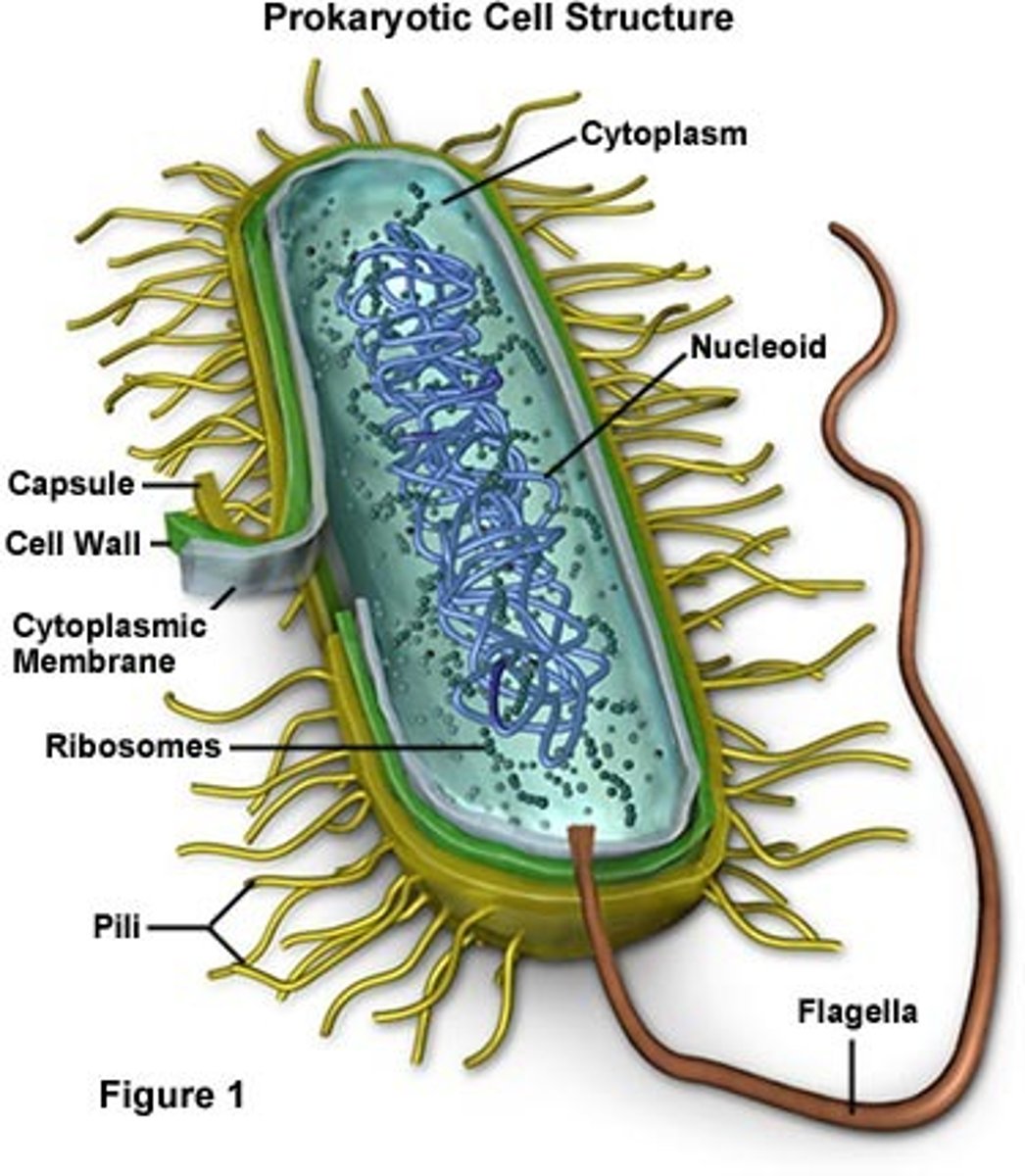
What is cell morphology?
describes the shape, structure, form, and size of cells.
what is Colonial morphology?
the visual culture characteristics of a bacterial colony on an agar plate
What are some shapes of bacteria ? Coccus , bacillus, vibrio?
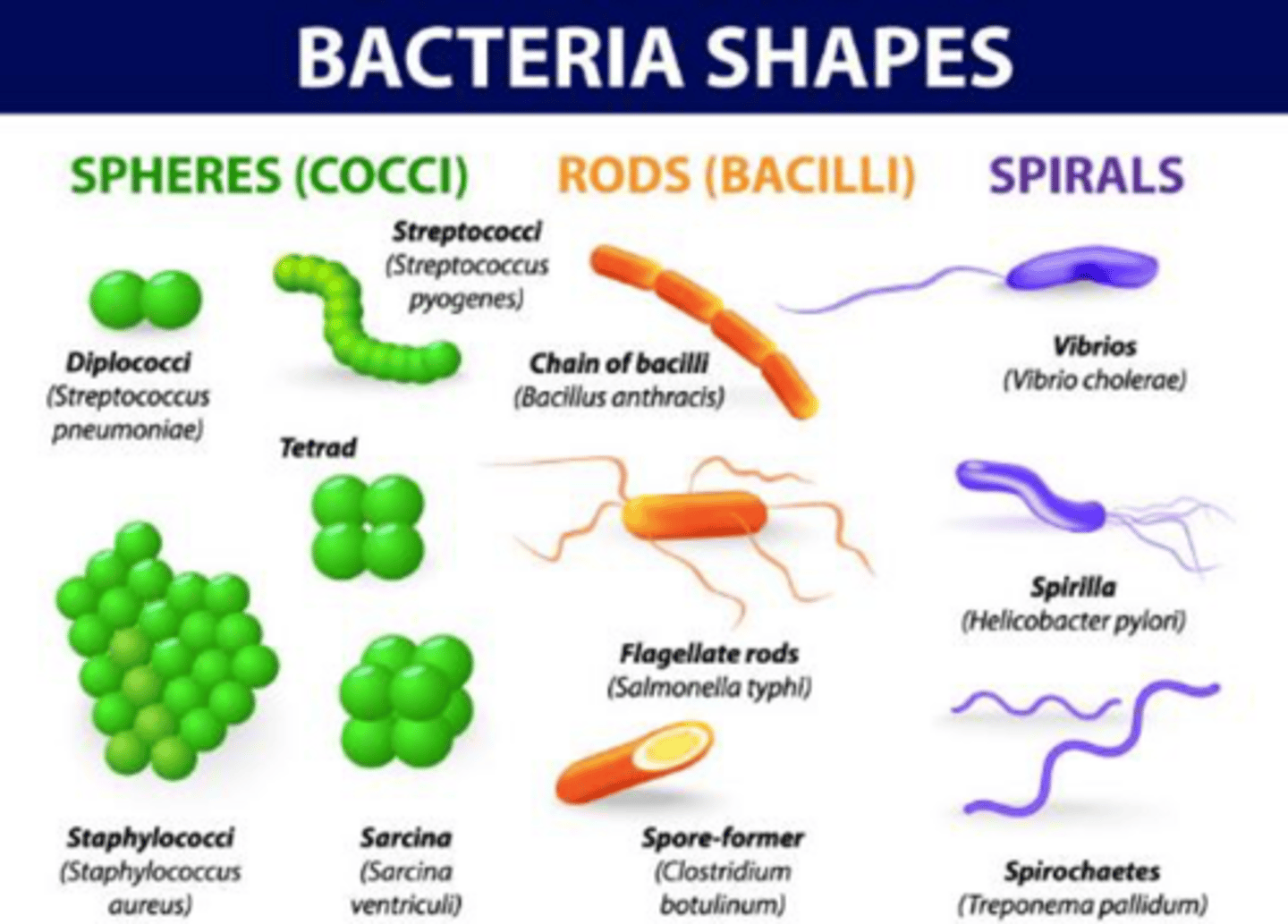
What does the term strepto- mean?
twisted
What is chemotaxis?
movement of a motile cell or organism, or part of one, in a direction corresponding to a gradient of increasing or decreasing concentration of a particular substance.
Describe Proteobacteria in terms of their cell wall structure
gram neg - Cell wall that is between 5 and 10 micrometers in thickness. Monolayer peptidoglycan.
What is the most common example of Gram negative Enterobacteriacea?
E. coli (Escherichia coli)
Cyanobacteria? Are they eukaryotic or prokaryotic?
Prokaryotic
What is the important role of Actinomyces/Streptomyces?
Actinomycete bacteria of the genus Streptomyces are major producers of bioactive compounds for the biotechnology industry. They are the source of most clinically used antibiotics
Are Lactobacillus spp. And Streptococcus spp. Gram positive?
gram postive
Describe the shape and arrangement of the cells of Staphylococcus aureus.
The cocci are arranged in grape-like clusters formed by irregular cell divisions in three plains.
Describe the unique cell characteristics of Archaea
Unique archaea characteristics include their ability to live in extremely hot or chemically aggressive environments,
Why do we know much less about Archaea species when compared to Bacteria species?
they are so hard to observe
Still learning (7)
You've started learning these terms. Keep it up!