CPSM Exam 1 Part B4
 Call Kai
 Learn
Learn Practice Test
 Spaced Repetition
 Match
Match Flashcards
 Knowt Play
1/53

Earn XP
Description and Tags
Task 3-B-4: Market the value of strategic sourcing, sourcing strategies and initiatives to management and internal stakeholders.
Name | Mastery | Learn | Test | Matching | Spaced | Call with Kai | Chat |
|---|
No analytics yet
Send a link to your students to track their progress
54 Terms
What is the goal of marketing strategic sourcing internally?
To communicate its value in supporting organizational goals and to become a trusted advisor to stakeholders.
What happens if communication uses the wrong language with executives?
Supply management may not get recognition for its achievements.
Q: How should communication differ between senior management and internal stakeholders?
A:
Senior management → strategic, outcome-focused language
Internal stakeholders → operational, unit-level concerns
Q: What do senior executives care about most in sourcing?
A: Cost reduction, profitability, and organizational-wide performance.
Q: Why is spend analysis important for senior management?
A: It identifies cost-saving opportunities and areas of overspending.
Q: How can supply management demonstrate value to executives?
A: Through regular updates, strategic sourcing reviews, and supplier executive meetings.
Q: Why involve executives in supplier meetings?
A: To align strategic sourcing initiatives with top-level business goals.
Q: What is the benefit of showing executives sourcing initiative progress?
A: It builds awareness of supply management’s impact on profitability and strategy.
Q: Who are internal stakeholders in supply management?
A: Managers and departments that directly use supply management services.
Q: What communication tools can be used with internal stakeholders?
A: Emails, newsletters, websites, blogs, and social media.
Q: What are the three types of proactive sourcing opportunities?
A: Maintenance, best practice, and special needs.
Actions that prevent recurring or known supply problems.
maintenance opportunities
Improvements that enhance already acceptable processes.
best-practice opportunities
Unique, one-time sourcing situations requiring special attention.
special-needs opportunities
Why is proactive sourcing better than reactive sourcing?
It builds strategic value and prevents supply management from being seen only as a problem solver.
What is the overall purpose of marketing strategic sourcing?
To demonstrate value, align with business goals, and position supply management as a strategic partner and trusted advisor
Q: What is the first step in creating alignment in supply management?
A: Clearly communicating the vision to all different stakeholder groups.
Q: What roles must a supply management leader play when communicating vision?
A: Chief advocate, chief communicator, and chief salesperson of the transformation.
Q: What are the three key questions leaders must answer to align stakeholders?
Who are the target stakeholders?
What are their interests?
How can the vision be linked to those interests?
Any person or group with an interest in or affected by an organizational decision.
stakeholder
stakeholder analysis
The process of identifying stakeholders’ interests to design strategies that address them.
stakeholder engagement
Involving stakeholders early to gather input before making decisions or changes.
What are the two main types of stakeholders?
Internal stakeholders and external stakeholders.
Who are internal stakeholders in supply management?
Employees within supply management and other departments like marketing, engineering, and design.
How can internal conflicts be resolved in supply management alignment?
Through communication, compromise, and balancing cost, quality, and service for overall benefit.
What challenge arises from different internal performance goals?
Different departments may prioritize different outcomes (e.g., cost vs. quality vs. service).
Who are external stakeholders?
A: Suppliers, government agencies, communities, professional groups, and other external parties.
Why is external stakeholder alignment important?
A: It expands supply management influence and protects organizational reputation.
How is alignment maintained with external stakeholders?
Through continuous communication of the organization’s vision and goals.
Q: How do interest and pressure groups influence supply management?
A: They can shape policies and encourage collaboration on social or ethical goals.
Q: What role do government and regulators play as stakeholders?
A: They set rules that affect what, how, and from whom organizations can purchase.
Q: How does society at large affect supply management?
A: Public expectations and government policies influence how organizations operate.
What is the goal of stakeholder alignment?
To connect supply management vision with stakeholder interests to achieve buy-in, cooperation, and successful execution.
Q: What are the three key components of executing a supply management plan?
Communication plan
Rollout plan
Phased timeline
A plan that defines how supply management strategies and results are shared across the organization.
communication plan
A detailed plan for deploying a strategy, including schedule, resources, training, and budget. Ensure efficient execution of strategy with proper resources and risk management.
a rollout plan
A structured sequence for implementing initiatives over time.
phased timeline
Why is sequencing important in execution?
Because stakeholders may not immediately accept or adapt to new initiatives.
What happens after organizational goals are set in a phased timeline?
They are cascaded down to functional levels and translated into KPIs.
How is progress tracked in a phased timeline?
Through KPIs that measure performance against objectives over time.
What is typically reviewed in quarterly performance reviews?
KPIs related to operational performance such as cost, quality, delivery, and supplier performance.
What is the purpose of off-site workshops?
To align goals, brainstorm ideas, and identify gaps between supply management and stakeholders.
A set of KPIs that provides a clear, high-level view of organizational performance.
executive dashboard
What should be included in a supply management dashboard?
A: Key metrics aligned with top management priorities and targets.
Q: What happens when performance gaps appear in a dashboard?
A: Explanations and corrective actions are typically included.
Q: What should effective presentations consider?
A: Audience, objective, environment, and appropriate communication medium.
Q: What are common uses of presentations?
A: Problem-solving, decision-making, gaining approval, and resolving conflicts.
7 steps in preaparing a presentation
Define the objective
Analyze the audience
Plan the presentation tactics length, structure, attendance, obstacles)
Organize the presentation: Organize opening, main message, and closing.
Prepare a clear, simple script and effective visuals.
Consider physical/environmental factors (lighting, noise, space, etc.).
Deliver the presentation: Engage audience, be confident, adapt, and handle issues smoothly.
Q: What is the difference between open and closed social media platforms?
A: Open platforms are public (e.g., LinkedIn), closed platforms are internal and secure (e.g., SharePoint).
Q: What types of tools are used as technology platforms?
A: Intranets, Google Drive, Salesforce Chatter, and other collaboration tools.
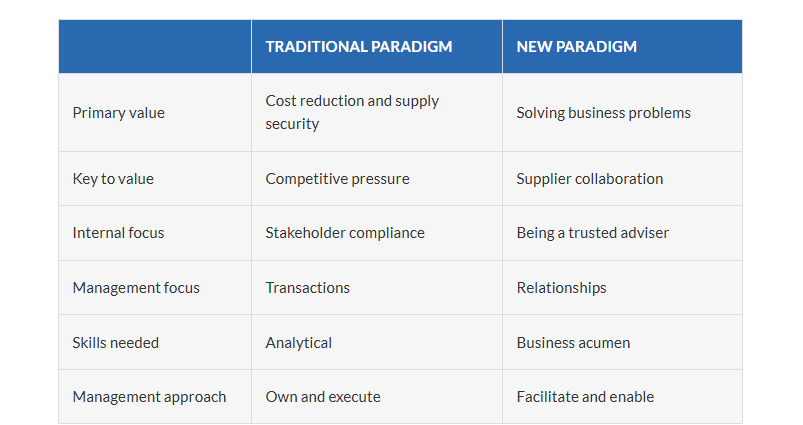
What is the shifting focus of supply management's primary value according to Hughes and Ertel (2016)?
It shifts from a traditional paradigm of "Cost reduction and supply security" to a new paradigm of "Solving business problems."
How does the management approach differ between the traditional and new paradigms of supply management?
he traditional approach focuses on "Own and execute," whereas the new paradigm centers around "Facilitate and enable."
What acts as the "Key to value" under the new paradigm of supply management?
"Supplier collaboration" replaces the traditional paradigm's reliance on "Competitive pressure."
able 1: Shifting paradigms for supply management (adapted from Hughes and Ertel 2016).