C2 Fluvial Landforms
 Call Kai
 Learn
Learn Practice Test
 Spaced Repetition
 Match
Match Flashcards
 Knowt Play
1/12

There's no tags or description
Looks like no tags are added yet.
Name | Mastery | Learn | Test | Matching | Spaced | Call with Kai | Chat |
|---|
No analytics yet
Send a link to your students to track their progress
13 Terms
Meander flows
Thalweg (where water swings side to side, approaching different banks alternatively)
Helicoidal flow (current from outer to inner bank)
Meander features
Point bar and River cliff
Point bar: deposition of sediment at inner convex bank
River cliff: erosional undercutting of bank at outer concave bank
Pools and Riffles
Pools: deeper
Riffles: shallower
A response to sinuous movement that occurs naturally in flowing water in a river channel
Meander formation
In a almost straight channel, thalweg takes on a sinuous course which results in alternating erosion and deposition on either bank
Asymmetric shoals create zones of accelerated and decelerated velocity
Zones of acceleration engage in erosion, forming pools
Zones of deceleration engage in deposition, forming riffles
As helicoidal flow flows into meandering channel, centrifugal forces cause water to pile up against outer bank and erode, forming river cliffs
When water moves towards convex bank, frictional drag slows river velocity and deposition occurs, forming a slip off slope
As erosion continues on concave and deposition occurs on convex, concave banks retreat and convex banks advance —> leading to increase in sinuosity ratio
Braided channel features
Anabranches
Mid channel bars (sometimes vegetated)
Braided channel formation
Wet szn: high discharge erodes and transports a large amount of coarse bedload
Conditions: presence of unconsolidated river banks that allow for easy lateral erosion, large supply of coarse bedload
Lateral erosion: lateral erosion made possible by high dishcarge leads to development of wide and shallow channel
Dry szn: lower discharge leads to deposition of bedload that the river was carrying, low hydraulic radius of river facilitates deposition process
Condition: fluctuating discharge
Deposition of coarse bedload occurs first which leads to disruption of water flow that leads to more deposition of sediment around it. When these deposits protrude above water surface, they form mid channel bars
Some bars may be vegetated over time and are more stable as vegetation helps to bind deposit together
Delta features
Delta Plain
Delta Front
Prodelta
Delta plain
Where river meets ocean
Low flat area that includes distributary creeks
Coarser materials deposited here
Delta front
Subaqueous area where sediment-laden river meets saline seawater and sediment is actively deposited
Steeply sloping portion of delta where deltaic deposits slope downwards from sea level to sea floor
Characterised by fine sediments, from bigger to smallest seaward
Prodelta
Lies seaward of delta front as a layer of clay and silt
Sediment is layered with silt, rock fragments and thin shell beds
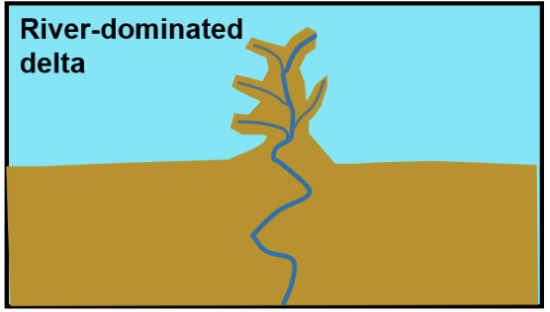
Formation of River-dominated deltas
As the river approaches its mouth, sediment load the river carries from fluvial erosion is deposited at the mouth
Slowing velocity of river and build up of sediment allows river to break from its single channel
Forms deltaic lobe that include a distributary network of smaller channels that branch off from mainstream river
Formation of Wave-dominated deltas
Waves redistribute the sediment and the shape of the delta is remodelled by the direction of the wave approach
Riverborne sediment is pushed back to give delta a straighter appearance, leading to development of wide beaches with smooth shorelines
Has few distributaries, often only a single channel
Arcuate: triangle shaped
Cuspate: pointed
Formation of Tide-dominated deltas
Channels become aligned with direction of tidal currents, hence have wide delta fronts
In a strong tidal zone, riverborne sediments moves back and forth over a length of channel, forming funnel-shaped river mouths resembling estuaries
Factors influencing Deltas
Dominant fluvial / coastal processes
Human activities (dams, groundwater extraction, sand mining)