Chapter 2
 Call Kai
 Learn
Learn Practice Test
 Spaced Repetition
 Match
Match Flashcards
 Knowt Play
1/13

There's no tags or description
Looks like no tags are added yet.
Name | Mastery | Learn | Test | Matching | Spaced | Call with Kai | Chat |
|---|
No analytics yet
Send a link to your students to track their progress
14 Terms
What are the filing requirements for individuals?
If gross income > standard deduction
married filed separately → must file if gross income is > $5 aka both spouses have to file returns
CAN file if below gross income level and are owed a refund or can claim a refundable income tax credit.
The statute of limitations defines the period in which the taxpayer can file an amended tax return, or the IRS can assess a tax deficiency for a specific tax year. When can it be audited?
3 years from the later of the date the tax return was actually filed or the tax return’s original due date
6 years if there is a substantial understatement (more than 25%) of gross income
Indefinite if fraudulent return or no return is filed
Audits are based on a return’s _______.
Discriminant function system (DFI) - assigns a score to each tax return that represents the probability that the tax liability on the return has been underreported (a higher score = a higher likelihood of underreporting).
What is a correspondence audit?
an audit conducted by mail and generally limited to one or two items on the taxpayer’s return. most common audit seeking supporting documentation.
What is an office audit?
wider in scope; notice details items subject to examination and the support needed; can have legal/tax representation
What is a field audit?
least common; generally limited to business returns and the most complicated individual returns
What happens after an IRS audit?
Agree with adjustment: Pay the taxes due.
Disagree with adjustment: Receive a 30-day letter and request an appeals conference.
Agree at appeals → Pay taxes due.
Disagree at appeals → File a refund claim with the IRS.
If the IRS denies the refund claim → Sue in U.S. District Court or the U.S. Court of Federal Claims.
If no response to the 30-day letter → Receive a 90-day letter:
Pay the tax → File a refund claim.
Do not pay → Petition the Tax Court (only a judge - no jury).
What does a stare decisis mean in a federal judicial system?
means that a court will rule consistently with its previous rulings and the rulings of higher courts with appellate jurisdiction. **Golsen rule
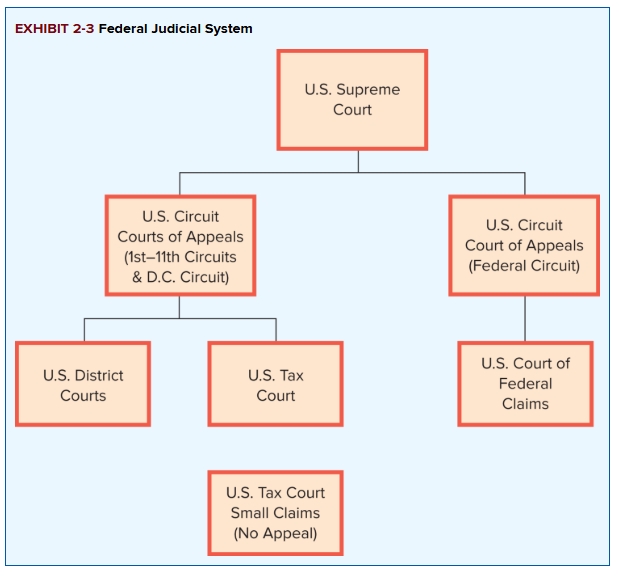
What does a writ of certiorari mean in a federal judicial system?
Supreme Court refuses to hear the case and litigation ends with the circuit court of appeals decision.

What are the common primary authorities?
Statutory authorities: U.S. Constitution, Treaties, Internal Revenue Code
Administrative authorities: Treasury regulations, revenue rulings & procedures
Judicial authorities: Supreme court, appellate courts, and trial courts
Explain this professional guideline/responsibility: Treasury Department Circular 230
Sets forth rules to practice before the IRS
Pertains to federal tax only
Explain this professional guideline/responsibility: AICPA Statements on Standards for Tax Services
Sets forth guidelines governing ethical issues
Not legally enforceable
SSTS No.2 - Tax Return Position: must comply with standards imposed by applicable tax authority when recommending a tax position or preparing/signing a return (such as IRC 6694: imposes a penalty on a tax practitioner for any position that is not supported by substantial authority (35-40%) unless the position has been disclosed and has reasonable basis (supported by one or more tax authorities))
IRS can impose both civil and criminal penalties for failure to file and failure to pay. true or false?
true
Is the penalty higher for failure to file or failure to pay?
Failure to file has the higher penalty.
Failure to file: 5% of unpaid taxes per month, up to 25%.
Failure to pay: 0.5% of unpaid taxes per month, up to 25%.