Lecture 1 - Trauma OT Radiography
 Call Kai
 Learn
Learn Practice Test
 Spaced Repetition
 Match
Match Flashcards
 Knowt Play
1/12

There's no tags or description
Looks like no tags are added yet.
Name | Mastery | Learn | Test | Matching | Spaced | Call with Kai | Chat |
|---|
No analytics yet
Send a link to your students to track their progress
13 Terms
Define polytrauma
Injuries to >2 body regions
Define triage
Patients seen in decreasing order of severity, from-threatening to minor injuries
Describe the categories of the Australian Triage Scale
Category 1: Life threatening conditions that require immediate assessment
Category 2: Should treated within 10min of arrival
Category 3: Should be treated within 30min of arrival
Category 4: Should be treated within 1hr of arrival
Category 5: Should be treated within 2hrs of arrival
What is I-MIST
Communication from the paramedics to ED regarding patients
Identification: Identity of patient
Mechanism: Mechanism of injury
Injuries: Injuries sustained, in order of severity
Symptoms: Current status i.e. stable, unstable, GCS, vital signs
Treatment: Interventions/medication administered, resource requirements
What’re acute beds used for
For non-ambulant stable patients waiting to move to a ward bed
Biggest section of the ED
What is the maximum time a patient should stay in an acute bed
24hrs
Often stay longer due to bed blocks in the wards
What is fast track used for
For ambulant patients presenting with minor injuries
Used for quick assessment, treatment and discharge
What is resus used for
For critically unwell patients who require advanced interventions
Goal is to stabilise them enough to transfer to acute care, ICU, OT, etc.
What is the trauma series for x-ray
Lateral C-spine (HBL)
AP chest
AP pelvis
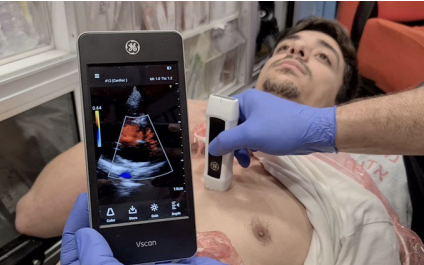
What does eFAST stand for and what is it used for
Emergency Focused Assessment with Sonography for Trauma
Used to look for:
Pericardial effusion and cardiac tamponade
Pneumothorax
Haemothorax
Internal bleeding
What is flail chest
3 or more ribs break in at least 2 places
What does CT polytrauma (panscan) involve
Non-con CT brain
Non-con CT C-spine
CT arterial chest
CT portal venous abdo/pelvis
What are some important design elements of the OT
Non-porous cleanable surfaces
Positive pressure atmosphere
Minimal extra equipment