exam 1: Anatomy of Roots + Leaves

0.0(0)
Studied by 0 people
call kaiCall Kai
Locked
learnLearn
examPractice Test
spaced repetitionSpaced Repetition
heart puzzleMatch
flashcardsFlashcards
GameKnowt Play
Card Sorting

1/48

encourage image

There's no tags or description

Looks like no tags are added yet.

Last updated 12:32 AM on 9/22/26
Name
Mastery
Learn
Test
Matching
Spaced
Call with Kai
Chat

No analytics yet

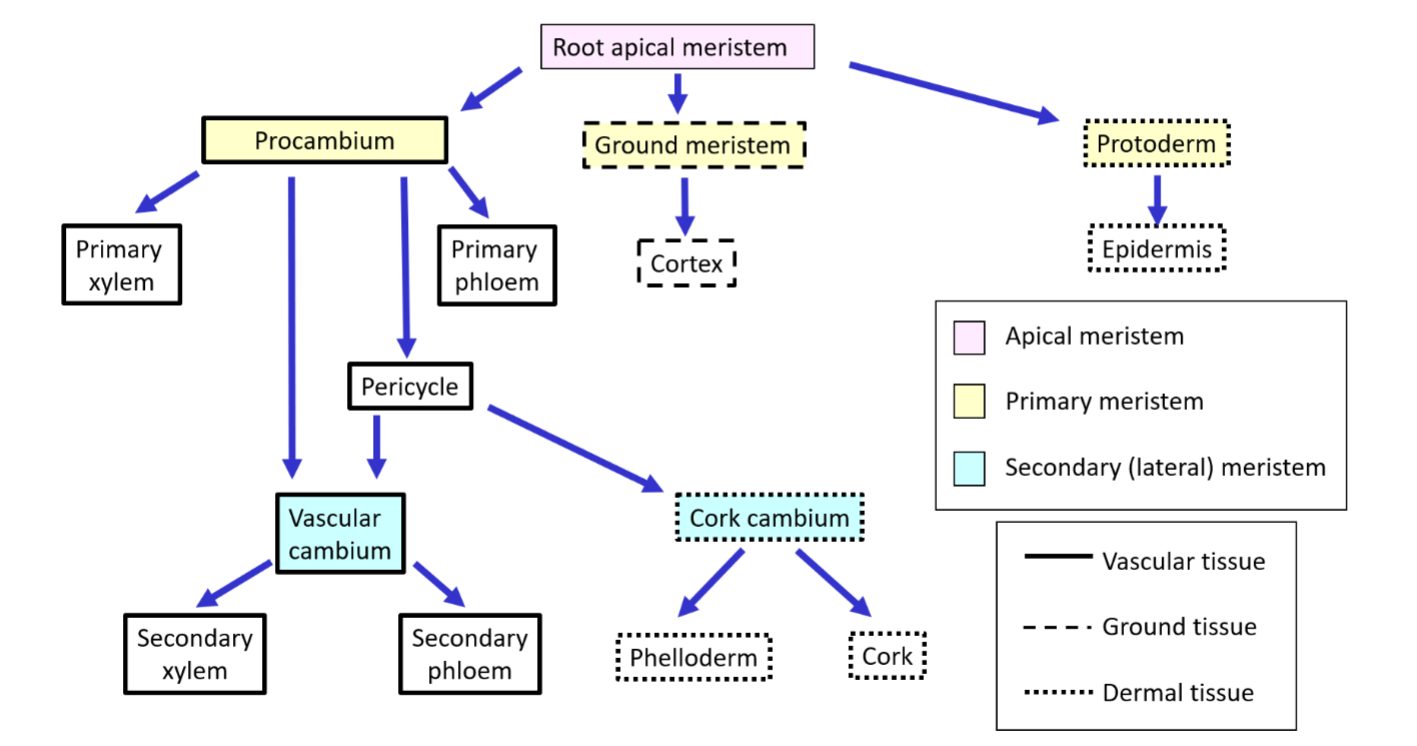
Send a link to your students to track their progress

49 Terms

1
New cards

Rhizosphere

Thin area around roots - where complex chemistry occurs for nutrient absorption

<p>Thin area around roots - where complex chemistry occurs for nutrient absorption</p>
2
New cards

Zone of Division

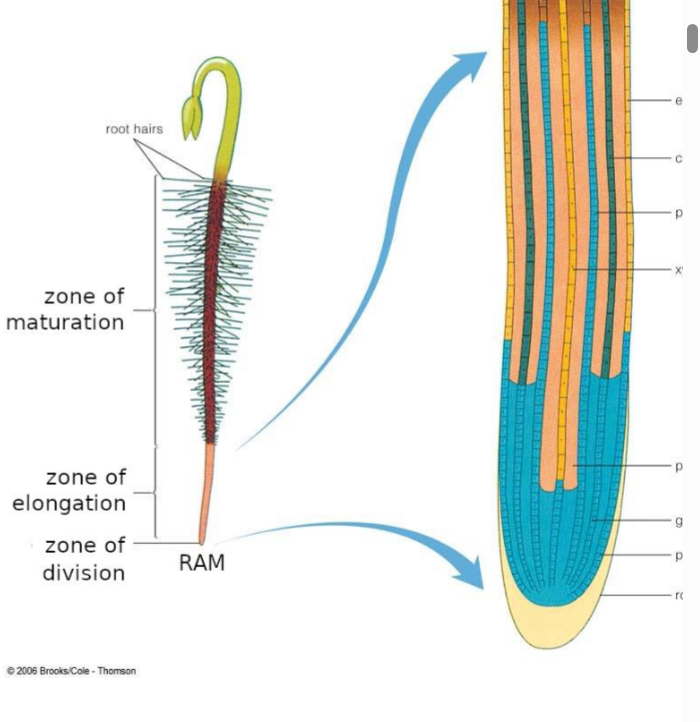
Root apical meristem divides to create primary meristematic tissue

  • protected by root cap


<p><strong>Root apical meristem</strong> divides to create primary meristematic tissue</p><ul><li><p>protected by root cap</p></li></ul><p></p>
3
New cards

Zone of Elongation

Newly divided cells grow longitudinally while cell wall remains flexible.
<p>Newly divided cells grow longitudinally while cell wall remains flexible.</p>
4
New cards

Zone of Maturation

Root hairs form and help absorb water and minerals.

  • Branching starts here.


<p><strong>Root hairs</strong> form and help absorb water and minerals. </p><ul><li><p>Branching starts here.</p></li></ul><p></p>
5
New cards

Quiescent Center

Area of the RAM (root apical meristem) that divides at an extremely slow rate.

<p>Area of the RAM (root apical meristem) that divides at an extremely slow rate.</p>
6
New cards

Root Cap

A structure that covers the tip of a root, protecting the root from injury.

Cells are constantly removed and replaced by apical meristem.

  • site of gravity perception


<p>A structure that covers the tip of a root, protecting the root from injury. </p><p>Cells are constantly removed and replaced by apical meristem.</p><ul><li><p><strong>site of gravity perception</strong></p></li></ul><p></p>
7
New cards

what is formed in zone of elongation?

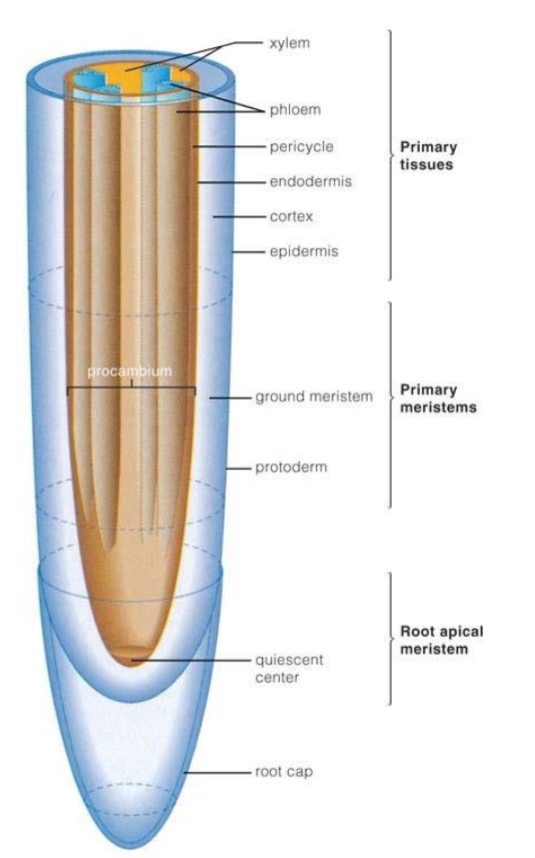
primary meristematic tissues โ†’ protoderm, ground meristem, procambium
<p>primary meristematic tissues โ†’ protoderm, ground meristem, procambium</p>
8
New cards

root primary tissues

  • epidermis

    • single layer of cells in outer

  • cortex

    • several layers btwn epidermis and vascular cylinder

  • vascular cylinder

    • differentiates from procambium โ†’occupies center of root

  • pericycle

    • outer boundary of vascular cylinder โ†’ site for root devel.


<ul><li><p><strong>epidermis</strong></p><ul><li><p>single layer of cells in outer</p></li></ul></li><li><p><strong>cortex</strong></p><ul><li><p>several layers btwn epidermis and vascular cylinder</p></li></ul></li><li><p><strong>vascular cylinder</strong></p><ul><li><p>differentiates from procambium โ†’occupies center of root</p></li></ul></li><li><p><strong>pericycle</strong></p><ul><li><p>outer boundary of vascular cylinder โ†’ site for root devel.</p></li></ul></li></ul><p></p>
9
New cards

Epidermis

A single layer of cells at outer boundary - arises from protoderm

  • have thin cell walls

  • external wall might elongate into root hairs:

    • sticky โ†’ soil particles stick to them

    • short-lived

    • constantly replaced

    • main role is to increase surface for water and mineral absorption


<p>A single layer of cells at outer boundary - arises from protoderm</p><ul><li><p>have thin cell walls</p></li><li><p>external wall might elongate into<strong><u> root hairs:</u></strong></p><ul><li><p>sticky โ†’ soil particles stick to them</p></li><li><p>short-lived</p></li><li><p>constantly replaced</p></li><li><p>main role is to increase surface for water and mineral absorption</p></li></ul></li></ul><p></p>
10
New cards

Cortex

Several layers between epidermis and vascular cylinder.

  • differentiates from ground meristem โ†’ mostly parenchyma cells

2 parts:

  • endodermis

    • innermost layer of cortex, surrounds vascular tissue

  • casparian strip

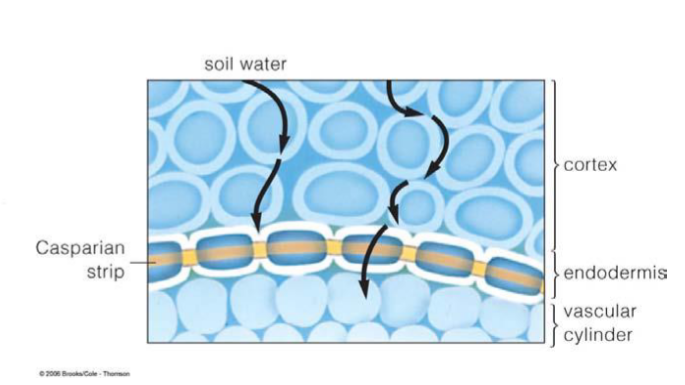
    • waxy material embedded in transversal and radial walls of endodermal cells โ†’ forces movement throuigh living cells, regulated by plasma membrane


<p>Several layers between epidermis and vascular cylinder.</p><ul><li><p>differentiates from ground meristem โ†’ mostly parenchyma cells</p></li></ul><p><strong><u>2 parts:</u></strong></p><ul><li><p><strong>endodermis</strong></p><ul><li><p>innermost layer of cortex, surrounds vascular tissue</p></li></ul></li><li><p><strong>casparian strip</strong></p><ul><li><p>waxy material embedded in transversal and radial walls of endodermal cells โ†’ forces movement throuigh living cells, regulated by plasma membrane</p></li></ul></li></ul><p></p>
11
New cards

Vascular Cylinder

Vascular tissue that differentiates from procambium - occupies center of the root.

  • consists of: primary xylem, primary phloem, and pericycle

in dicots:

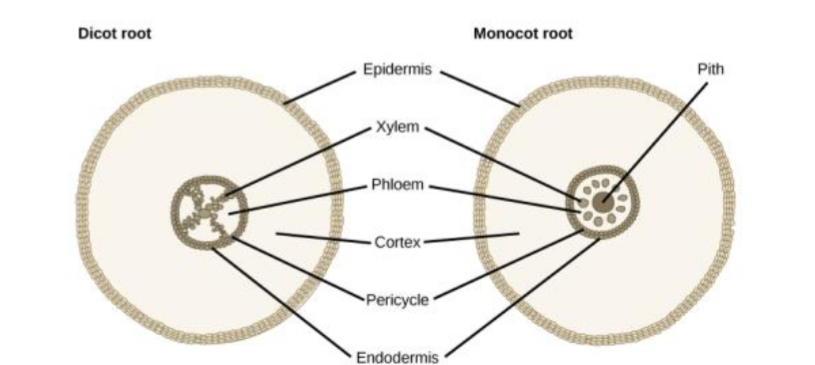
  • xylem forms central core (looks like an X) organized in 2 or more radiating pts. Phloem is placed btwn radial branches of xylem


in monocots:

  • central pith, surrounded by concentric rings of xylem and phloem


<p>Vascular tissue that differentiates from <strong>procambium</strong> - occupies center of the root.</p><ul><li><p>consists of: primary xylem, primary phloem, and pericycle</p></li></ul><p><u>in dicots:</u></p><ul><li><p>xylem forms central core (looks like an X) organized in 2 or more radiating pts. Phloem is placed btwn radial branches of xylem</p></li></ul><p></p><p><u>in monocots:</u></p><ul><li><p>central pith, surrounded by concentric rings of xylem and phloem</p></li></ul><p></p>
12
New cards

Pericycle

Zone of root branching

  • where branching root is gonna form, donโ€™t have nodes like stems

  • Outer boundary of vascular cylinder - site for lateral root development.


<p><strong>Zone of root branching</strong></p><ul><li><p>where branching root is gonna form, donโ€™t have nodes like stems</p></li></ul><ul><li><p>Outer boundary of vascular cylinder - site for lateral root development. </p></li></ul><p></p>
13
New cards

Root Hairs - Epidermis

Sticky, Short lived, Constantly replaced. May or may not elongate from the external wall of the epidermis cells. These increase surface for water and mineral absorption

14
New cards

Endodermis

Innermost layer of cortex.

  • Single row of cells surrounding the vascular tissue. Helps control mineral accumulation


<p><strong>Innermost</strong> layer of cortex. </p><ul><li><p>Single row of cells surrounding the vascular tissue. Helps control mineral accumulation</p></li></ul><p></p>
15
New cards

Casparian Strip

A waxy material embedded in the transversal and radial walls of endodermal cells. In some species, located in exodermis

  • in the cortex

  • forces movement through the living cell โ†’ regulated by the plasma membrane


<p>A waxy material embedded in the transversal and radial walls of endodermal cells. In some species, located in exodermis</p><ul><li><p>in the cortex</p></li><li><p>forces movement through the living cell โ†’ regulated by the plasma membrane</p></li></ul><p></p>
16
New cards

Vascular Cylinder - Dicots

Xylem forms a central core organized in 2 or more radiating points. Phloem is placed in between radial branches of xylem

  • looks like an X


<p><strong>Xylem</strong> forms a central core organized in 2 or more radiating points. Phloem is placed in between radial branches of xylem</p><ul><li><p>looks like an X</p></li></ul><p></p>
17
New cards

Vascular Cylinder - Monocots

Central pith, surrounded by concentric rings of xylem and phloem

  • monocot roots look like dicot stems! dont get it mixed up
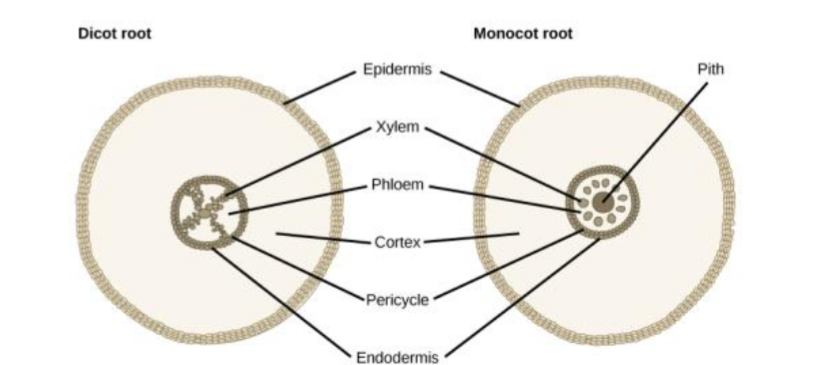

<p>Central pith, surrounded by concentric rings of xylem and phloem</p><ul><li><p>monocot roots look like dicot stems! dont get it mixed up</p></li></ul><p></p>
18
New cards

Xylem Tissue

Composed of tracheids and (sometimes) vessel elements.

19
New cards

Phloem Tissue

Forms sieve tubes with companion cells

20
New cards

xylem + phloem formation

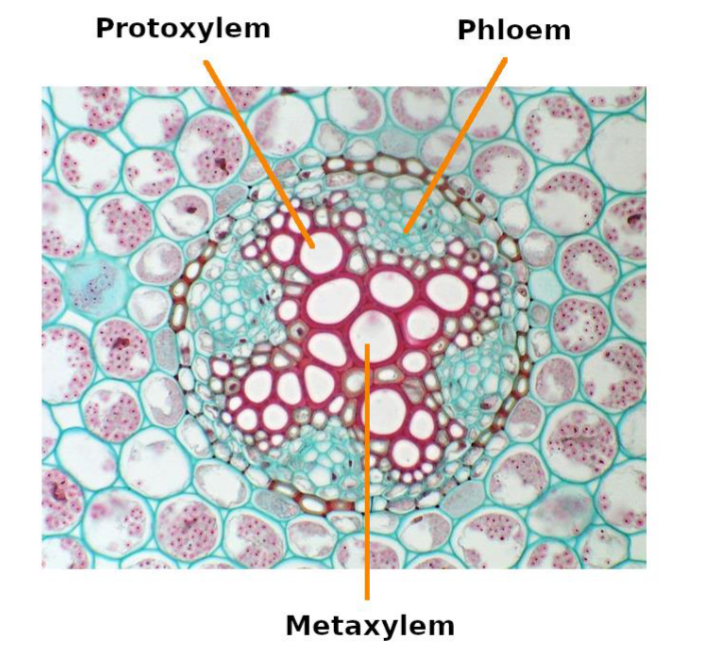
protoxylem โ†’ metaxylem crushes protoxylem cells as they grow

  • phloem forms in area btwn protoxylem arms

    • 1st part of vascular sys. to become functional


<p>protoxylem โ†’ metaxylem crushes protoxylem cells as they grow</p><ul><li><p>phloem forms in area btwn protoxylem arms</p><ul><li><p>1st part of vascular sys. to become functional</p></li></ul></li></ul><p></p>
21
New cards

Protoxylem

First xylem element to mature (baby). Capable of transporting water while elongating - secondary walls form annual ring

<p>First xylem element to mature (baby). Capable of transporting water while elongating - secondary walls form <strong>annual ring</strong></p>
22
New cards

Metaxylem

Mature after cell elongation is completed. Form thick secondary walls for water and mineral transport.

  • Crush protoxylem cells as they grow


<p>Mature after cell elongation is completed. Form thick secondary walls for water and mineral transport. </p><ul><li><p>Crush protoxylem cells as they grow</p></li></ul><p></p>
23
New cards

Phloem - Formation

Form in area between protoxylem arms.

  • First part of vascular system to become functional!!


<p>Form in area between protoxylem arms.</p><ul><li><p> First part of vascular system to become functional!!</p></li></ul><p></p>
24
New cards

Lateral Root Primordia

Result of chemical growth regulators that cause the pericycle to start dividing at specific sites

  • resulting lateral root primordia continues to form new cells

  • as it expands, lateral root pushes and destroys cortex cells and epidermis

    • endodermal cells join newly developed root
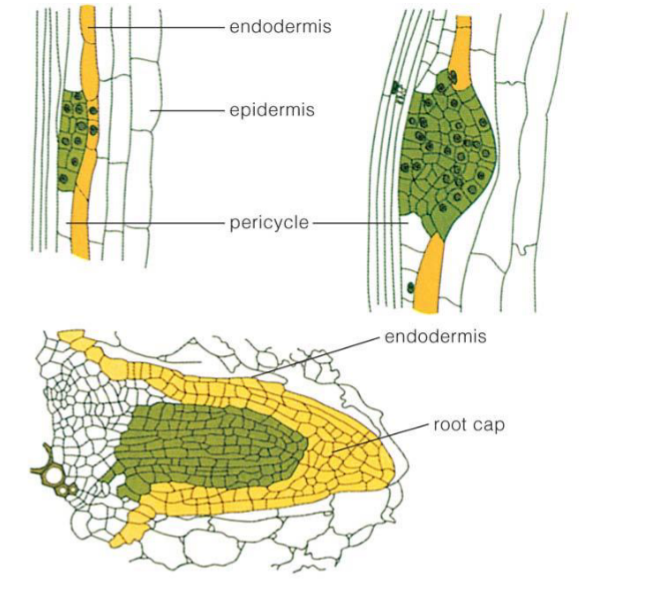

<p>Result of chemical growth regulators that cause the <strong>pericycle </strong>to start dividing at specific sites</p><ul><li><p>resulting lateral root primordia continues to form new cells</p></li><li><p>as it expands, lateral root pushes and destroys cortex cells and epidermis</p><ul><li><p>endodermal cells join newly developed root</p></li></ul></li></ul><p></p>
25
New cards

role of pericycle

Pericycle cells are meristematic, meaning they can divide and grow. They act as "founder cells" that trigger the creation of lateral roots (branch roots) pushing outward from deep inside the main root

  • In many plants (like dicots and eudicots), the pericycle helps make the plant thicker by dividing to form parts of the vascular cambium and the cork cambium


26
New cards

what does pericycle become?

In long-lived dicot plants,part of pericycle cells combine with residual procambium (located between arcs of xylem and phloem) to produce a vascular cambium

  • a secondary phloem also pushes remaining pericycle out and it becomes the cork cambium
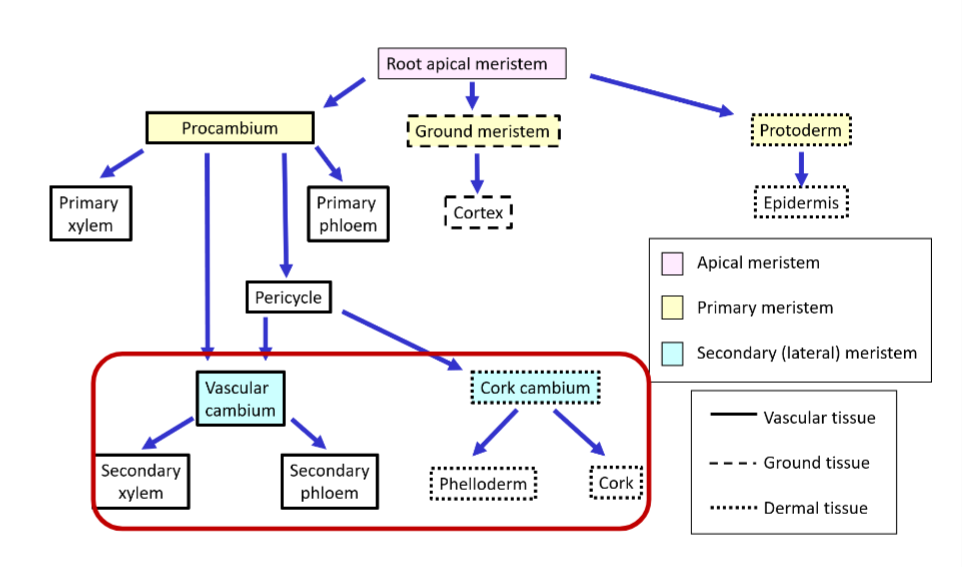

<p>In long-lived dicot plants,part of pericycle cells combine with residual procambium (located between arcs of xylem and phloem) to produce a <strong>vascular cambium</strong></p><ul><li><p>a secondary phloem also pushes remaining pericycle out and it becomes the<strong> cork cambium</strong></p></li></ul><p></p>
27
New cards

Secondary phloem - Secondary Meristems

Forms inner bark, pushing the remaining pericycle outwards.

  • Cortex is crushed and flakes off, with the epidermis

  • remaining pericycle becomes cork cambium


<p>Forms inner bark, pushing the remaining pericycle outwards. </p><ul><li><p>Cortex is crushed and flakes off, with the epidermis</p></li><li><p>remaining pericycle becomes cork cambium</p></li></ul><p></p>
28
New cards

Cork Cambium

Lateral meristematic tissue that produces the outer covering of stems. (forms from remaining pericycle)
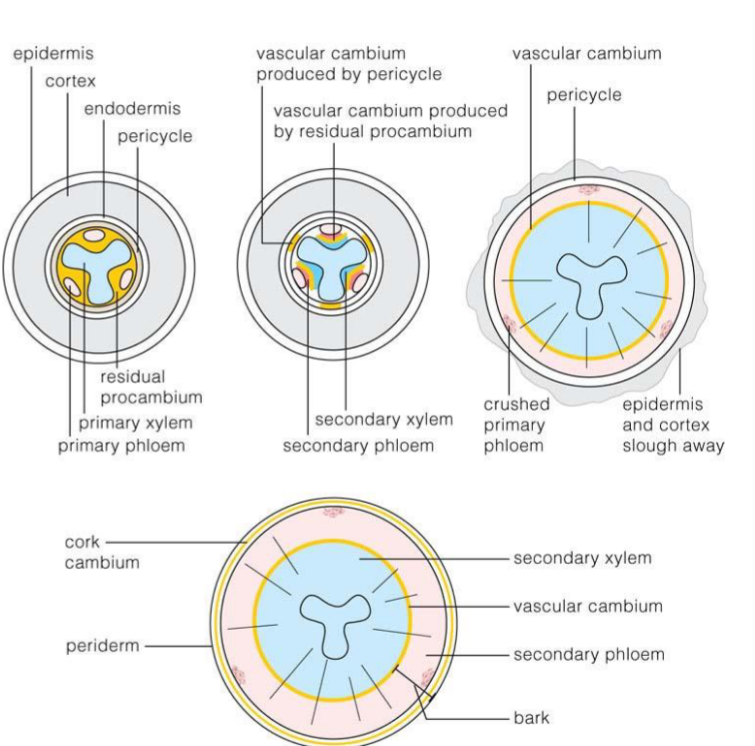
<p>Lateral meristematic tissue that produces the outer covering of stems. (forms from remaining pericycle)</p>
29
New cards

Lateral Growth

Growth occurs in a similar fashion as in stems.

  • Secondary forms towards inside of vascular cambium, forming wood-like tissue.

  • Secondary phloem + periderm form the bark.

    • Bark encases origin point of lateral roots.


30
New cards

what is the main function of leaves?

to conduct photosynthesis

  • needs water, CO2, sunlight

    • leaf blade increases surface for light to reach chloroplasts

    • xylem (in veins) brings water from roots

    • Pores let CO2 in from the air


31
New cards

where do true leaves arise from?

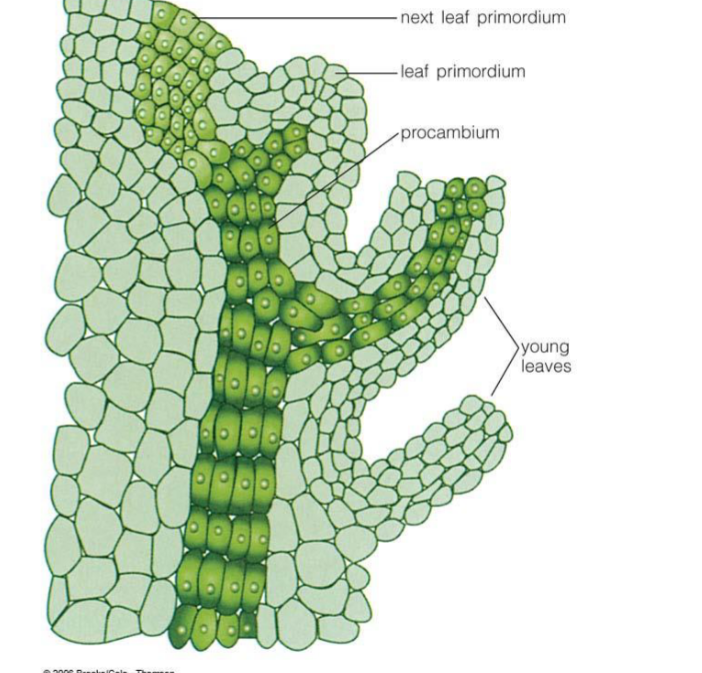
leaf primordia
<p>leaf primordia</p>
32
New cards

Leaf Primordia

crescent shaped bumps along the side of a shoot apical meristem, from which leaves arise.

  • Contains a set of primary meristematic tissue (periderm, ground tissue, and procambium).

  • The pattern of production of this defines the phyllotaxis of plant.


<p>crescent shaped bumps along the side of a shoot apical meristem, from which leaves arise. </p><ul><li><p>Contains a set of primary meristematic tissue (periderm, ground tissue, and procambium). </p></li><li><p>The pattern of production of this defines the phyllotaxis of plant.</p></li></ul><p></p>
33
New cards

leaf anatomy

  • epidermis

    • single layer in upper + lower surface (sandwich)

  • mesophyll

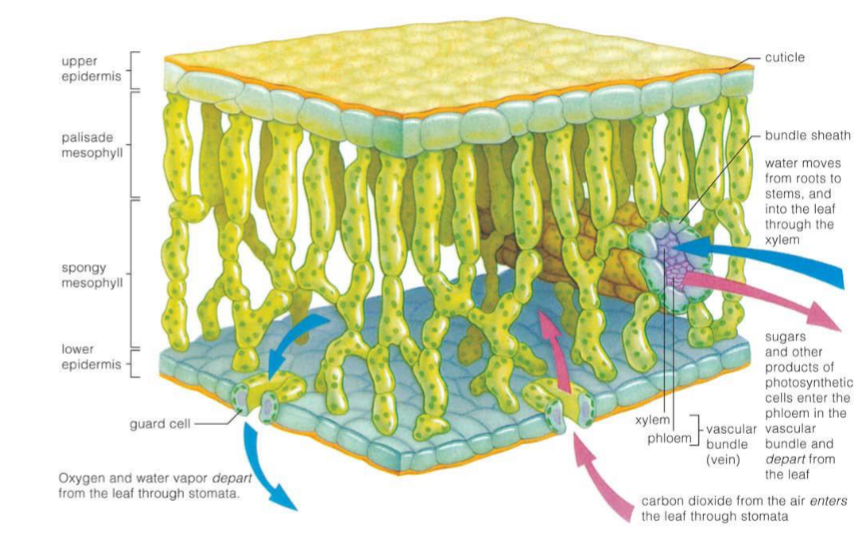
    • middle layer of cells, including chloroplast containing cells

      • palisade tissue

      • spongy tissue

  • veins

    • contains xylem + phloem


<ul><li><p><strong>epidermis</strong></p><ul><li><p>single layer in upper + lower surface (sandwich)</p></li></ul></li><li><p><strong>mesophyll</strong></p><ul><li><p>middle layer of cells, including chloroplast containing cells</p><ul><li><p>palisade tissue</p></li><li><p>spongy tissue</p></li></ul></li></ul></li><li><p><strong>veins</strong></p><ul><li><p>contains xylem + phloem</p></li></ul></li></ul><p></p>
34
New cards

Mesophyll - Leaf

middle layer of cells, including chloroplast-containing cells.

Divided in 2 parts:

  • Palisade tissue

  • Spongy tissue


<p>middle layer of cells, including chloroplast-containing cells. </p><p><strong><u>Divided in 2 parts: </u></strong></p><ul><li><p>Palisade tissue</p></li><li><p>Spongy tissue</p></li></ul><p></p>
35
New cards

Veins - Leaf

Contain xylem and phloem that transverse the leaf blade.
<p>Contain xylem and phloem that transverse the leaf blade.</p>
36
New cards

Epidermis - Leaf

Single layer of cells in the upper and lower surfaces (sandwich). Covers the entire surface of the blade and the petiole.

contains:

  • epidermal cells

    • flattened, covered by cuticle (waxy) that prevents water loss

  • guard cells

    • surround pores aka stomata

  • subsidiary cells

    • support guard cells

  • trychomes

    • pubescent (hairy)

    • glabrous (shiny)


<p>Single layer of cells in the upper and lower surfaces (sandwich). Covers the entire surface of the blade and the petiole.</p><p><strong><u>contains:</u></strong></p><ul><li><p><strong>epidermal cells</strong></p><ul><li><p>flattened, covered by cuticle (waxy) that prevents water loss</p></li></ul></li><li><p><strong>guard cells</strong></p><ul><li><p>surround pores aka stomata</p></li></ul></li><li><p><strong>subsidiary cells</strong></p><ul><li><p>support guard cells</p></li></ul></li><li><p><strong>trychomes</strong></p><ul><li><p>pubescent (hairy)</p></li><li><p>glabrous (shiny)</p></li></ul></li></ul><p></p>
37
New cards

Epidermal Cells

Flattened; outer wall often covered by cuticle (a waxy layer) that prevents water loss.

  • in leaf epidermis


38
New cards

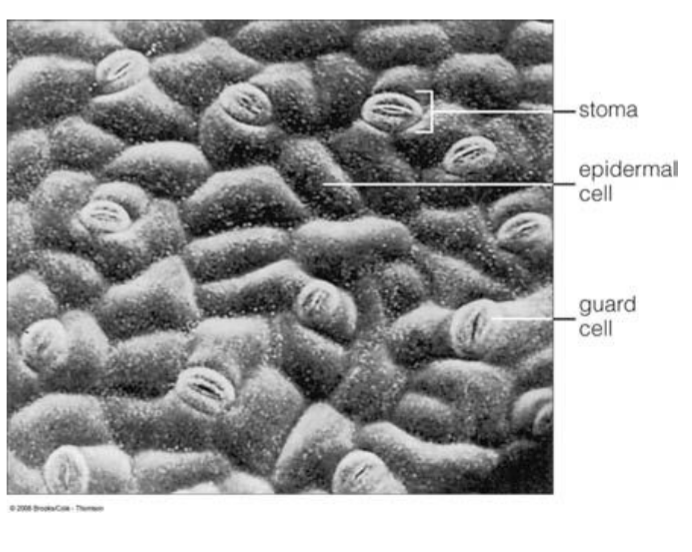
Guard Cells

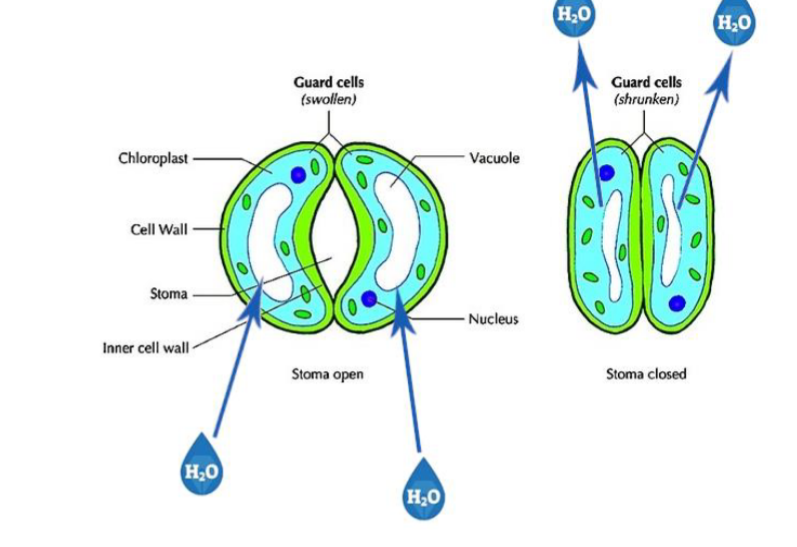
Surround pores known as stomata. These cells are on either side of stomata and control size of opening.

  • in relaxed state (low water), cells lie parallel

  • when water is pumped into cells, thinner walls stretch and curve the cells away from each other โ†’ opening

in epidermis of leaves!

<p>Surround pores known as stomata. These cells are on either side of stomata and control size of opening.</p><ul><li><p>in relaxed state (low water), cells lie parallel</p></li><li><p>when water is pumped into cells, thinner walls stretch and curve the cells away from each other โ†’ opening</p></li></ul><p>in epidermis of leaves!</p>
39
New cards

guard cell in stomata

as cell volume increases โ†’ stomata opens

as cell volume decreases โ†’ stomata closed

<p><strong>as cell volume increases โ†’ stomata opens</strong></p><p><strong>as cell volume decreases โ†’ stomata closed</strong></p>
40
New cards

Subsidiary Cells

Support the guard cells in the epidermis of leaves!

41
New cards

Trychomes

Hairs that can secrete substances โ†’ makes the leaf pubescent (hairy) instead of glabrous (shiny)

  • in epidermis of leaves


42
New cards

Stomata

Special pores that control exchange of gasses.

  • There are usually many more of these pores in the lower epidermis than the upper epidermis โ†’ cuz lower is in shade

  • cell wall of guard cells facing stomata r thicker

  • opened/closed by guard cells


<p>Special pores that control exchange of gasses. </p><ul><li><p>There are usually many more of these pores in the lower epidermis than the upper epidermis โ†’ cuz lower is in shade</p></li></ul><ul><li><p>cell wall of guard cells facing stomata r thicker</p></li><li><p>opened/closed by guard cells</p></li></ul><p></p>
43
New cards

Stomata - Functions

  • Avoids having pores clogged by dust.

  • Reduces infection from fungi.

  • Allows to pack upper area with chloroplast- containing cells.

  • Species with up-right leaves are the exception (e.g. corn)

stomata remains closed when photosynthesis stops (at night),or when conditions can lead to desiccation (drought, wind)!

44
New cards

Mesophyll - Palisade Cells

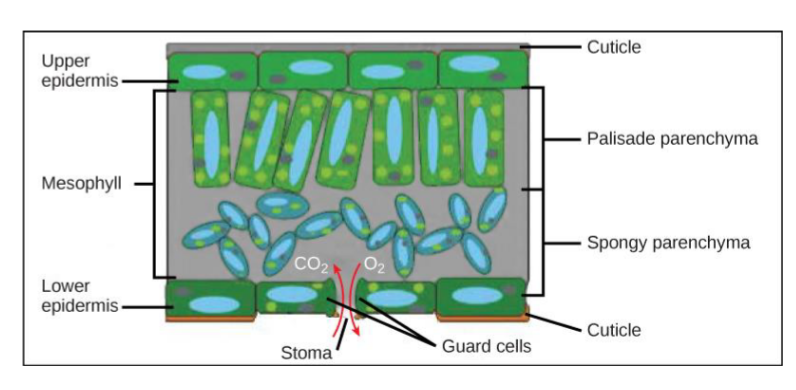
The cells that are closely packed and elongated in the upper part of the mesophyll. โ€˜wallโ€™

  • These cells contain chloroplast and r main tissue for photosynthesis

  • differentiated from ground meristem


<p>The cells that are closely packed and elongated in the <strong>upper part of the mesophyll. โ€˜wallโ€™</strong></p><ul><li><p>These cells contain chloroplast and r main tissue for photosynthesis</p></li><li><p>differentiated from ground meristem</p></li></ul><p></p>
45
New cards

Mesophyll - Spongy Cells

The cells that are loosely packed and irregular in the lower part of the mesophyll.

  • Main function is to allow diffusion of gasses from stomata to the palisade, but also have some chloroplast to catch residual sunlight

  • also differentiated from ground meristem


<p>The cells that are <strong>loosely packed and irregular in the lower part of the mesophyll</strong>. </p><ul><li><p><strong>Main function is to allow diffusion of gasses from stomata to the palisade,</strong> but also have some chloroplast to catch residual sunlight</p></li><li><p>also differentiated from ground meristem</p></li></ul><p></p>
46
New cards

what is the main tissue for photosynthesis?

the chloroplasts inside of the palisade cells of the mesophyll (in leaves)
<p>the chloroplasts inside of the palisade cells of the mesophyll (in leaves)</p>
47
New cards

Veins - Vascular Tissue

The veins consist of vascular bundles that form a network of xylem (on the upper part) and phloem (lower part).

  • arrangement of xylem + phloem is consequence of their arrangement in the stem


<p>The veins consist of vascular bundles that form a network of xylem (on the upper part) and phloem (lower part).</p><ul><li><p>arrangement of xylem + phloem is consequence of their arrangement in the stem</p></li></ul><p></p>
48
New cards

in stems, the xylem is on the _____ and in roots/leaves itโ€™s on the ____ part

stems โ†’ xylem is inside

roots/leaves โ†’ xylem is upper

49
New cards

in stems, the phloem is on the _____ and in roots/leaves itโ€™s on the ____ part

stems โ†’ phloem is outside

roots/leaves โ†’ phloem is lower