HSC Modern History - Power and Authority
 Call Kai
 Learn
Learn Practice Test
 Spaced Repetition
 Match
Match Flashcards
 Knowt Play
1/98

There's no tags or description
Looks like no tags are added yet.
Name | Mastery | Learn | Test | Matching | Spaced | Call with Kai | Chat |
|---|
No analytics yet
Send a link to your students to track their progress
99 Terms
1. An overview of the peace treaties which ended World War 1 and their consequences
- Treaty of Versailles
- Treaty of St Germain
- Treaty of Neuilly
- Treaty of Trianon
- Treaty of Sevres
1. Treaty of Versailles
- Germany --> 28th June 1919
- harsh territorial and population concession
-- 1 million square miles of land
- harsh military restrictions
-- 100 000 men in army, no tanks, no navy, no Air Force, 6 capital naval ships
- harsh reparations
-- 132 million gold marks, War Guilt Clause
Consequences:
- severe economic decline & recession
- STAB IN THE BACK LEGEND developed
- unhappy with harshness - growth of nationalism (rise of the Nazi Party)
1. Treaty of St Germain
- Austria --> 10th Sept 1919
- end of Austro-Hungarian empire through solidifying Austria's independent status
- territorial concessions and military restrictions (60% of pre-war territory + blame for war + 30 000 volunteers in army and no navy
- Austria = bankrupt before reparations
- no political/ economic unions
Consequences:
- severe economic decline & recession
- resentment for Allies
- Nationalism --> Germans heritage
- seeking Anschluss with Germany (UNION)
1. Treaty of Neuilly
- Bulgaria --> 27th Nov 1919
- territorial concessions
- military concessions (20 000 men, no airforce, military or possession of artillery)
- reparations = 90 million British pounds
- cattle and coal for Allies
Consequences:
- resentment over lack of Bulgarian self-determination
- growth of leftist ideologies = Bolshevism and anarchism
- Bulgarian attempts to align with Allied powers
1. Treaty of Trianon
- Hungary --> 4th June 1920
- end of Austro-HUngary empire, Hungary = independent status
- 2/3 pre-war territory
- army 35 000, no navy, no airforce
- accept blame for the war
- Hungary bankrupt before reparations
Consequences:
- severe economic decline & recession
- resentment over lack of Hungarian self-determination
- resentment of treaty -- no awareness of historical, cultural and ethnic groups
- growth of Nationalism
- attempts to ally with Axis nations
1. Treaty of Sevres
- Ottoman Empire --> 10th Aug 1920
- territorial concessions designed to dissolve and divide the empire
- military restrictions on navy, army and air force
- complete allied control over the Ottoman Empire
Consequences:
- resentment for allied nations
- growth of Turkish Nationalism
- Turkish war of independence
2. The conditions that enabled dictators to rise to power in the interwar period
- interwar period = 21 years between WW1 and WW2
- WW1 and the treaty of versailles
- the rise of extreme ideologies and nationalism
- Great Depression
2. The conditions that enabled dictators to rise to power in the interwar period: ITALY
- mussolini
- italy's dissatisfaction with the ToV = didnt receive as much as they were promised based on their war performance
- economic uncertainty = suggest failure of democracy
- widespread unrest in post-war government --> proportional representation -> stagnant gov -> Mussolini rise
- fascist political gov -> Blackshirts fascist group = violent
- collapse of European order -> tsar in Russia, kaiser in Germany = political and economic turmoil (early 1917-8)
2. The conditions that enabled dictators to rise to power in the interwar period: GERMANY
- stab-in-the-back legend -> army to the politicians who signed ToV
- scapegoats of public -> jews. communists, socialists, democrats -- good for Hitler
- Weimar Republic disrespected from ToV --> hitler gained support
- Hitler's appeal to everyone + Nazi party well organised
- fragile democracy ->Right-Wing military groups overpowering Left
- economic factors -> hyperinflation, Great Depression (6 mill unemployed)
2. The conditions that enabled dictators to rise to power in the interwar period: RUSSIA
- destruction of the monarchy --> bolshevik seizure of power in nov 1917
- Stalin took control of the Communist party
- death of lenin in 1924 -> Stalin natural successor
- Stalin vs Trotsky
- Stalin's use of terror (secret police, show trials)
- Stalin's destruction of peasants through collectivisation (used to starve richer peasants into submission through collective farms)
2. The conditions that enabled dictators to rise to power in the interwar period: JAPAN
- Emperor Hirohito
- building strong Japan to counter threat of Western Imperialism
- tradition of institutional militarism ->military influenced Japan in Meiji restoration
- universal military conscription -> indoctrinated 1000s of men with patriotic values and unquestioned loyalty to Emperor (kokutai)
- foreign policy - resources from Manchuria, Taiwan, Korea
- Imperialism - China and Russia - Sino-Japanese wars, Russo-Japanese war
- Economic issues - trade barriers imposed by the west for Japan military aggression in China, Great Depression
- ultranationalism - brought demise od taisho democracy after PM Tsuyushi was assassinated
2. features of a dictatorship
- single political party (dictator)
- single leader
- individual freedoms and liberties restricted
- immensely nationalistic (patriotic)
- war glorified to enhance prestige and power of nation
- racial superiority
- totalitarian state = controls every aspect of the individuals life
2. League of Nations failure
- denied Germany entry until 1926
- Japan and Italy were both founding members but both withdrew
- Soviet Union was expelled in 1939 after Finland invasion
- USA WAS NOT IN THE LoN --> reduced effectiveness highly
3. An overview of the features of the dictatorship that emerged in Russia
- rapid industrialisation
- building a national sense of pride - social conditions improved (employment and health) but no freedom
- cult of personality in leadership of Stalin
- cultural conformity - 1000s purged for creating things "anti-Soviet"
- policy of terror
- show trials
- cautious foreign policy -> emphasis on eco development and consolidating S power at home
- Collectivisation of agriculture
- intention to eradicate minorities to create the "Soviet" citizen
- Class conflict -> stalin approved to forcibly purge societies of bourgeoisie (threat from tsar rule)
- Religious Persecution -> atheism enforced
3. Russia = rapid industrialisation
- five-year-plans aimed to industrialise rural SU
-- this would help accelerate communist development
- ridiculously high quotas for economic growth was achieved, especially in coal and iron
- harsh totalitarian measures introduced
- to hasten industrialisation, Stalin created joint venture contracts with major American private enterprises (Ford Motor Company)
3. Russia = cult of personality in leadership of Stalin
- School children ended the pledge of allegiance everyday by saying "....and thank Comrade Stalin for this happy life"
3. Russia = policy of terror
- Stalin suspicious of everyone
- "Great Terror" 1936-37 — stalin signed 40 000 death warrants, 3.7 mill accused of counter-revolutionary crimes, 600k killed, 2.7 mill sent to gulags
3. Russia = Collectivisation
- mass collectivisation and rapid urbanisation converted small villages into industrial cuties
- most peasants opposed it, Ukraine peasants killed their livestock instead of giving it to the state; Stalin angry and let famine kill millions
- Richer peasant farmers were deported to forced labour camps in siberia ( at least 2.5 mill)
3. Russia = intention to eradicate minorities to create the "Soviet" citizen
- stalin wanted to create a "soviet" citizen
- aim: eradicate national identities such as russians, ukrainians
- he enforced every language to be converted to the Cyrillic alphabet
- resistance=mass deportations
3. An overview of the features of the dictatorship that emerged in Italy
- Support from Roman Catholic Church (religious education made compulsory, catholicism made official religion)
- support from industrialists (M = against communism and disruption of economy)
- support from working class (8hour work days)
- support from middle and upper classes (wealth inheritance passed to families not gov)
- militarisation and foreign conquests (aim=restore hegemony of the Roman Empire in Italy)
- foreign allies (germany and spain)
3. An overview of the features of the dictatorship that emerged in Japan
- attempted coups
- japan as a militaristic state
- general Hideki Tojo as PM
- suppression of democracy
- anti-communism
- territorial ambitions and foreign invasion
3. Japan = attempted coups
- Oct 1931 = october incident failed coup by Sakurakai
- may 1932 = PM tsuyoshi inukai assassinated
- feb 1936 - civilian leaders killed and military leaders began to take over civilian leadership roles
3. Japan = general Hideki Tojo as PM
- emperor hirohito thought tojo could control extreme ideals in the army
- hung as a war criminal in 1948, obliged to take responsibility for emperors decisions
3. japan = suppression of democracy
- censorship and no freedom of speech
- 1940, all political parties dissolved for one party state based on totalitarian values
- givernment bureaucrats opposed military influence and military was divided within its own factions
3. Japan = territorial ambition and foreign invasion
-manchuria 1931
- shanghai 1933
- china 1937
4. The rise of the nazi party and Hitler in Germany and the collapse of the Weimar Republic
- background to the Weimar Republic
- background to hitler and nazi party
- constitutional flAws in the Weimar Gov
- ToV
- rise of nationalism
- occupation of the Ruhr
- hyperinflation
- stresemann era
- great depression
4. background to the Weimar Republic
- formed as Kaiser Wilhelm II abdicated and monarchy was abolished
- left wing groups fought between democracy (SDP) and the Spartacists (revolutionary socialism)
- election held on 19 Jan 1919 with SDP winning most seats but not majority
- Friedrich Ebert = chancellor of the SDP (democracy) —> president of Weimar Republic (Phillip Scheidemann as chancellor)
— to combat opposition, Ebert granted the army autonomy in exchange of repressing left wing extremism ——> established friekorps (volunteer militia units)
4. The Weimar Constitution
- Bill of Rights guaranteed freedom of speech/religion, and equality under the law
- suffrage granted to all men and women over 20
4. The Weimar Constitution >>> role of the PRESIDENT
- limited role in everyday governance of Germany
- chose the chancellor
- power to dissolve the Reichstag and call re-elections
- power over armed forces
4. The Weimar Constitution >>> role of the CHANCELLOR
= the leader of the party with the most seats
- chooses ministers to help run the country and could pass laws that were supported by the Reichstag
4. The Weimar Constitution >>> role of the REICHSTAG
- parliament elected by the German people
- had the power to create/debate laws and legislation
- composition dependent on proportional representation
4. The Weimar Constitution >>> Article 48
In an emergency, the president can pass laws that were supported by the Reichstag (but they would also define what was classed as an emergency ♀️ thus could be abused to form a dictatorship)
4. background to hitler
- born in Austria
- very strong anti-Semitic values
- joined the war in 1913 and fought in the Bavarian infantry unit during WWI but was injured and hospitalised - shocked and outrage to hear German Collapse and ToV signed
- joined the German Workers Party DAP (precursor to tech Nazi Party and aligned with H nationalist, anti-comm, anti-Semite values)
4. background to hitler >>> quote
“The war ... brought for him, at twenty-five, a new start on life” he was a “impassioned warrior, deadly serious at all times about the war’s aims and Germany’s manifest destiny” (Shirer)
4. background to nazi party
- H became leader in 1921
- formulated a twenty-five-point program, outlining the party platform
- members suggested that his leadership was too dictatorial but he was rejected from resigning making him indispensable and he abolished the committee altogether
- Nazi party membership grew rapidly (testament to Hitler’s public speaking, charisma)
- 55000 members by 1923
4. background to nazi party >>> appeal of Nazism
- Junkers (landed gentry) supported H because they despised democracy and preferred autocracy
- industrialists offered financial support because Nazism could resist communism and socialism
- militarists favoured H doctrine of power and nationalism as it required a strong army
- working class felt let down by SPD and Nazism > Bolshevism
- middle class wanted strong leadership after facing two economic crisis’
- Agriculture peasantry believed Nazis would redistribute land, end debt repayment slavery and were flattered by H insistence of them as the backbone of the German race (from H idea of ‘Blood and Soil’
- Nazism was exciting and RADICAL >> election of Sept 1930 saw 18-30 age group provided largest percentage of voters
4. constitutional flAws in the Weimar Gov
- proportional representation
— parties gain seats based on the number of votes cast for them
— made it impossible for parties to secure a majority (more difficult to get laws passed)
— development of coalition - large parties would align with smaller parties to gain the majority; larger parties compromised their position giving smaller parties disproportionate power
- article 48
4. Treaty of Versailles
- Weimar Republic blames for harshness if the ToV
- some terms of treaty:
—> reparations set at 132 billion gold marks
—> territorial concessions
—> limited military
—> War guilt Clause accepting fault for the war
November Criminals = the nickname given to the German politicians who negotiated and signed the armistice which ended the war in Nov 1918 - emphasised by unhappy army #weimarrepublicwasdoomedfromthebeginning
Stab-in-the-back legend = right wing notion blaming socialists, pacifists, Jews and democratic politicians for sabotaging the war efforts (used to deal with German defeat but didn't acknowledge the dire state of the home front at the end of the war) - military felt #attacked
4. Rise of nationalism >>> Kapp Putsch
- showed how easily the Weimar Republic could lose its power
—> no support from military - “Reichswehr does not fire at Reichswehr”
—> 1920 - support for SPD had fallen
—> Kapp supporters became Nazi supporters later
- organised by Wolfgang Kapp (alliances with Walther von Luttwitz, an estranged army general)
- 13th March 1920 - marinebrigade took control of Berlin and Weimar politicians fled
- German workers organised a mass strike and Kapp government collapsed on 17th March
4. Rise of nationalism >>> Beer Hall Putsch
- hitler and Bavarian leadership unite take over Munich
-hitler storms the Beer Hall where a meeting was taking place and declares "the national revolution has begun"
—>> despite agreeing to support, the Bavarian leaders escaped in the commotion and called the the PO-PO
- Nazi's enter Munich expecting little resistance, but was faced with the army reinforcements
- hitler arrested and Nazi party banned
- hitler wrote Mein Kampf in jail and used his trial to gain support
- The Beer Hall Putsch revealed to Hitler that revolution was not the way forward for the Nazi Party - they needed to gain power legitimately, through constitutional means.
4. The occupation of the Ruhr
Ruhr = industrial heart of Germany
- Weimar gov was struggling to pay reparations —> 1923 shipment of telegraph poles hadn’t been delivered to France and FRANCE AND BELGIUM SENT TROOPS TO TAKE CONTROL OF THE RUHR
-Weimar orders passive resistance against French aggression (workers strike over violence)
- “Ruhr stopped beating”
—> production numbers fell dramatically – the French receive
1% of coal deliveries they previously enjoyed.
- occupation lasted 2.5 years and as industrial production fell, enter HYPERINFLATION
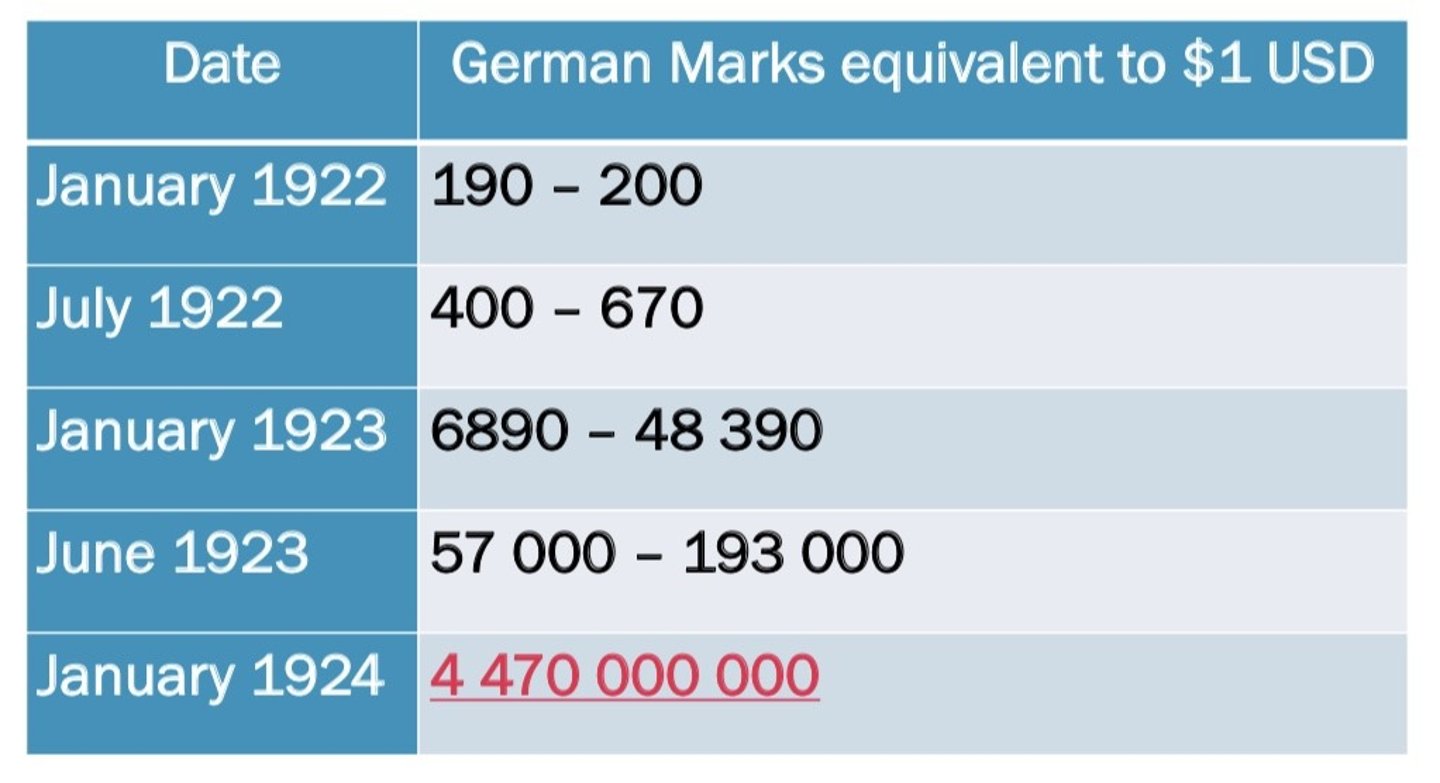
4. Hyperinflation table
4. Hyperinflation in the 1920s
- government handled it bad —> printed MORE MONEY of high value, encouraging inflation as the value of the mark decreased, money became USELESS
- EG. loaf of bread in 1918 was 0.63 marks and in 1923 it became 201 000 000 000
- working class = no savings, unemployment, unable to afford ridiculous prices
- middle class = no savings, unemployment, inflated rent prices
- upper class = BENEFITED from inflated rental prices
- stresemann introduces Rentemark
4. Stresemann era #goldenyears
- 1924 -1929
- stresemann detested the ToV and believe in regaining national prestige
-believed in the policy of fulfilment (make ping the treaty work for Germany)
-made Germany a cultural and tech hub
-DAWES PLAN (1924)
— fixed annual reparations payments at a manageable level
— increase in American loans to Germany, reviving economy (fell apart GD)
— France would leave Ruhr
-LOCARNO TREATIES (1925)
— signed between Britain, France and Germany
— legitimised franc-German & Belgian-German border
— Germany admitted into LoN (1926)
-YOUNG PLAN (1929)
— revisited reparations
— brought an end to the military occupation of the Rhineland
Nazi party was doWN! For now 🤪
4. Great depression
- because of the Dawes Plan, German economy was too tied with America so they suffered -> they didn’t get the American loans but still had to pay tariffs 🤷🏽♀️😭
- Weimar gov were dumb, they raised taxes and cut wages
- 1932 - industrial production in Germany was at 58% of its 1928 levels (mass employment)
- chancellor Bruening asks Hindenburg to invoke 48 to pass deflationary policies
— Hindenburg then CANCELS the Reichstag and calls for new elections and 😒hitler😒 starts campaigning
- nazi party = in 1928, 12 seats; in 1932, 107 seats
-“The non-manual employees, civil servants and teachers – who aligned themselves with Nazism [were] a direct result of the depression.” (Stephen Lee)
4. Main ideas of the nazi party
- greater Germany (gross Deutsche), union of all Germans
-reversal of ToV
- confiscation of war profits and unearned income made by German citizens
- guaranteed living wage for all citizens
- nationalisation of major industries
- assistances to small businesses
- farming and agriculture reform
- self-sufficiency (autarky) in economics
- expansionist foreign policy for lebensraum
- exclusion of Jews and immigrants from German society
4. Nationalism and fascism are
Far right
4. Communism is
Far left
4. Democracy is
Centre right
5. The initial consolidation of Nazi Power
- appointment of Hitler as chancellor
- Reichstag fire
- The enabling Act
- Trade Unions
- The Reichskonkordat
- The Night of the Long Knives
- death of President. Hindenburg
5. Hitler as Chancellor
- appointed on Jan 30 1933 (Hindenburg was v hesitant)
- the evening of appointment, hitler declared "The New Reich as been born" and basically two months later, he controlled germany
- initially, Hndenburg appointed Kurt von Schleicher despite the Nazis hiding the most seats
- hitler's ally former chancellor FRANZ von PAPEN saw his own gain in H's appt and explained that hitler needed to be controlled and that was easiest to do within the gov, he heavily underestimated Hitler.
5. The Reichstag fire
- Feb 27 1933, Reichstag building was set on fire
- culprits believe to be Communists and Hitler spreads this rumour further to spark communist outrage
- communist party = banned
- Hitler's issues the Decree for the Protection of German Peoples and Reichstag Fire Decree (which suspended RIGHT TO ASSEMBLY, FREEDOM OF SPEECH AND PRESS)
- Nazi uses fire to justify persecution and imprisonment of political opponents
5. The Enabling Act
- 24th March 1933
- GAVE HITLER DICTATORIAL POWERS OVER GERMANY - no longer needed president approval
- act was SIGNED BY Hindenburg, passed through Reichstag and Reichsrat making it #legal
-----> post fire, Reichstag operated in the smaller building, making the SA more INTIMIDATED
-----> HITLER convinced parties to vote for act
-----> only Social democrats didnt vote in favour but failed their boycotts
- July 14 1933 - all parties banned from operating
5. Trade Unions
- trade unions held too much power over workers so
- may 2 1933, police arrested leaders and officials, money was confiscated, strikes were banned, ALL TRADE UNIONS DISSOLVED
- DUETSCHE ABEITSFRONT (The German Labour Front) was established and all workers were forced to be members
---> promoted nationalism and loyalty to Nazi regime through programs and leisure activities
5. The Reichskonkordat
- Signed by Von Papen and the Cardinal Secretary of State on 20th July 1933.
- guaranteed the rights of the Roman Catholic Church in Germany, as long as they subjected to the authority of the Nazi Party
- nazis breached the agreement shortly after it was made
- issue was declared that all religious instruction in schools must be combined with ANTI-SEMITIC values --> went against the religious decree to "love thy neighbour"
- Pope Pius XII responded to Nazi's breaches of the treaty in Mit brenneder Sorge (“With Burning Concern”)
5. The Night of the Long Knives
- 30th June - 2nd July 1934, was Hitler’s purge of his own party through murder and arrest (like STALIN)
- officially 85 killed but 200 estimated to be the real number
- most were assassinated by the SS/ GESTAPO
- army said they'd support hdawg if SA was surpressed so... SA became the sole armed force in the state
--> SA leaders were targeted the most (ERNST ROHM) since H thought the members took the socialist side of the ideology too seriously
5. death of President. Hindenburg
- August 2 1934
- with army support, hitler combine the role of president and Chancellor!
- later he abolished the president's office and declared himself Fuhrer of Germany
- Hitler OFFICIALLY the DICTATOR of Germany
5. #historians on hitler's role in gov
- US Historian NORMAN RICH believes that Titler was Master in the Third Reich
- German Historian Hans Mommsen argued that Hitler was indecisive, influenced by his entourage, and, in some respects, a weak dictator
6. The nature of Nazi Ideology
- nazism reflected HItler's beliefs and ideas of Nazism were outlined in the 25 points of the Nazi Party (1920) and within his memoir Mein Kampf (1924)
nazism support appealed from Nationalism --> Nationalists and the Imperialists, ”socialist” elements attracted the workers, anti-communism appealed to the rich.
- Nationalism
- Totalitarianism and the Fuhrerprinzip
- Social Darwinism
- Lebensraum (Living Space)
- Autarky (self sufficiency)
- conservatism
6. nationalism
- Nazi's were ETHNONATIONALISTS (GERMAN BY ETHNICITY AND BLOOD ALONE)
- No diplomatic intentions, sole concern was to safeguard German interests --> any treaty/policy/negotiation ws ignored if they countered German interest
- "Volksgemeinschaft" (people's community) --> belief that all germans should unite and work together to reduce inequality (never followed but aspect of Nazi prop.)
6. totalitarianism and the fuhrerprinzip
- The Führerprinzip (the leader principle): the words of the Führer are above the law
- Hitler was the political father figure and eventually no activity or organisation in Germany was independent
- censorship and propaganda played a key role in maintaining his cult of personality as Fuhrerprinzip)
6. Social Darwinism
- racist and based on Darwin's theory of evolution
- belief that certain races are superior and others inferior
--> inferior = jews, slavs, roma, African
--> superior = aryan germans (nordic heritage)
- SD was used to justify Lebensraum and extreme mistreatment of non-Aryan groups
EUGENICS ("racial hygiene")
- aim to BIOLOGICALLY improve the ARYAN RACE
- required getting rid of inferior groups and Lebensunwetes Leben ("life unworthy of life")
- mass euthanasia, forced sterilisation, laws preventing relationships with Aryans
6. Lebensraum (Living Space)
- expansionist desire of the NAzi's to occupy other nations to provide greater living room for growing GERMAN race
- tied with SD (inferior groups believed to be occupying space that could be used for the Germans)
- used to JUSTIFY GERMAN COLONIALISM IN Eastern Europe
---> Nazi Generalplan Ost suggested that populations in East europe needed to be PERMANENTLY REMOVED
6. Autarky (self sufficiency)
- economic self sufficiency meant that Germany wouldn't require assistance from outside the nation to survive
- Autarky created more jobs for unemployed Germans
6. conservatism
- nazis believed in traditional values ---> roles of women solely as domestic and child-bearing, "positive Christianity," sexual conservatism (and modesty) in theory (but not in practice --> population growth)
6. #historians on nazism support >>> Eric Hobsbawm
- Jewish Communist historian
"In Germany there wasn’t any alternative left. Liberalism was failing. If I’d been German and not a Jew, I could see I might have become a Nazi, a German nationalist. I could see how they’d become passionate about saving the nation. It was a time when you didn’t believe there was a future unless the world was fundamentally transformed”
6. #historians on nazism support >>> Walter Rinderle & Bergland Norling
“Nazism seemed to many just an extreme version of what [most Germans] had always believed in or taken for granted ... they welcomed parts of the Nazi political smorgasbord and told themselves the rest was less important or not meant seriously”
7. The role of prominent individuals in the Nazi State
- JOSEPH GOEBBELS
- HERMANN GÖRING
- HEINRICH HIMMLER
- RUDOLF HESS
- ROBERT LEY
- ALBERT SPEER
- ERNST RÖHM
7. Joseph Goebbels
- Minister for Public Enlightenment and Propaganda (march 13 1933)
- consolidated the Fuhrer myth (saviour and protector of Germany (one people, one country, one leader)
- many forms of propaganda under geobbels (speech, writing, pamphlet, leaflet, poster, radio, film, music)
- Geobbels merged forms of cultural expression with Nazi Ideology
- Hitler named Geobbels his successor as chancellor in his will
7. Hermann Goring
- former military officer
- 1932, president of Reichstag
- Goring formed the Gestapo and established concentration camps and helped organise the "Night of the Long Knives"
- 1935, commander in Chief of the Luftwaffe
- After finding out that H planned to commit suicide, G sent a telegram to H, asking to assume control of the Reich and then Hitler REMOVED GORING FROM ALL HIS POSITIONS, EXPELLED HIM FROM THE PARTY AND ORDERED HIS ARREST
7. Heinrich Himmler
- leader of the Schutzstaffel (SS), appointed in 1929
- initially a small part of Nazi militia, Himmler developed the SS into a powerful group with its own military
- under Himmler, the SS had two new functions including: protecting the internal security for the country and maintaining GUARDIANSHIP over racial purity
- 1934, he was both Chief of German Police and Minister of the Interior --> overseeing all police and security forces including the gestapo (secret State Police)
7. Rudolf Hess
- Hitler’s Deputy Führer of the Nazi Party from 21st April 1933 to 12 May 1941
- role included:
-->appearances and speeches on hitlers behalf
-->signing legislation into law (nuremburg laws 1935)
- 1941, plane crashed in Britain and was arrested --> kept their for the duration of the war
7. Robert Ley
- the Head of the German Labour Front (Deutsche Arbeitsfront) from 1933 to then end of World War II in 1945.
- trade unions banned
7. Ernst Rohm
- SA chief of staff in 1931 which gave him a lot of power and HITLER was convinced that he was a traitor (arrested and killed in the Night of the Long Knives)
- In February 1934, Röhm strongly suggested that the German Army should be incorporated into the SA - unpopular.
- Hitler reduced the SA by two-thirds, and pledged to reduce it further in order to gain the Army's support.
7. Albert Speer
- First Architect of Nazi Germany from 1934 till 1939.
- helped to renovate the Nazi Party's headquarters
- close with hitler after meeting at the Nuremburg rally in 1933
- he helped rebuild the chancellery once hitler came into power
8. the various methods used by the Nazi regime to exercise control
- laws
- censorship
- the nuremburg laws
- repression and terror
- propaganda and cult of personality
8. laws
- laws were changed to align with nazi ideology
- Hitler = supreme judicial force (police held considerable influence maintaining the law --> after intro of Schutzhaft (protective custody))
- Volksgerichtshof (People’s Courts) allowed Hitler to try opponents outside of the Supreme Court.
8. censorship
- Nazis censored all opposing viewpoints from the public
- Geobbels organised the burning of "un-German" books namely written by Jewish people
- may 10th 1933 book burning outside of Berlin University --> +25000 books were deemed inappropriate were destroyed
8. the nuremburg laws
- institutionalised of anti-Semitism into Law
- the REICH CITIZENSHIP LAW
--> revoked german citizenship from jews an made them subjects of the state
--> status of Jews determined by ANCESTRY, not religious/ cultural adherence
- The Law for the Protection of German Blood and German honour
--> prohibited relationship between jews and "racial" Germans - as it was considered Rassenschande (race defilement)
-->Nov 1935, law extended to Romani and African people
--> other anti-Semitic laws were passed following this, allowing SYSTEMATIC DISCRIMINATION of Jews in Germany to WORSEN
8. repression and terror
- Support for the Nazi’s often driven by a sense of fear and coercion
- Gestapo
--> acted outside normal Judicial process
--> created a culture of mistreat through perceived omnipresence
--> main targets: Jews, Communists, Jehovah’s Witnesses and Homosexuals
- The SS and the SA
- SA Implemented the Kristallnacht (Night of the Broken Glass)
– terror
reigned over the Jewish community.
- The SS, took control of the concentration camps in 1934.
- SS operated key positions in the police force, along with agriculture, and health industries.
8. propaganda and cult of personality
- ‘Hitler Myth’
--- presentation of Hitler as both a powerful
demagogue and a mighty defender of Germany.
- All forms of communication were opportunities to spread the Nazi message.
- nazi propaganda = clear, direct, simple
--- Use of the radio – approximately 70% of German households had one.
–-- Cinema = subtle propaganda.
–-- Rallies and demonstrations attracted large crowds
(eg. Nuremburg rallies in 1934).
–-- The Berlin Olympics in 1936 was a propaganda opportunity, not only directed at the German people, but at the whole world.
–-- Education heavily featured propaganda in the curriculum.
9. the impact of the nazi regime on life in germany
- cultural expression
- religion
- workers
- youth
- women
- minorities
- persecution of jews
9. cultural expression
- the transformation of culture to one exemplifying Nazism and Hitler
- Reichskulturkammer (Reich Culture Chamber) = regulated German culture, promoting Nazi ideals, Aryanism and justifying war
- Chambers for film, music, theatre, radio, fine arts, press and writing
--> couldn't work as a creative professional if you weren't in these chambers
9. religion
- pre-Nazi, German was Christian (2/3rd Protestant, 1/3rd Roman Catholic)
- state> religion
- Catholic Church retained limited freedom but Jehovahs W was banned (unequal)
- Christianity was only tolerated when it was combined with the teachings of Nazism.
- unified Protestant Reich Church (Positive Christianity) FAILED
---> Confessing Church formed in protest
9. workers
- significant portion of the nazi party's supporters
-- Aimed to maintain this support through the inclusion of worker orientated policies and reforms.
- Nazi's were willing to concede to the needs of the workers, in order to maintain their support --> law to reduce unemployment, "beauty of work' campaign
- Still experienced oppression, e.g. the Abolition of Trade Unions
Workers from minority groups were treated harshly - policies created that negatively harmed their businesses.
9. youth
- education used to secure ultimate power
- The children = the future
- Hitler Youth set up 1926 = Aryan children were
recruited and educated in Nazi principles.
- youth who went to Uni didnt support nazis
- membership = Aryan, German, healthy, free of hereditary disease
- Girls joined the Bund Deutscher Mädel (The League of German Girls).
9. women
- responsibility = make babies - awards and incentives given for having more kids) (FAILED= BIRTH RATES DECLINED DURING REGIME)
- aim = increase Aryan population of Germany
- Abortion banned, birth control info suppressed.
- strictly domestic work, no working women and underrepresented in politics
- Mother's Cross Award - bronze medal = 5 children, silver = 6-7 & gold = 8 or more.
- FEMININE IDEALS
--> RACIALLY PURE (blonde, blue eyes)
--> married with many children
9. minorities
- ROMANI
--> Genocide of the European Roma = 85% German Romani killed
- African
--> many came to Germany as students, artists, entertainers and colonial officials
--> racial prejudice already existed in Germany - exacerbated by the nazis
--> victims of forced sterilisation, medical experiments, murder, concentration camps
- mentally and physically disabled
--> labelled Lebensunwetes Leben
--> policies targeting the disabled were disguised as POSITIVE
--> victims of forced sterilisation and murder
9. minorities 2.0
- Homosexuals
--> Nazis propagated belief that homosexuality was contagious
--> persecution = concentration camps, forced dissolution of organisation
-->Accusing someone of homosexuality – easy excuse to target political opponents
- Jehovah's Witnesses
--> broken up
--> sent to prisons and cc's
--> unwilling to accept state authority of the Nazis
9. persecution of jews
- early 30s - jews were a VISIBLE minority
- Stab in the back myth
- Jews = evil, capitalist and inferior to Aryans (dehumanisation of jews by hitler and propaganda)
- over 400 pieces of anti-Jewish legislation passed between 1933 - 1939 (nuremburg laws 1935)
- State-sponsored physical violence --> the Kristallnacht (the Night of Broken Glass) in November 1937.
10. Opposition to the Nazi Regime
- civilians
- the Church
- the political left
10. civilians
- civilian opposition strongest in the younger generations (uni)
- Edelweisspiraten (Edelweiss Pirates) --> 14-17 year olds who evaded HITLER YOUTH by dropping out of school and too young for military
- as actions became more radical, punishments more severe (public humiliation, arrest)
- Opposition through fashion, art and music choices (the swing youth)
10. church
- Confessing Church - formed to protest the merging of Protestant churches to form the Reich Church.
--> 175 Protestant pastors were arrested
- Pope Pius XI wrote Mit brennender Sorge (‘With Burning Concern’)
--> response to Nazis
--> written in German and smuggled into germany
--> 693 arrests for “oppositional activities” to Nazis
10. political left
- largest opposition to the Nazis.
- Included = Social Democrats, Communists, Marxists, Socialists and trade unionists
---> encouraged acts of sabotage, work to rule and absenteeism from the workers.
--> Political Left (namely Communists) were targeted by the Gestapo
= SS statistics, approximately 20 000 of the 32 5000 death sentences ordered for political reasons were of communists.
11. an overview of the search for peace and security 1919–1946:
- the ambitions of Germany in Europe and Japan in the Asia-Pacific
- the intentions and authority of the League of Nations and the UN
11. the ambitions of Germany in Europe
- Aim = establish the New order of Europe (deeply connected to Nazi ideology of Lebensraum & Social Darwinism).
- Aims of new order:
- Creation of pan-German racial state,
- Supremacy of an Aryan master race.
- Undertaking of ‘Final Solution’
- Extermination, expulsion, or enslavement of Slavic people.
- Implementing long-term economic program.
- Historians opinion = was the ‘New Order’ intended just for Europe, or did Nazi’s have intercontinental ambitions.
- Nazi’s opinion = control over Europe would lead to global domination.
- Final Solution suggested existence of Jews posed a threat & needed to be supressed.
11. ambitions of Japan in the Asia-Pacific
- Aim = grow their empire by conquering lands around them.
- Invasion & occupation of Manchuria:
-- September 1931, Japan Kwantung Army invaded following the Mukden incident.
-- Invasion spanned over 5 months = Japanese victory. 1932 Japan had conquered all of Manchuria.
-- Japan wanted Manchuria, as their country was overcrowded & Manch had rich agricultural land.
-- Despite China’s appeals. L.O.N powerless to stop Japan. Japan pulled out of L.O.N & invaded Jehol that year.
-- L.O.N powerless to stop them. Occupation of Manchuria led to 2nd Sino-Japanese War.
- Japan wanted supremacy over USA/ be dominant Pacific power = Pearl Harbour attack.
- Pearl attack incentivised USA to enter WW2.
- Early success of Japan came to end w/ Battle of Midway.
11. the intentions and authority of the League of Nations and the UN
- Founded 1920 by US President Woodrow Wilson.
- Role = maintain world peace & prevent wars through diplomacy.
- Withdrawals of UN include; Germany (1933), Italy (1937), France (1941) & Japan (1933).
- If international dispute occurred, UN could place sanctions, including;
-- Moral - condemnation of an action undertaken by member state.
-- Economic – suspending trade w/ offending member state.
-- Military – raise an army to fight offending member.
- Factors that decreased power of L.O.N
-- Didn’t have military force, so their threats were empty.
- Absence of US (most influential state) decreased governing power.
- They were closely associated w/ T.O.V.
- Rise of dictators. Them not fearing L.O.N.
- Structure of L.O.N. Votes unanimous and veto power make it hard to come to an agreement.
AIMS OF THE LEAGUE OF NATIONS
WORLD PEACE
- Restructure Europe by the philosophy of self-determination
- Disarmament
- Collective security - everyone's responsible for each other
11. United Nations
United Nations
- Role = promote international cooperation & maintain diplomacy.
- Established 1945 as replacement for L.O.N who couldn’t do their job.
- 193 members.
- Allied Big Four; US, UK, Soviet Union & China.