**Biology Chapter 2 Cell Structure**
 Call Kai
 Learn
Learn Practice Test
 Spaced Repetition
 Match
Match Flashcards
 Knowt Play
1/57

There's no tags or description
Looks like no tags are added yet.
Name | Mastery | Learn | Test | Matching | Spaced | Call with Kai | Chat |
|---|
No analytics yet
Send a link to your students to track their progress
58 Terms
Cell
The fundamental unit of life; cells are the building blocks of all organisms.
Single-celled organism
An organism in which the single cell is everything.
Multicellular organism
An organism organized into a hierarchy of cells, tissues, organs, and organ systems.
Tissue
Interconnected cells with a common function.
Organ
Several tissues combined together.
Organ system
Organs working together to perform functions.
Organism
Multiple organ systems functioning together to form the entire organism.
Cell theory
An underlying principle of biology stating that cells are the basic units of life, all living organisms are made of cells, and all cells come from preexisting cells.
Why are microscopes important?
Most cells are too small to be seen by the unaided eye, so microscopes make them easier to see.
Structural Similarities of All Cells
Enclosing plasma membrane, cytoplasm made of cytosol, DNA (genetic material) and Ribosomes (synthesize proteins)
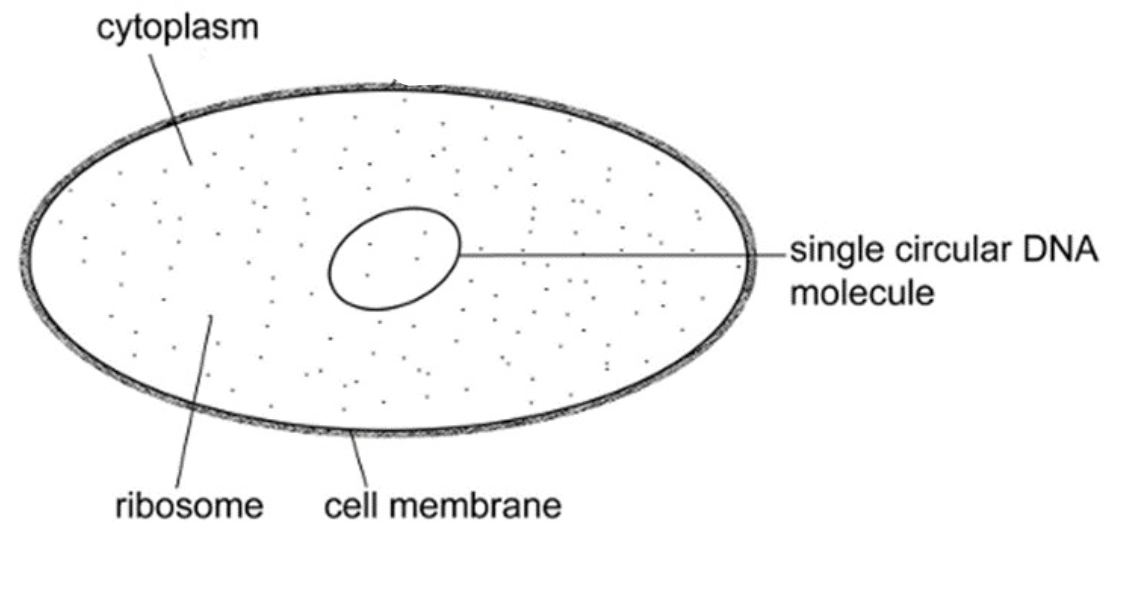
Plasma membrane
An enclosing membrane that separates the cell's interior from the environment.
Cytoplasm
The cytosol in which other components of the cell are found.
Cytosol
The fluid portion of the cytoplasm.
DNA
The genetic material of the cell.
Ribosomes
Cell structures that synthesize proteins.
Two major classes of cells
Prokaryotic cells and eukaryotic cells.
Prokaryotic cells
Cells that lack membrane-bound internal compartments such as a nucleus, Most have a cell wall containing petidoglycan (*not Archea), and include organisms in the domains archaeological and bacteria


Structure of a prokaryotic cell
Chromosome DNA is localized in a nucleoid, ribosome are in the cytoplasm, cell membrane is surrounded by a cell wall
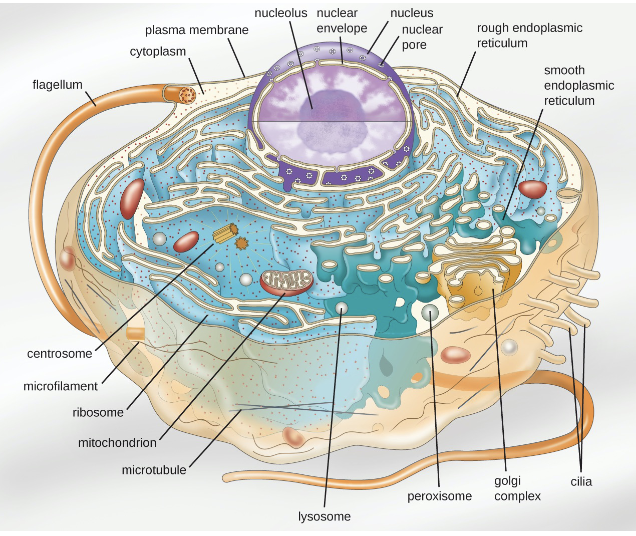
Eukaryotic cells
Cells that have membrane-enclosed internal compartments, such as a nucleus.
Main differences between prokaryotic and eukaryotic cells
Size and the presence or absence of membrane-bound organelles.
Prokaryote size
Prokaryotic cells are smaller than eukaryotic cells.
Prokaryotic cell chromosome DNA
Chromosome DNA is localized in a nucleoid.
Nucleoid
The region of a prokaryotic cell where chromosome DNA is localized.

Prokaryotic ribosomes location
located in the cytoplasm.
Prokaryotic cell wall composition
Most prokaryotic cell walls contain peptidoglycan.
Peptidoglycan
A major component of most bacterial cell walls.
Archaea and peptidoglycan
Archaea lack peptidoglycan.
Why are prokaryotic cells small?
A favorable surface area-to-volume ratio and the lack of modifications found in eukaryotes that aid internal transport.
Why does surface area-to-volume ratio limit cell size?
As cells get bigger, volume increases faster than surface area, making movement of materials into and out of the cell less favorable.
Bacterial cell wall
Most bacteria are encased by a strong cell wall composed of peptidoglycan.
Functions of the bacterial cell wall
Protects the cell, maintains its shape, and prevents excessive uptake or loss of water.
Bacterial cell walls and antibiotics
Susceptibility of bacteria to antibiotics often depends on the structure of their cell walls.
Archaea cell walls lack what?
peptidoglycan

Prokaryotic flagella
Structures present in some prokaryotic cells that are used for locomotion.
How do prokaryotic flagella move cells?
Rotary motion propels the cell.
Animal and plant cell similarities
Both have plasma membranes and contain most of the same organelles.
Major difference between plant and animal cells
Plant cells have extra components usually not present in other eukaryotic cells, such as cell wall on the outside of the plasma membrane (made of cellulose instead of peptiglycan)

Plant cell wall is made of what
cellulose
Animal Cell structure

Plant Cell Structure

Plant cell wall vs. bacterial cell wall
Plant cell walls are made of cellulose, while bacterial cell walls are made of peptidoglycan.
Chloroplasts
Extra internal components found in plant cells.
Specialized vacuoles
Extra internal components found in plant cells.
Capsule
A term associated with prokaryotic cells in the chapter summary.
Plasmids
A term associated with prokaryotic cells in the chapter summary.
Pili
A term associated with prokaryotic cells in the chapter summary.
Four features all cells share
An enclosing plasma membrane, cytoplasm, DNA, and ribosomes.
How many major classes of cells are there?
Two: prokaryotic and eukaryotic cells.
What organisms contain prokaryotic cells?
Organisms in the domains Archaea and Bacteria.
What is located in the nucleoid?
Chromosome DNA.
Where are prokaryotic ribosomes located?
In the cytoplasm.
What surrounds the cell membrane of a typical prokaryotic cell?
A cell wall.
What is the function of a cell wall?
Protection, maintaining cell shape, and preventing excessive uptake or loss of water.
What structure separates a cell's interior from its environment?
The plasma membrane.
What structure synthesizes proteins?
Ribosomes.
What is the genetic material of the cell?
DNA.
What is a major structural characteristic of prokaryotes?
They lack membrane-bound organelles.
What is a major structural characteristic of eukaryotes?
They have membrane-enclosed internal compartments.